
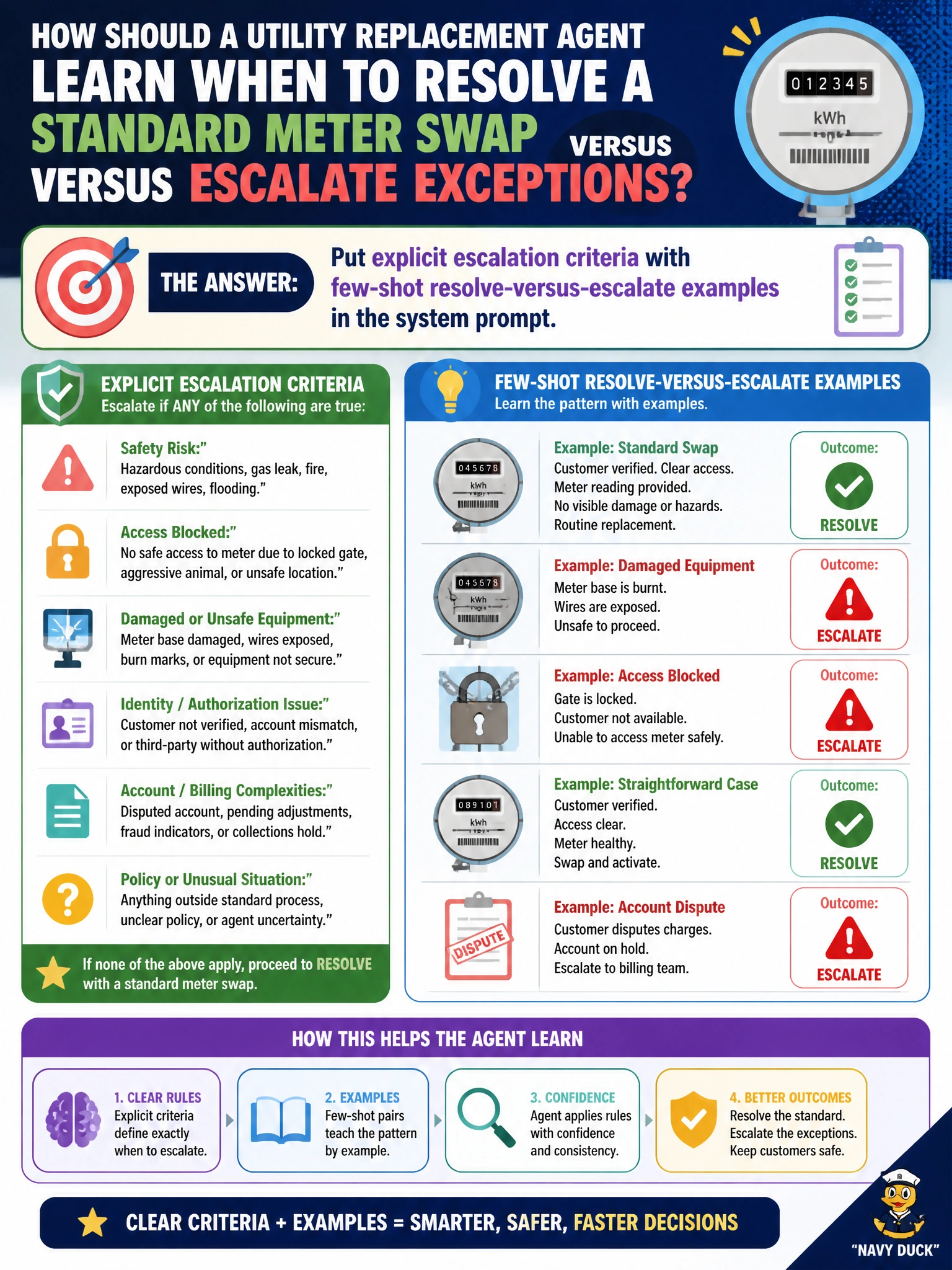
How should a utility replacement agent learn when to resolve a standard meter swap versus escalate exceptions?
Select an answer to reveal the explanation.
Short Explanation
Show a couple of "this swap is fine / this one needs a human" examples up front. Few-shot escalation criteria teach the boundary better than vibes.
Full Explanation
A utility meter-replacement agent needs an explicit teachable boundary between standard swaps it may resolve and exceptions it must escalate. The correct design is to put explicit escalation criteria plus few-shot resolve-versus-escalate examples in the system prompt. Those examples show the difference between an ordinary like-for-like residential swap under published policy and cases involving commercial tariffs, disputed ownership, safety holds, or incomplete premise data.
Explicit criteria with few-shot pairs work because they encode the policy edge in both rule form and concrete demonstrations. The agent learns which fields must be present, which exception codes force a human, and how to phrase the handoff—reducing both over-automation and unnecessary clerk load on routine replacements.
Relying only on free-form chat tone with no written criteria fails because tone is not policy; the agent will drift across shifts and models. Escalating every replacement regardless of policy fit fails because it defeats automation ROI and creates a human bottleneck for standard swaps the utility already approved for self-serve. Never escalating and always completing the swap automatically fails because exception paths (locked meters, shared service lines, billing disputes) require human judgment and physical-field coordination the agent cannot invent.
Exam caveat: few-shot examples must reflect real municipal utility policy, not generic retail RMA patterns. Operational check: before go-live, load resolve-versus-escalate exemplars in the system prompt and test that standard swaps complete while flagged exceptions route to a human with reason codes.