
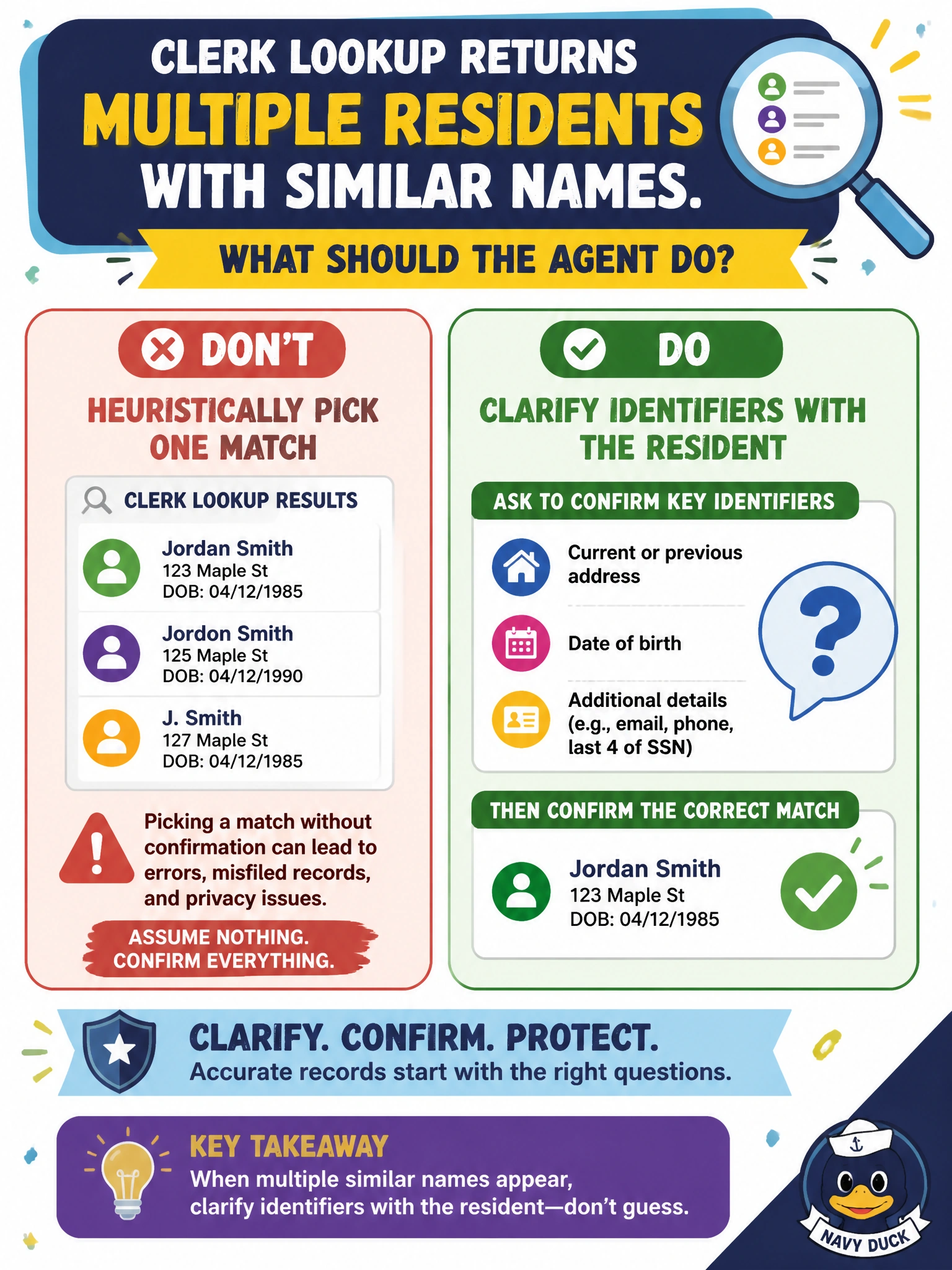
A clerk lookup returns multiple residents with similar names. What should the agent do?
Select an answer to reveal the explanation.
Short Explanation
Two "Maria Garcias" is not a coin flip—ask which address, DOB, or account. Clarifying identifiers beats guessing the wrong resident.
Full Explanation
When a municipal clerk lookup returns multiple residents with similar names, the agent must clarify distinguishing identifiers with the resident rather than heuristically picking one match. Acting on the wrong Maria Garcia can misfile a utility case, disclose another household's account details, or apply a fee credit to the wrong ledger—privacy and accuracy failures that 311 and revenue desks cannot absorb.
Clarification works because residents can supply address, date of birth, account number, parcel ID, or last four of a phone without the agent guessing. The lookup should present the ambiguity, request the minimum discriminating fields allowed by policy, and only then continue with a single confirmed record.
Picking the first alphabetical match fails because sort order is unrelated to identity truth and systematically biases toward certain spellings. Choosing the most common ZIP code and assuming it is correct fails because population density is not identity evidence and can silently select a stranger in a dense district. Merging all matches into one case without confirmation fails because it creates a franken-record that contaminates history, notices, and collections across unrelated households.
Exam caveat: multi-match resident resolution is an identity-disambiguation problem, not a ranking or merge problem—never auto-select or coalesce without confirmation. Operational check: on ambiguous name search hits, pause automation, ask for policy-approved discriminators, log the clarification, and proceed only after a single resident record is confirmed.