
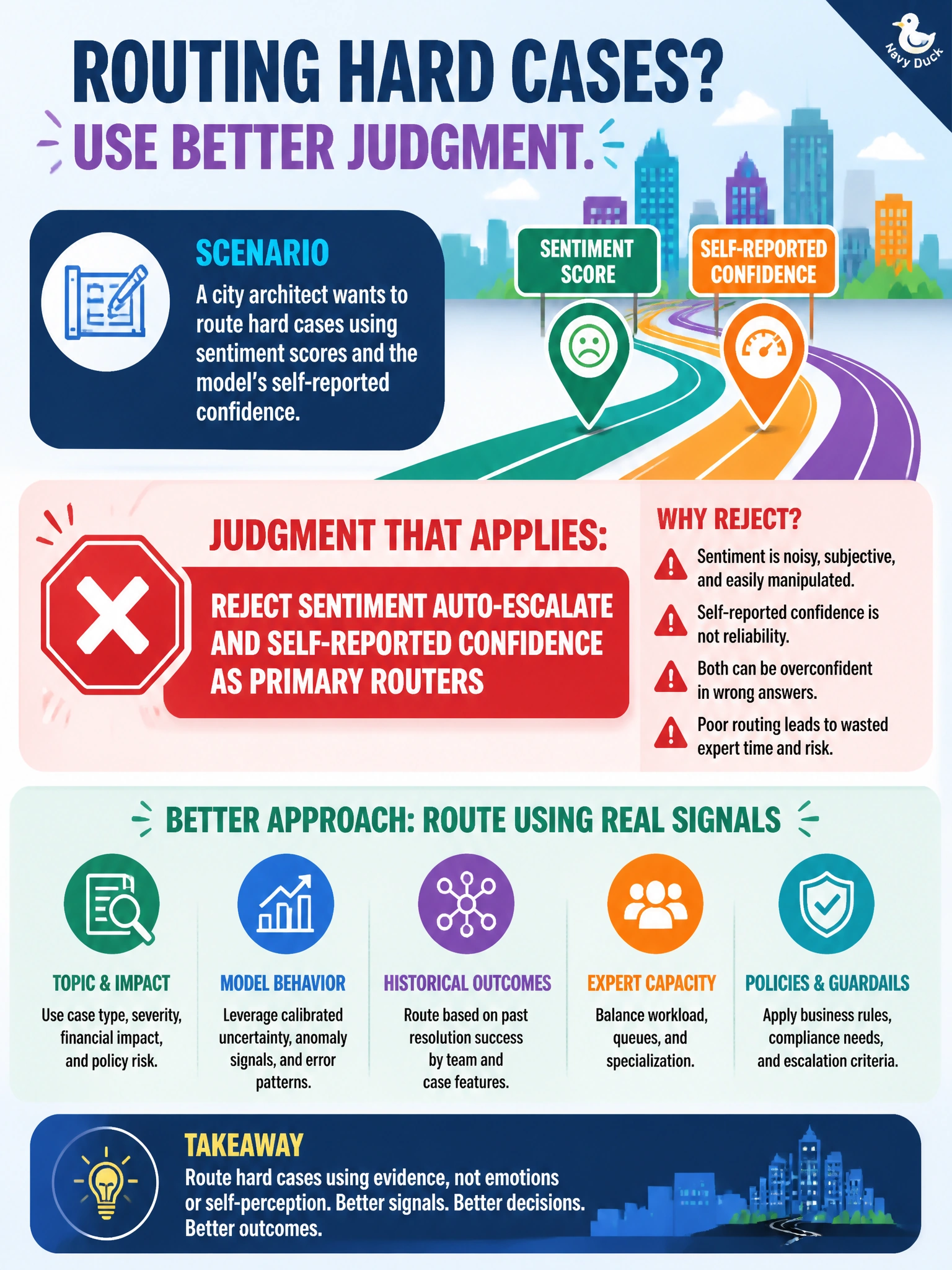
A city architect wants to route hard cases using sentiment scores and the model's self-reported confidence. What judgment applies?
Select an answer to reveal the explanation.
Short Explanation
Angry tone and "I'm 92% sure" are shaky thermometers for complexity. Don't let sentiment or self-confidence be the main router—use clearer escalation criteria.
Full Explanation
When a city architect designs escalation routing for hard 311 or permitting cases, sentiment scores and the model's self-reported confidence must not be the primary routers. The correct judgment is to reject sentiment auto-escalate and self-reported confidence as primary complexity proxies. Civic routing needs durable criteria—explicit human request, policy gaps, stuck progress, identity ambiguity—that survive accents, short replies, and overconfident model prose.
Rejecting those proxies works because sentiment classifiers confuse urgency with anger and miss calm residents who still need a clerk, while self-reported confidence is poorly calibrated on municipal forms and often tracks fluency rather than correctness. Primary routers should stay tied to observable policy and progress signals that auditors can replay.
Making sentiment score the sole escalation gate fails because tone alone does not encode whether policy can answer the ask or whether tools already failed. Trusting self-reported confidence as a complexity proxy fails because a model can be confidently wrong on parcel IDs, fee tables, or eligibility rules. Combining anger detection with confidence while skipping all other criteria fails because stacking two weak sensors does not create a strong router; it still ignores explicit requests and documented playbook gaps.
Exam caveat: secondary monitoring of sentiment or confidence can inform analytics, but neither should be the primary escalate/resolve gate for municipal agents. Operational check: review the escalation decision tree—if the first branch is anger score or model confidence, redesign it around explicit request, policy gap, and inability to progress before any soft signals.