
Downstream context budgets are tight after several research subagents. What should subagents return?
Select an answer to reveal the explanation.
Short Explanation
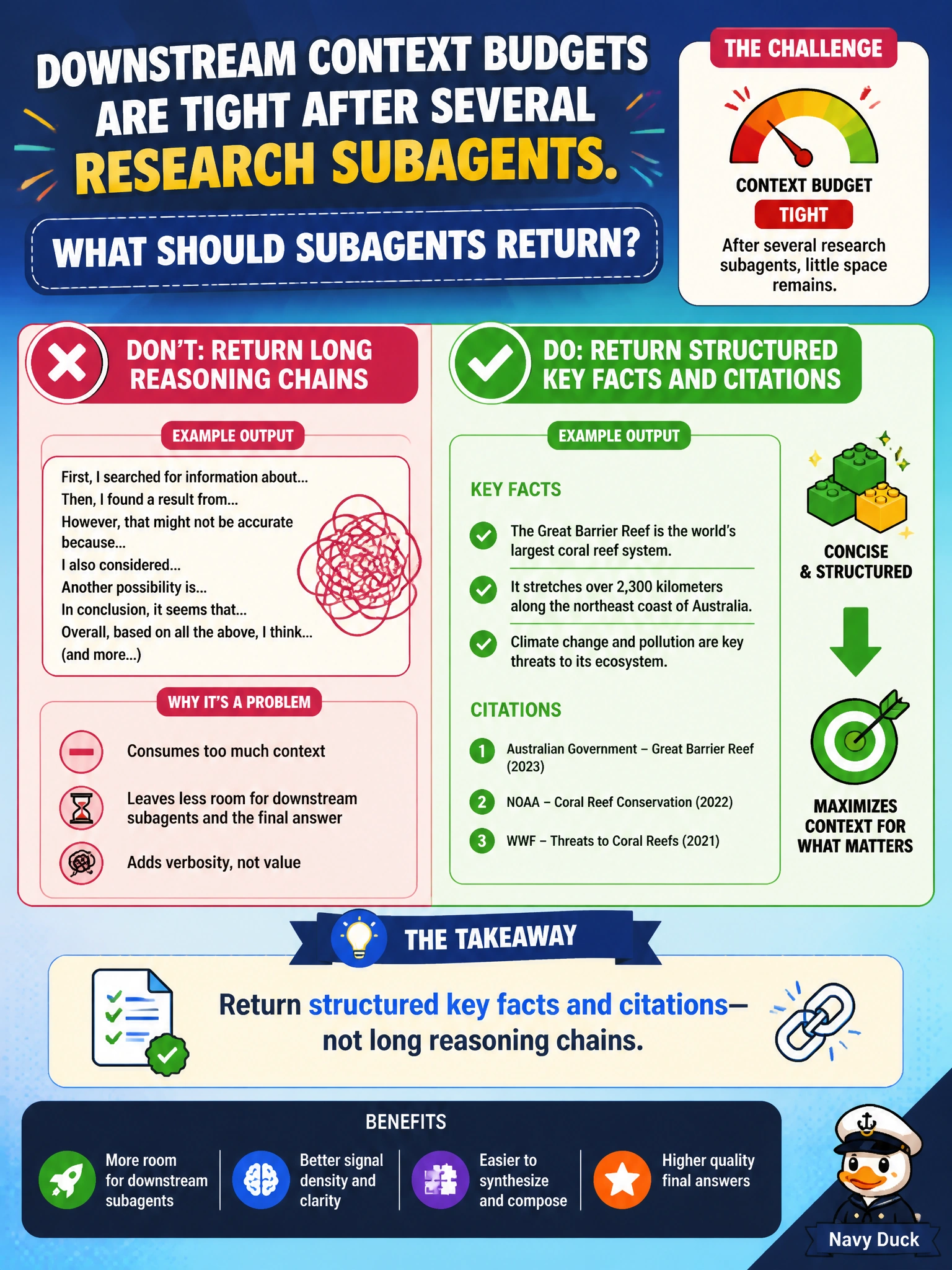
Send the index cards, not the whole notebook of thinking aloud. Structured key facts and citations keep the coordinator's budget alive.
Full Explanation
When downstream context budgets are tight after several research subagents, those subagents should return structured key facts and citations instead of long reasoning chains. Coordinators need transferable evidence—claims, numbers, ordinance references—not unabridged scratchpads that exhaust the window before synthesis starts. Structured returns preserve municipal research value under token pressure and make downstream verification feasible. Unabridged chain-of-thought transcripts with no structure dump process noise into a scarce budget and dilute findings until the coordinator cannot locate citations. Only emotional impressions without citations or facts cannot support a defensible policy brief for council or department leadership. Empty acknowledgments that omit findings entirely waste the subagent spend and leave the coordinator empty-handed after paying for parallel research. Exam caveat: compressing to key facts must not strip uncertainty markers or conflicting sources that clerks or analysts need to see. Operational check: cap subagent return schemas to facts, citations, and confidence or conflict flags; reject or truncate returns that exceed a reasoning-transcript budget; and verify the coordinator can answer brief questions from returns alone without the raw chains.