
Date-and-timezone bugs interact in a clerk scheduler, while lint nits are independent. How should issues be batched?
Select an answer to reveal the explanation.
Short Explanation
Tangled date/timezone bugs are one knot—pull them together in a single careful message. Independent lint fluff can go one-at-a-time so each snip stays clean.
Full Explanation
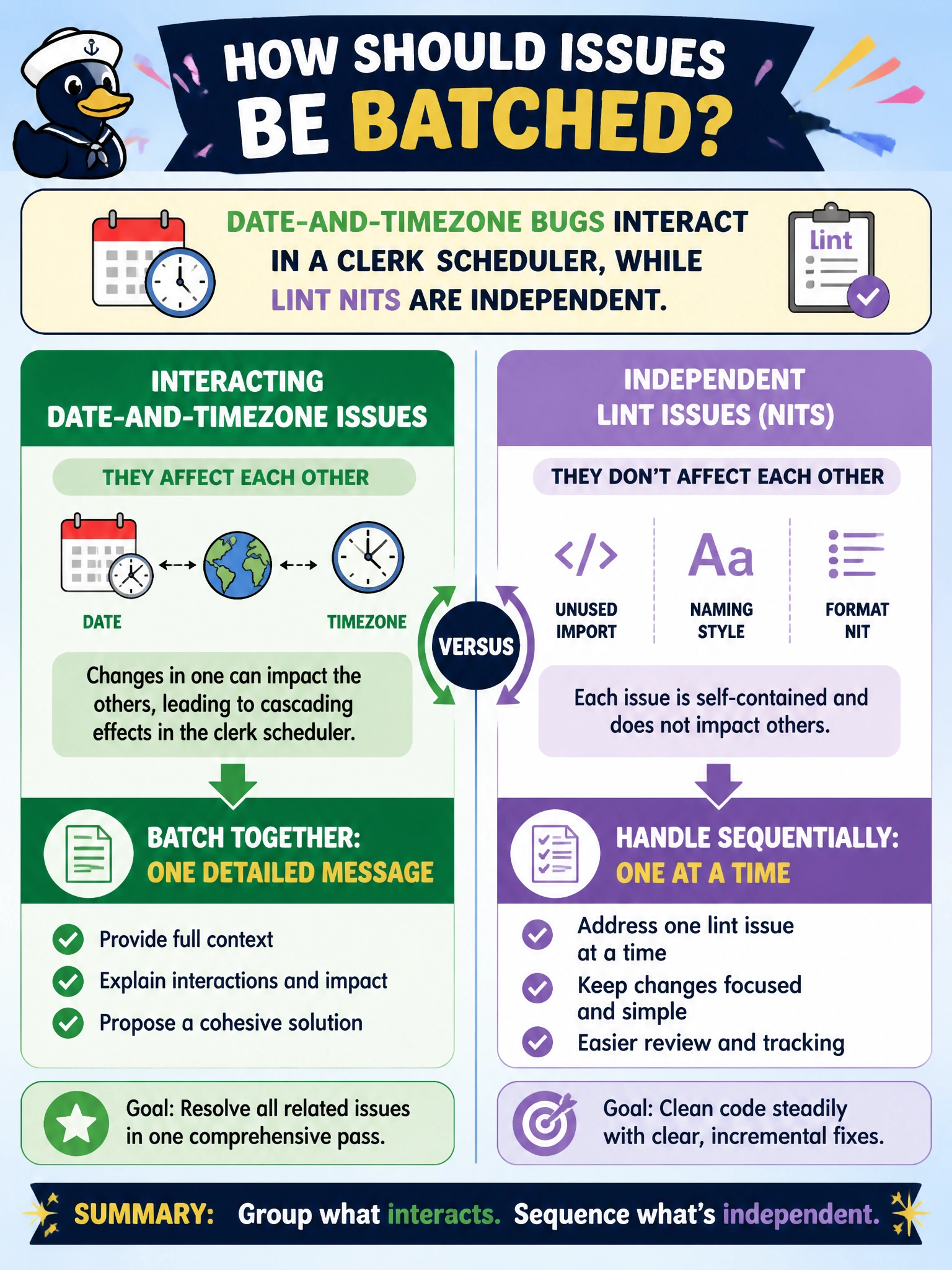
Date-and-timezone bugs that interact in a clerk scheduler should be batched differently from independent lint nits: put interacting date-and-timezone issues in one detailed message, and handle independent lint issues sequentially. Batching should follow dependency, not ticket count.
Grouping interacting defects works because timezone offsets, DST boundaries, and stored UTC versus display-local times jointly determine clerk scheduler correctness. One detailed message lets Claude reason about coupled effects and avoid fixing one symptom while breaking another. Independent lint nits do not share that coupling, so sequential handling keeps each change small, reviewable, and unlikely to entangle unrelated diffs.
Sending every lint nit and timezone bug in one unordered megaprompt always fails by mixing coupled reasoning needs with unrelated noise and overwhelming the session. Never mentioning interacting bugs in the same session fails by forbidding the very joint reasoning those bugs require. Fixing only lint nits and leaving timezone defects for an unrelated vendor ticket fails by concept: the scheduler's correctness problem is the team's interacting date/time defects, not cosmetic lint.
Exam caveat: interactivity—not severity alone—drives whether issues share one message. Operational check: bundle the coupled date/timezone scheduler bugs in one detailed prompt with examples; open separate sequential prompts for independent lint nits.