
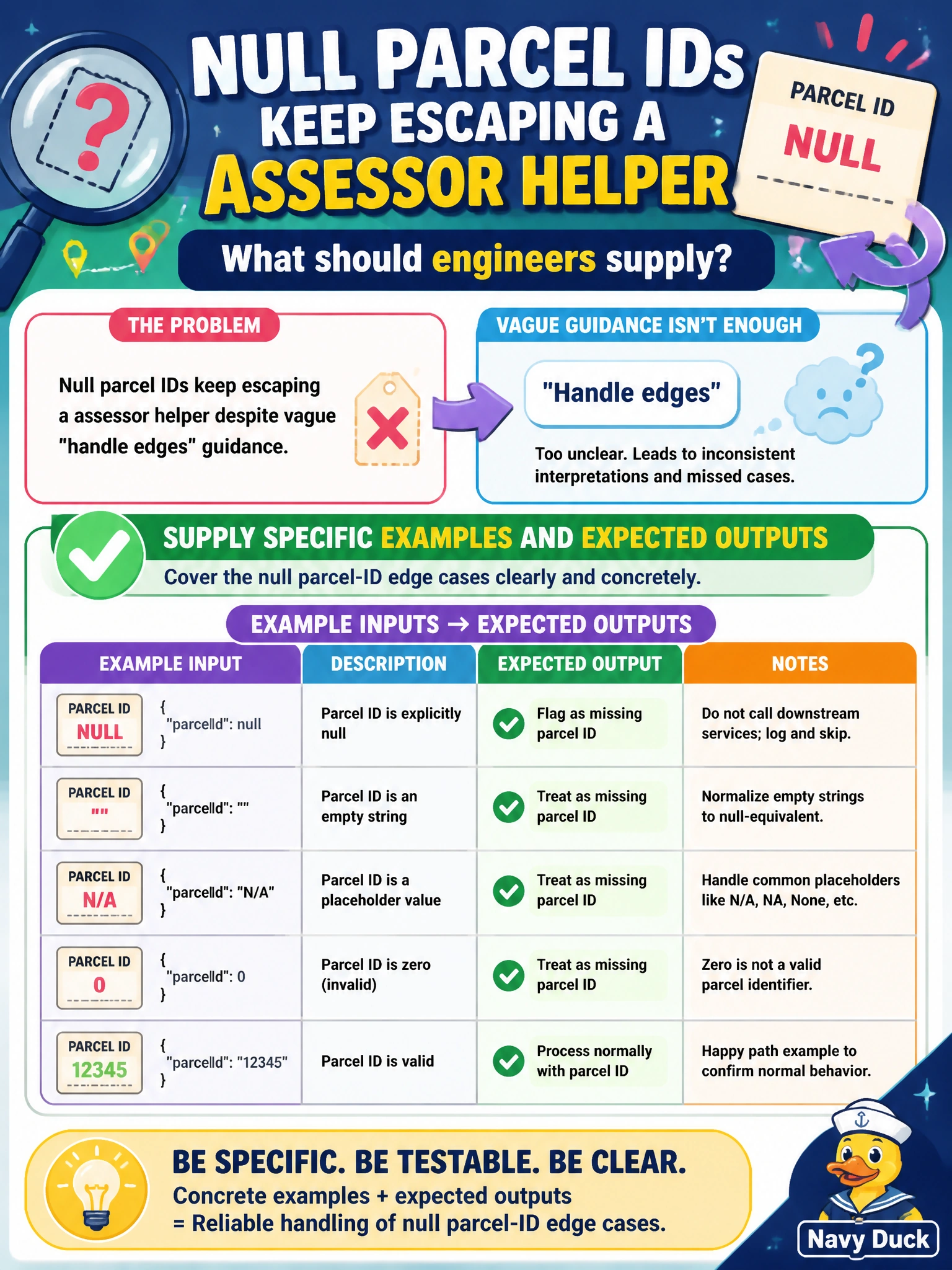
Null parcel IDs keep escaping a assessor helper despite vague "handle edges" guidance. What should engineers supply?
Select an answer to reveal the explanation.
Short Explanation
"Handle edges" is fog; a null parcel ID in and the exact error or fallback out is a street sign. Feed specific example I/O for those edge cases.
Full Explanation
When null parcel IDs keep escaping an assessor helper despite vague "handle edges" guidance, engineers should supply specific example inputs and expected outputs covering those null parcel-ID edge cases. Concrete cases convert foggy edge advice into testable behavior.
Specific I/O works because null parcel IDs need an explicit municipal policy: reject with a clear error, map to a sentinel, or skip the row—each is a different correct answer until examples say which. Providing payloads with null or missing parcel IDs plus the expected error or fallback stops Claude from inventing a plausible but wrong policy. Vague "handle edges" language is what allowed escapes in the first place.
Only a longer prose paragraph with no sample payloads fails because more adjectives still leave the null policy underspecified. A request to disable validation so nulls are accepted silently fails by removing the control the assessor helper needs. Instructions to invent parcel IDs when fields are missing fails by concept: fabricating civic identifiers hides data defects and can corrupt assessor records.
Exam caveat: edge-case examples must state expected outputs, not only bad inputs. Operational check: add example null parcel-ID inputs with expected errors or fallbacks, re-run the helper, and confirm nulls no longer escape silently.