
Discovery across a noisy legacy clerk codebase floods the main chat. How can Claude Code isolate that pass?
Select an answer to reveal the explanation.
Short Explanation
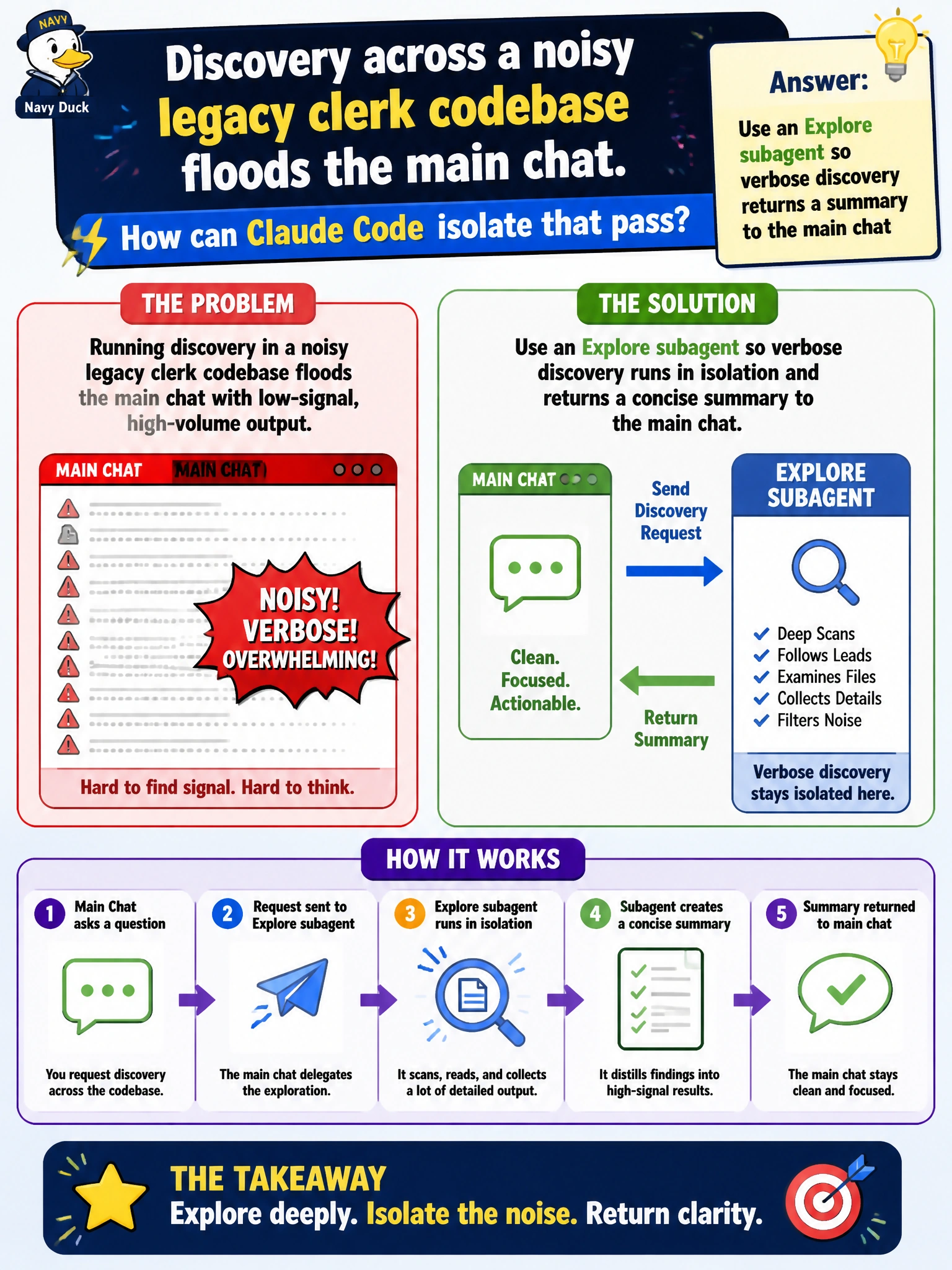
Noisy codebase archaeology belongs in a side room, not the main council chamber. An Explore subagent digests the mess and brings back a summary so the main chat stays usable.
Full Explanation
Discovery across a noisy legacy clerk codebase that floods the main chat should be isolated with an Explore subagent so verbose discovery returns a summary to the main conversation. Explore exists to dig through large or messy trees without polluting the primary thread with raw walk output.
The Explore subagent works because legacy clerk systems often contain sprawling modules, dead paths, and contradictory naming. Running discovery in a subagent keeps the main chat focused on decisions while the subagent returns a condensed map of boundaries, hotspots, and risks. Municipal engineers then plan or edit from the summary rather than from thousands of noisy lines.
Pasting the entire discovery transcript into root CLAUDE.md permanently fails by turning ephemeral archaeology into always-on project context and bloating every future session. Turning off all tools and guessing module boundaries from memory alone fails because legacy clerk structure is exactly what tools must discover empirically. Committing raw discovery dumps directly to the default branch fails by concept: reviewers need curated findings or plans, not unfiltered tool noise as a permanent repo artifact.
Exam caveat: Explore isolates discovery; it does not permanently encode findings into CLAUDE.md unless the team deliberately promotes curated standards. Operational check: launch Explore for the legacy clerk pass, confirm the main chat receives a summary rather than the full dump, and only then promote agreed conventions into project docs.