
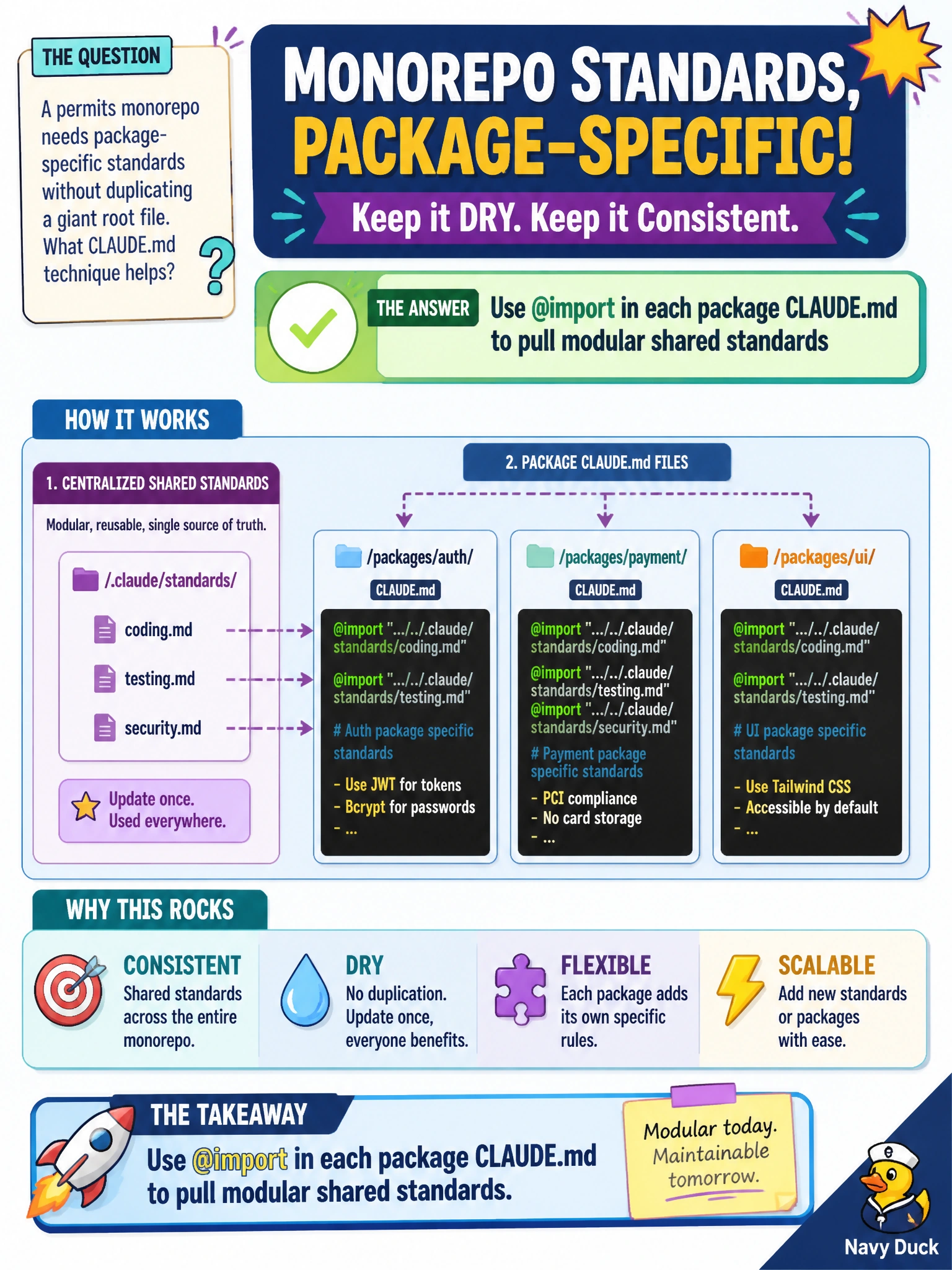
A permits monorepo needs package-specific standards without duplicating a giant root file. What CLAUDE.md technique helps?
Select an answer to reveal the explanation.
Short Explanation
@import is the municipal filing trick—one shared standards sheet, pulled into each package CLAUDE.md so you are not photocopying a phone book into every folder.
Full Explanation
Large shared standards should be modularized with @import rather than copied wholesale into every package. In a municipal monorepo, each package CLAUDE.md can @import shared standards so one canonical sheet updates everywhere instead of hand-maintaining thousand-line duplicates.
Why the correct option works: @import supports modular CLAUDE.md organization across packages. City platforms with many services need consistent security, logging, and API rules; importing a shared module keeps packages thin and standards single-sourced while still allowing package-local notes.
Why the other three fail by concept: pasting identical thousand-line standards into every package by hand only creates drift and painful updates. Deleting all CLAUDE.md files so packages share nothing intentional removes guidance entirely. Storing standards exclusively in unrelated PDF binders outside the repo hides them from Claude sessions and from git-based onboarding.
Exam caveat: @import organizes CLAUDE.md content—it does not replace project-versus-user scope rules. Operational check: place shared standards in an importable file, @import from package CLAUDE.md files, change one rule centrally, and verify packages pick up the change without re-pasting.