
A transit repo's CLAUDE.md became an unmaintainable monolith covering testing, APIs, and deploy. What should the team do?
Select an answer to reveal the explanation.
Short Explanation
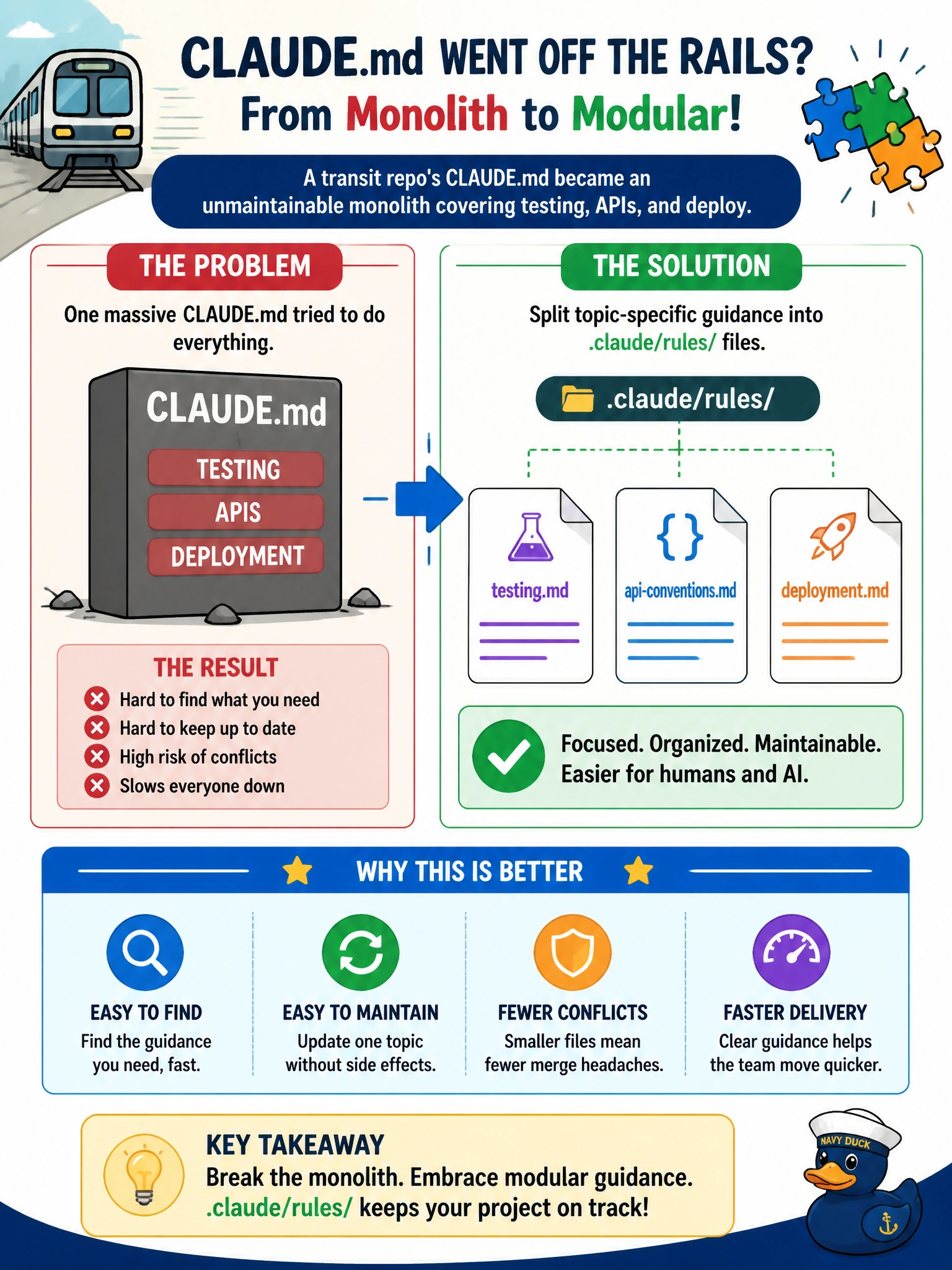
One mega CLAUDE.md is a junk drawer. Split testing, API, and deploy guidance into tidy .claude/rules/ files so the team can find—and fix—one topic at a time.
Full Explanation
When CLAUDE.md becomes an unmaintainable monolith covering testing, APIs, and deploy, split topic-specific guidance into .claude/rules/ files—for example testing, api-conventions, and deployment. A transit repo benefits from topic files that can be reviewed and updated independently without opening a single mega-document.
Why the correct option works: .claude/rules/ is the structured home for focused rule sets. Maintainers fix deploy policy without risking accidental edits to testing guidance; agents still receive the composed rules. The monolith’s topics become navigable files with clear ownership.
Why the other three fail by concept: merging even more unrelated policies into the single CLAUDE.md file worsens the maintainability problem. Moving all guidance into ephemeral chat so nothing persists in git destroys reproducibility for transit engineers. Replacing CLAUDE.md with a binary spreadsheet Claude cannot read removes machine-usable guidance.
Exam caveat: splitting into rules files is about maintainability of project guidance, not abandoning CLAUDE.md for every one-line note. Operational check: extract testing, API, and deploy sections into .claude/rules/, leave a slim CLAUDE.md pointer if needed, and confirm sessions still load the split rules after clone.