
A sanitation department launches a subagent to redesign collection routes, but the specification is ambiguous about whether holiday routes are in scope. Given that a subagent cannot ask the user a clarifying question mid-task, what is the correct design?
Select an answer to reveal the explanation.
Short Explanation
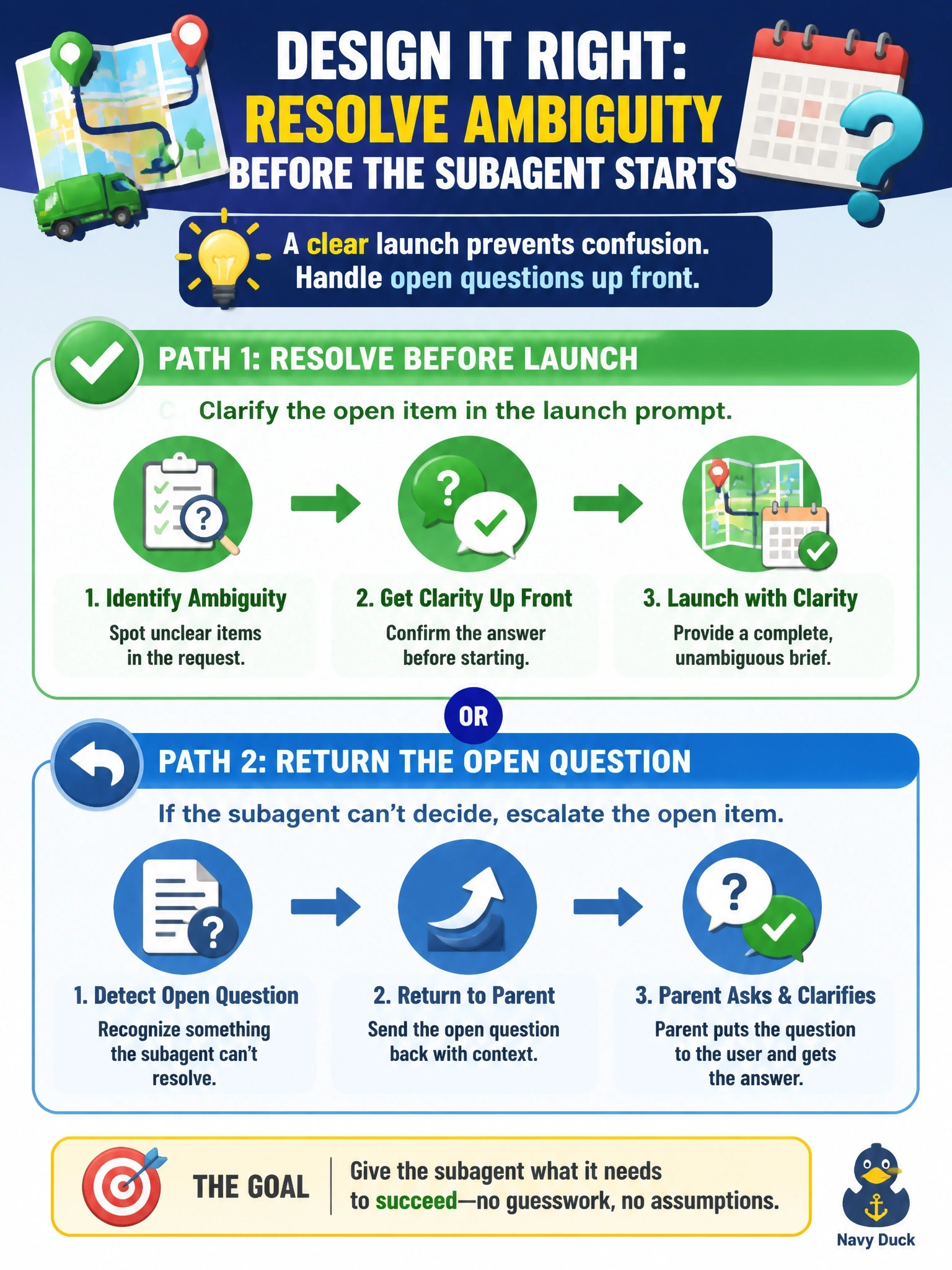
A subagent works behind a closed door—there is no way to lean out and ask whether holiday routes count. Answer it up front, or tell it to hand the question back.
Full Explanation
A delegated agent has no interactive channel to the person driving the session. Its only outbound communication is the message it returns at the end, so every ambiguity in a route-redesign specification has to be resolved either before the handoff or through that single return channel.
Settling whether holiday routes are in scope inside the launch prompt removes the question entirely. Where that is not possible, instructing the subagent to stop and return the open question gives the parent—which does have a line to the user—a chance to answer and relaunch. For a redesign where holiday coverage changes the output materially, one extra round trip is far cheaper than a wrong assumption baked into every route.
Telling the subagent to pause and wait assumes a mechanism that does not exist, since no user response can reach a running subagent. Letting it pick an interpretation and log the choice defers discovery until the wrong assumption has already propagated through the whole route set. Granting access to the user's earlier messages misstates the boundary—the subagent sees only its launch prompt, so any needed history must be copied into that prompt.
Exam caveat: returning early with a question is a legitimate outcome, not a failure, and prompts should say so explicitly or the subagent will guess. Operational check: launch a subagent with a deliberately ambiguous scope and confirm it returns the question rather than silently choosing a reading.