
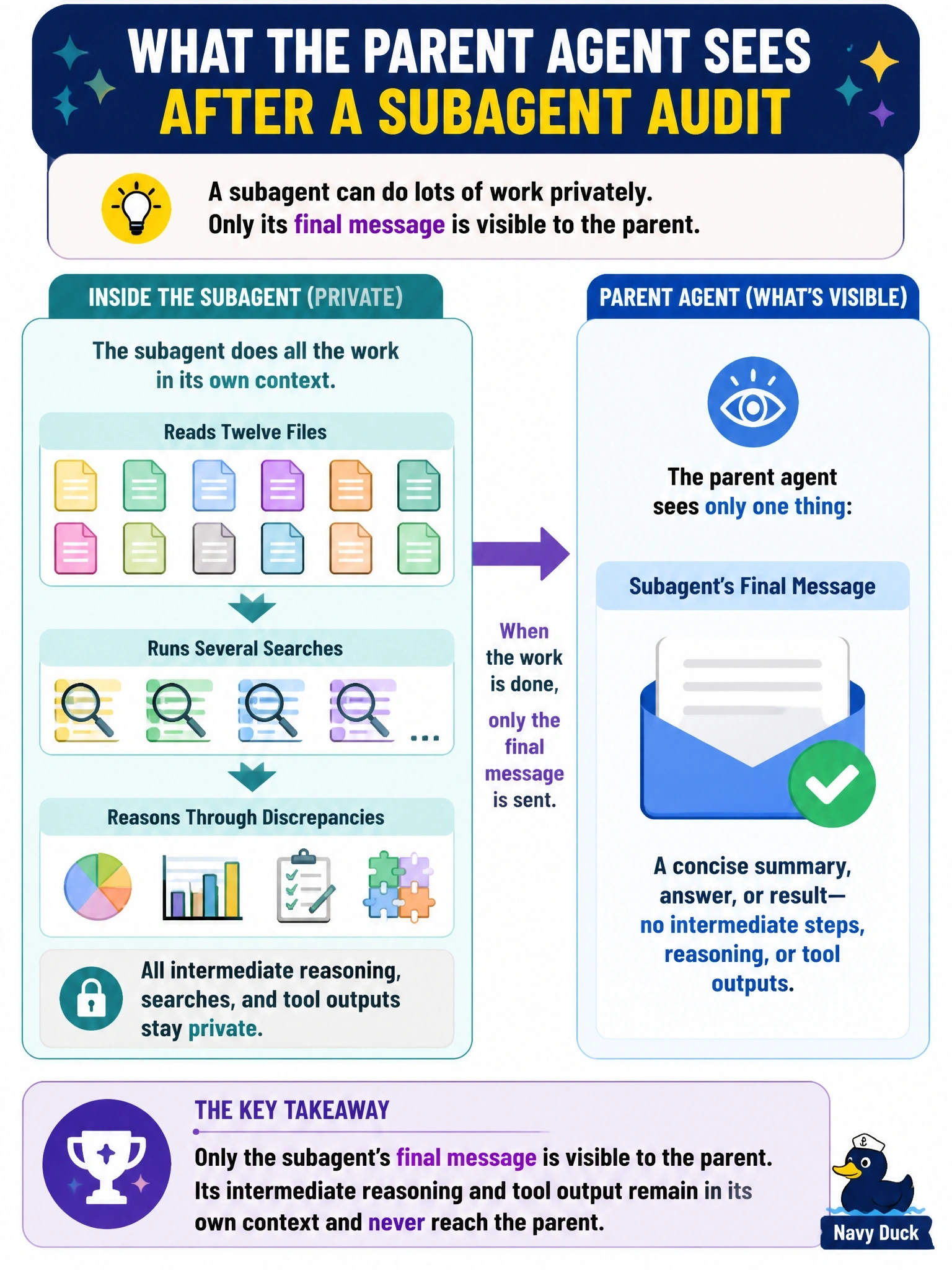
A public library delegates an audit of its summer-reading program data to a subagent. The subagent reads twelve files, runs several searches, and reasons through the discrepancies it finds. What portion of that work is visible to the parent agent afterward?
Select an answer to reveal the explanation.
Short Explanation
You get the memo the archives researcher hands you, not the stack they sifted through. Which is the point—but it means the memo has to stand on its own.
Full Explanation
The delegation boundary is one-way in both directions. Just as the parent's history does not flow down into a subagent, the subagent's work does not flow back up: what returns is a single closing message, and everything that produced it stays behind in a context that is then discarded.
The summer-reading audit subagent's twelve file reads, its searches, and its reasoning about discrepancies all live in its own context, and the parent pays only for the final message. That asymmetry is what makes delegation a context-management tool—large amounts of intermediate material can be spent cheaply because none of it is inherited by the parent conversation.
Returning the entire transcript would defeat delegation outright, since the parent would absorb exactly the context the subagent existed to contain. Concatenating every assistant message the subagent produced has the same problem and additionally floods the parent with partial, superseded reasoning. Returning tool results while discarding the prose inverts the real behavior: raw output is the bulky, disposable part, and the closing synthesis is what crosses.
Exam caveat: because nothing else survives, the launch prompt must specify what the final message has to contain—an audit that finds three discrepancies and returns "audit complete" has lost them. Operational check: run the same audit with and without a required return format, and compare what the parent can actually act on.