
A code-enforcement office launches a subagent to review a backlog of forty open violation cases. Partway through, the subagent considers splitting the backlog and launching subagents of its own. What is the sound architectural guidance?
Select an answer to reveal the explanation.
Short Explanation
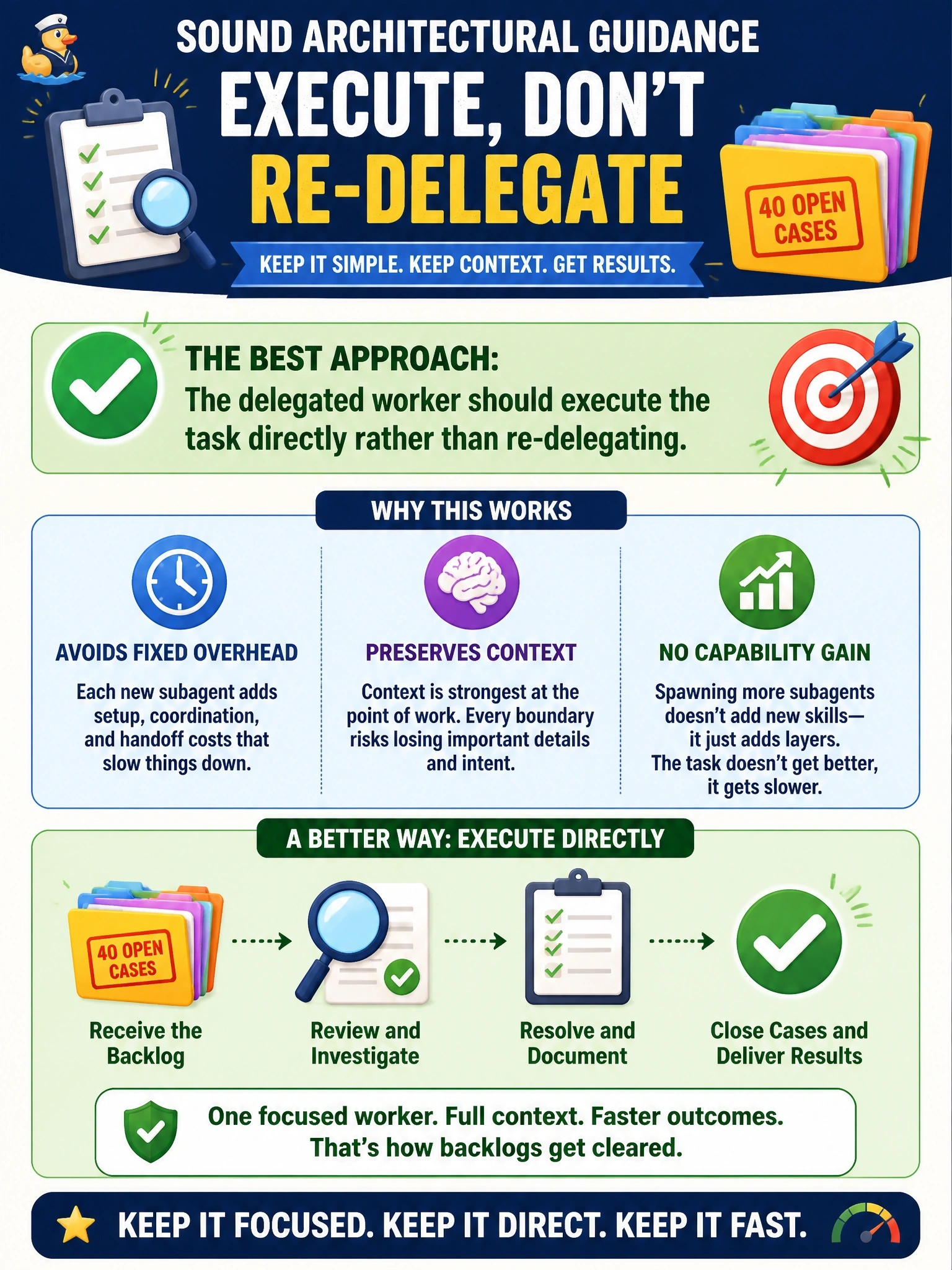
Once you are the subcontractor, you do the work—you do not hire your own. Every delegation hop costs a fresh context and drops whatever did not fit in the handoff.
Full Explanation
Delegation trades information for isolation: only a launch prompt goes down, and only a final message comes back. That trade is worth making once at the top of a job, where an orchestrator can see the whole forty-case backlog and decide how to split it. Repeating it inside a worker compounds the loss without adding capability.
The delegated worker should simply review the cases it was given. Stacking delegation boundaries two or three deep makes instructions thinner at each level and returned summaries vaguer on the way back, while multiplying the fixed cost of spawning a context. The sound shape is a shallow tree—one orchestrator deciding the split, and workers executing their slice directly.
Treating deep nesting as the intended pattern misreads delegation as free parallelism and ignores the overhead and information loss each level introduces. Re-delegating in response to context pressure applies the wrong remedy; the fix is a narrower task scope or a checkpointed handoff, not another layer that must be briefed from scratch. Dropping to a smaller model at each level does not repair nesting, because the cost comes from spawn overhead and repeated context loss rather than per-token price.
Exam caveat: one extra level is occasionally defensible when a worker uncovers genuinely independent, large subtasks—the guidance is against habitual nesting, not an absolute prohibition. Operational check: instrument delegation depth and flag any code-enforcement run that exceeds a single level for review.