
A public-health records team delegates a records-cleanup analysis to a subagent after the parent agent has already read several schema files and run half a dozen tool calls. What context does the subagent actually receive?
Select an answer to reveal the explanation.
Short Explanation
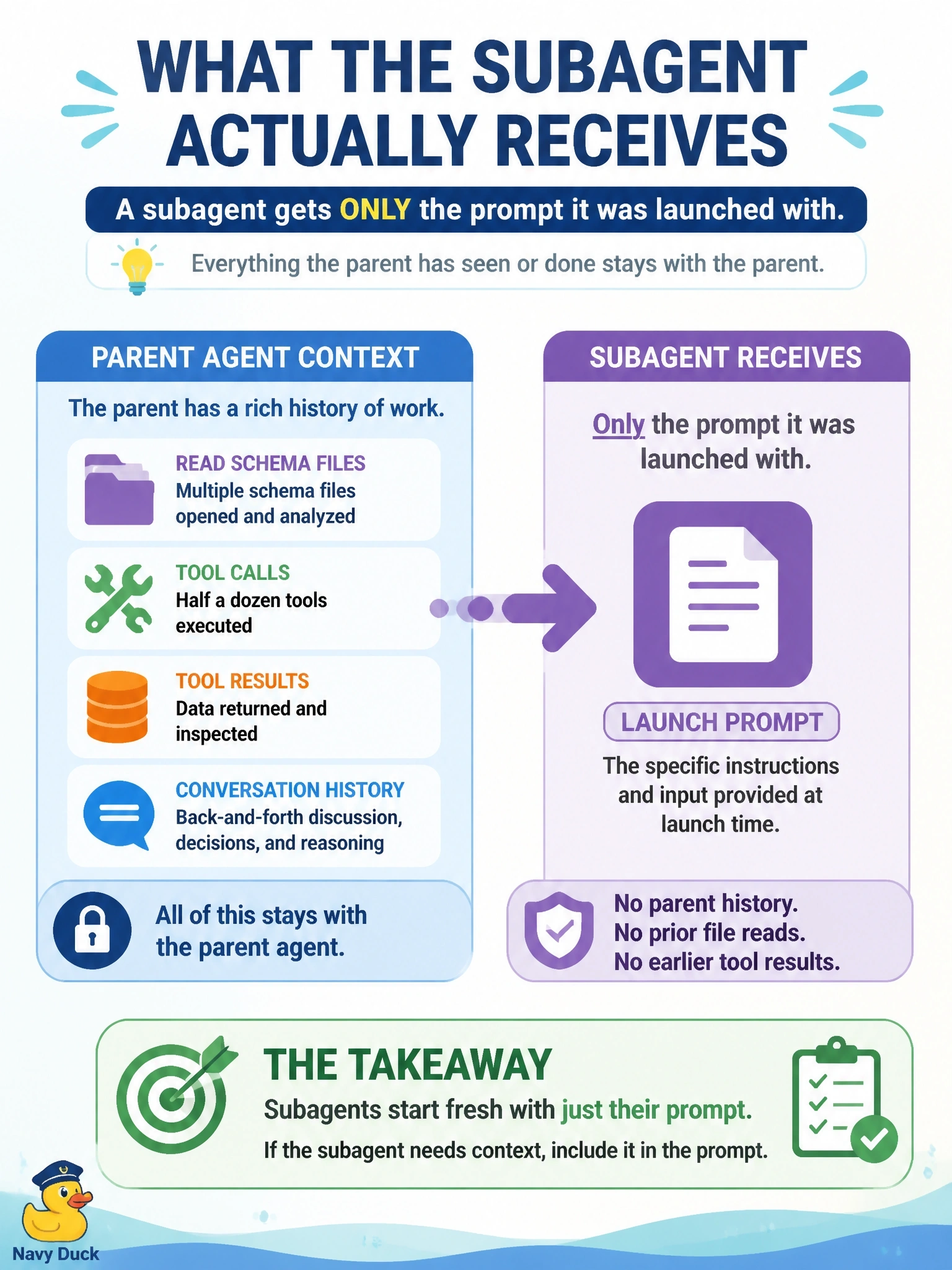
A subagent walks in holding exactly one piece of paper: the assignment. Every schema file the parent already read, and the whole conversation with the user, are invisible to it.
Full Explanation
Delegation in Claude Code is a context boundary, not a shared workspace. A subagent runs in its own fresh context window, which is precisely why delegating a records-cleanup analysis protects the parent from bloat—and precisely why nothing the parent has accumulated crosses over with the task.
The subagent receives only the prompt it was launched with. The parent's schema file reads, its half-dozen tool results, and the user's messages all stay in the parent's context. The architectural consequence is that the launch prompt is the entire interface: file paths, schema conventions, constraints, and a definition of done have to be written into it explicitly.
The notion that only the system prompt is withheld overstates what crosses the boundary, since the conversation does not transfer at all. Tool results and file reads are equally confined to the context that produced them and are not forwarded to a delegated agent. There is no automatic compaction of the parent conversation into the launch prompt—any summary the subagent receives is one the parent deliberately wrote.
Exam caveat: teams that assume inheritance write prompts like "clean up the records as discussed" and get work that is confidently wrong. Operational check: launch a subagent with a prompt that references a health-records schema detail only the parent read, and confirm it cannot proceed without being told.