
A water utility assistant receives an assistant turn containing two tool_use blocks: a meter-reading lookup and an outage-map query. The team decides the outage-map call is unnecessary, so they return a tool_result only for the meter reading and omit the other. The next API request fails. What is the correct explanation?
Select an answer to reveal the explanation.
Short Explanation
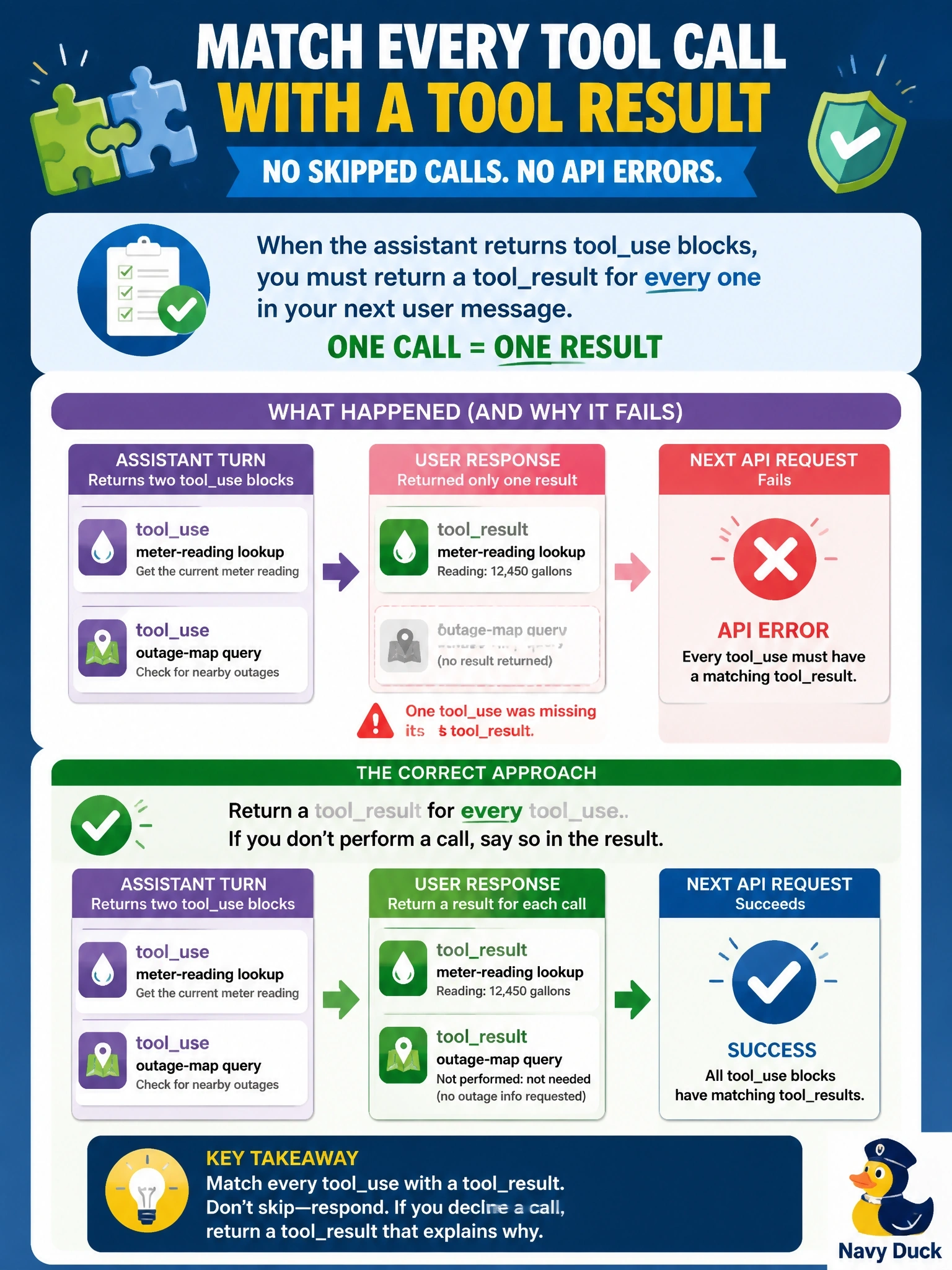
An outstanding tool_use block is an unanswered question; the API will not move on. To decline the outage-map call, still return a result—and put the reason in its content.
Full Explanation
The tool loop is validated structurally before the model ever sees the conversation. Every tool_use block in an assistant turn must be answered by a tool_result in the following user message, so a water utility that simply omits the outage-map result has sent a malformed request rather than a partial one.
Declining is expressed as content, not as absence. Returning a tool_result whose content states the call was not performed satisfies the pairing and tells the model the outcome, so it can explain the missing outage data to the caller instead of answering as though it had the map. The strictness is a feature—the model always learns what happened to every call it made.
The pairing requirement is not relaxed for server-side tools, and an empty content array is not a sanctioned way to decline a call. Blaming a missing tool_use_id on the result that was sent misdiagnoses the failure, which is caused by the absent block. Removing the tool from the tools array does not retire an outstanding tool_use block from the prior turn, and stripping declarations mid-conversation invites further validation problems.
Exam caveat: a declined call is still a call the model reasons about—vague decline text produces vague hedging in the answer. Operational check: return an explicit decline for one of two parallel calls and confirm the response acknowledges the missing outage data rather than inventing it.