
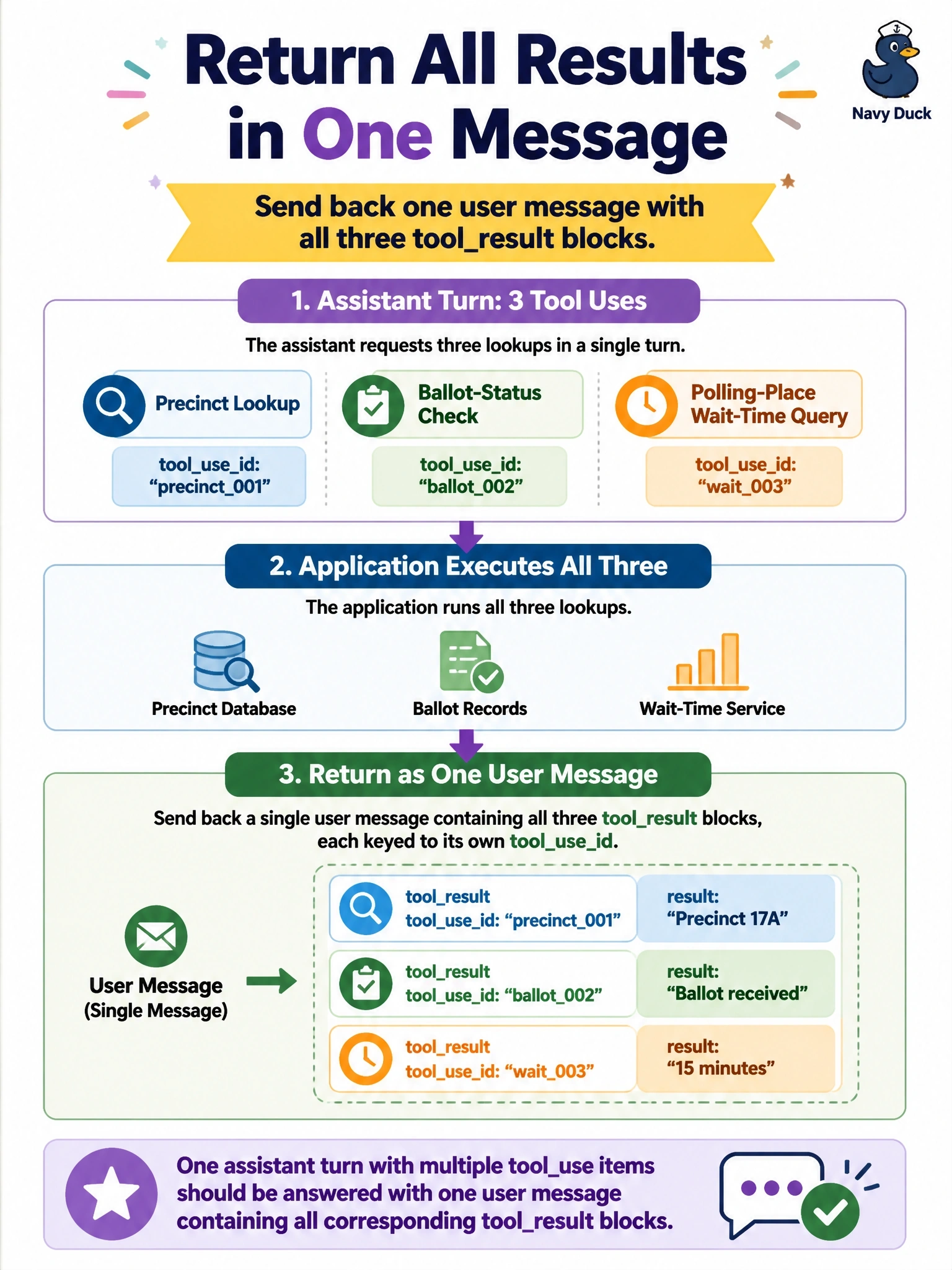
An elections office assistant produces one assistant turn containing three tool_use blocks: a precinct lookup, a ballot-status check, and a polling-place wait-time query. The application executes all three. How should the results be returned to the model?
Select an answer to reveal the explanation.
Short Explanation
One assistant turn, one user turn back. Three election lookups fan out together and ride home together—three tool_result blocks in a single message, each stamped with its own id.
Full Explanation
Parallel tool use has a symmetric shape. Multiple tool_use blocks go out inside one assistant turn, and the API expects every one of them to be answered inside one user turn. The elections orchestrator's return message is therefore a batch, not a sequence of messages.
A single user message whose content array holds a tool_result for each outstanding tool_use block satisfies the pairing and preserves turn alternation. Because each result carries its own tool_use_id, the precinct lookup, ballot-status check, and wait-time query can execute concurrently and be assembled in whatever order they finish. This batched shape is also what makes parallel tool use efficient—one additional round trip rather than three.
Three separate user messages break the expected alternation, since the assistant turn holding tool_use blocks must be answered by exactly one user turn. Repeating the original assistant turn in each message duplicates content and inflates token count while leaving the structure malformed. Concatenating the three outputs into a single tool_result destroys the identifier pairing, leaves two tool_use blocks unanswered, and merges distinct data sources into one undifferentiated blob.
Exam caveat: batching results is not the same as batching execution—concurrency is the application's choice, and one slow wait-time query still gates the whole turn. Operational check: inspect the outgoing user message and confirm the number of tool_result blocks equals the number of tool_use blocks in the preceding assistant turn.