
A library digital team pauses Claude Code briefly overnight and most prior context remains valid. What should they do next morning?
Select an answer to reveal the explanation.
Short Explanation
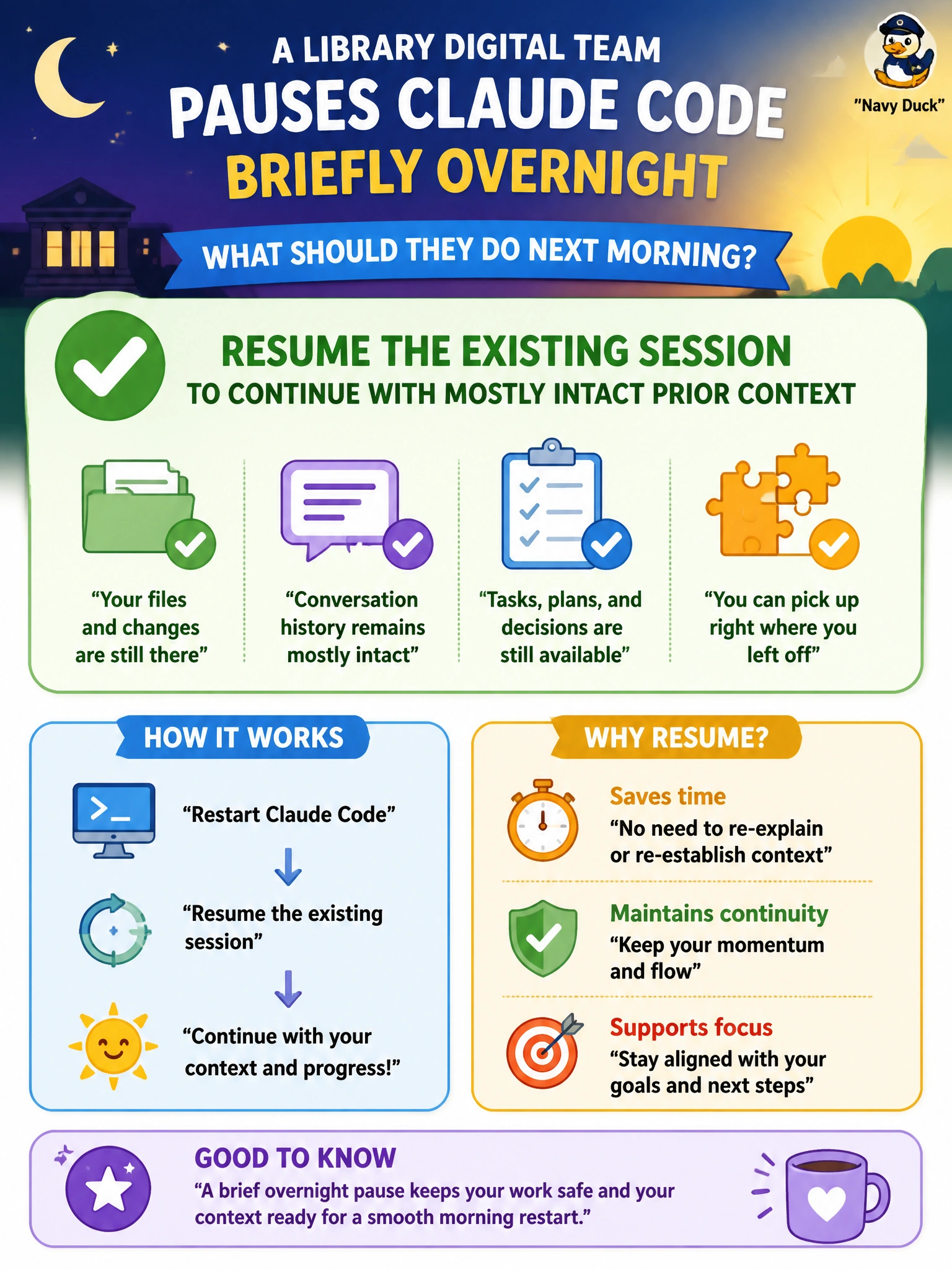
If last night's context is still mostly good, just hit resume. No need to torch a solid library session over a short break.
Full Explanation
When a library digital team pauses Claude Code briefly overnight and most prior context remains valid, the correct next-morning action is to resume the existing session. Short, intentional interruptions do not invalidate tool contracts, file edits, or decisions already anchored in the thread. Resumption preserves library project state—catalog scripts, digital-collections notes, and MCP results—without paying the cost of a full restart.
Resume is appropriate when nothing material changed in the environment overnight: schemas, credentials, and repository contents are still aligned with what the session last observed. Continuity keeps the model’s working memory of library constraints and reduces redundant re-exploration of the same codebase.
Always discarding the session because any pause requires a full restart is wasteful when context is still accurate; it forces re-discovery of paths already validated for digital collections work. Ignoring the prior thread and pasting only the last assistant sentence as a new prompt collapses rich multi-turn state into a thin fragment, losing earlier decisions and tool outcomes. Switching to a different unnamed session so history cannot be recovered abandons recoverable library context and breaks auditability of how catalog changes were derived.
Exam caveat: resume only when context is mostly intact—if overnight a schema migrated or secrets rotated, prefer a fresh session with a structured summary instead. Operational check: after a short pause with no infra change, resume and confirm the model still references the same library files and prior tool results correctly before continuing edits.