
After a county GIS schema migration leaves prior tool results stale, how should the platform team continue the investigation?
Select an answer to reveal the explanation.
Short Explanation
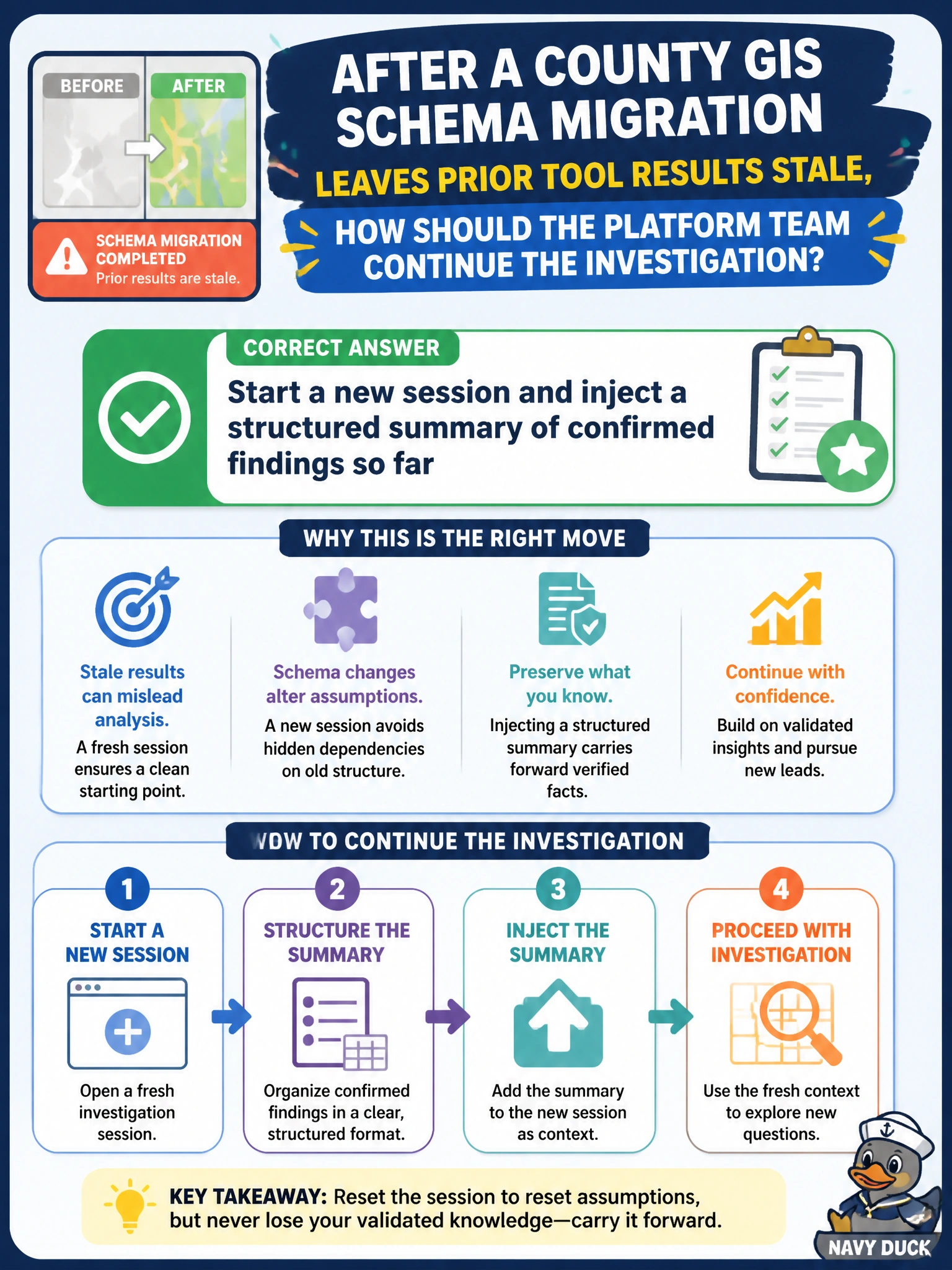
Stale MCP payloads after a schema migration are landmines. Start fresh and hand the new session a tight summary of what you already proved—don't resume on rotten tool results.
Full Explanation
After a county GIS schema migration, prior MCP tool payloads in the old session are structurally obsolete: field names, joins, and layer definitions may no longer match the live catalog. The reliable continuation is to start a new session and inject a structured summary of confirmed findings so far—verified parcel IDs, accepted hypotheses, and open questions—then force fresh tool calls against the migrated GIS. That preserves civic investigation progress without treating stale schemas as current evidence.
A structured handoff works because the model’s memory of earlier tool JSON is not version-aware. Explicitly separating “what we already proved” from “what must be re-queried” prevents silent drift in map layers, zoning attributes, or coordinate systems that municipal planners depend on.
Resuming the old session unchanged and trusting every prior MCP result fails because those results were produced under the pre-migration schema; reasoning over them can invent parcels that no longer exist or miss mandatory new fields. Deleting all notes and asking the model to reinvent the investigation from scratch with no summary discards verified county findings and wastes prior fieldwork, increasing the chance the new session rediscovers wrong paths. Forking endlessly without documenting which schema version each branch used multiplies inconsistency—branches cannot be compared or audited when GIS versions are unlabeled.
Exam caveat: a fresh session alone is insufficient if the injected summary still embeds raw obsolete tool dumps; summarize conclusions and evidence IDs, then re-call tools. Operational check: after migration, confirm a resumed session still cites old field names, then open a new session with a structured summary and verify the next GIS call returns post-migration fields only.