
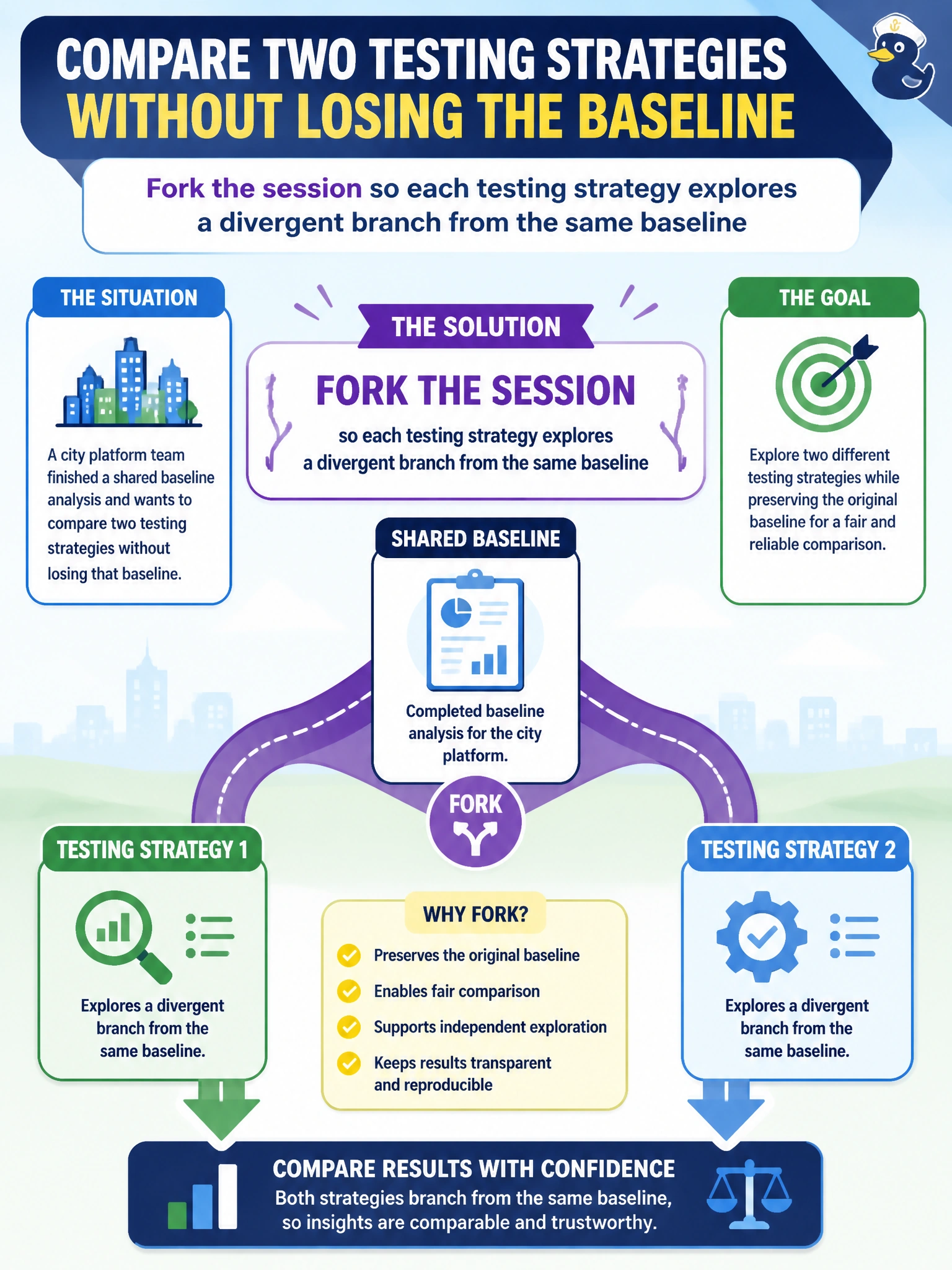
A city platform team finished a shared baseline analysis and wants to compare two testing strategies without losing that baseline. What should they do?
Select an answer to reveal the explanation.
Short Explanation
Forking is the clean A/B lab for sessions. Keep the shared baseline, branch two testing strategies, and compare without torching the original analysis.
Full Explanation
Forking the session so each testing strategy explores a divergent branch from the same baseline lets the city platform team compare approaches without destroying the shared analysis. Fork preserves the completed baseline as a common ancestor while allowing isolated experimentation—exactly the A/B structure municipal platform work needs when two testing strategies must be judged fairly.
Overwriting the baseline session with the first strategy and discarding the second idea fails because it collapses comparison into a single surviving path and loses the other strategy’s evidence before judgment. Exporting nothing and verbally describing both strategies to a fresh empty session fails conceptually—verbal restatement drops structured findings, metrics, and file references and forces an expensive rebuild of the baseline. Deleting the baseline analysis before trying either strategy fails because it removes the shared reference the comparison depends on and makes results incomparable.
Exam caveat: forks diverge quickly; merge conclusions deliberately or the team will argue from incompatible session states and cherry-picked artifacts. Operational check: fork once per strategy from the named baseline, record branch IDs and hypotheses, compare outcomes against the same acceptance metrics, keep the baseline session read-only during the experiment, and archive both forks with a decision memo.