
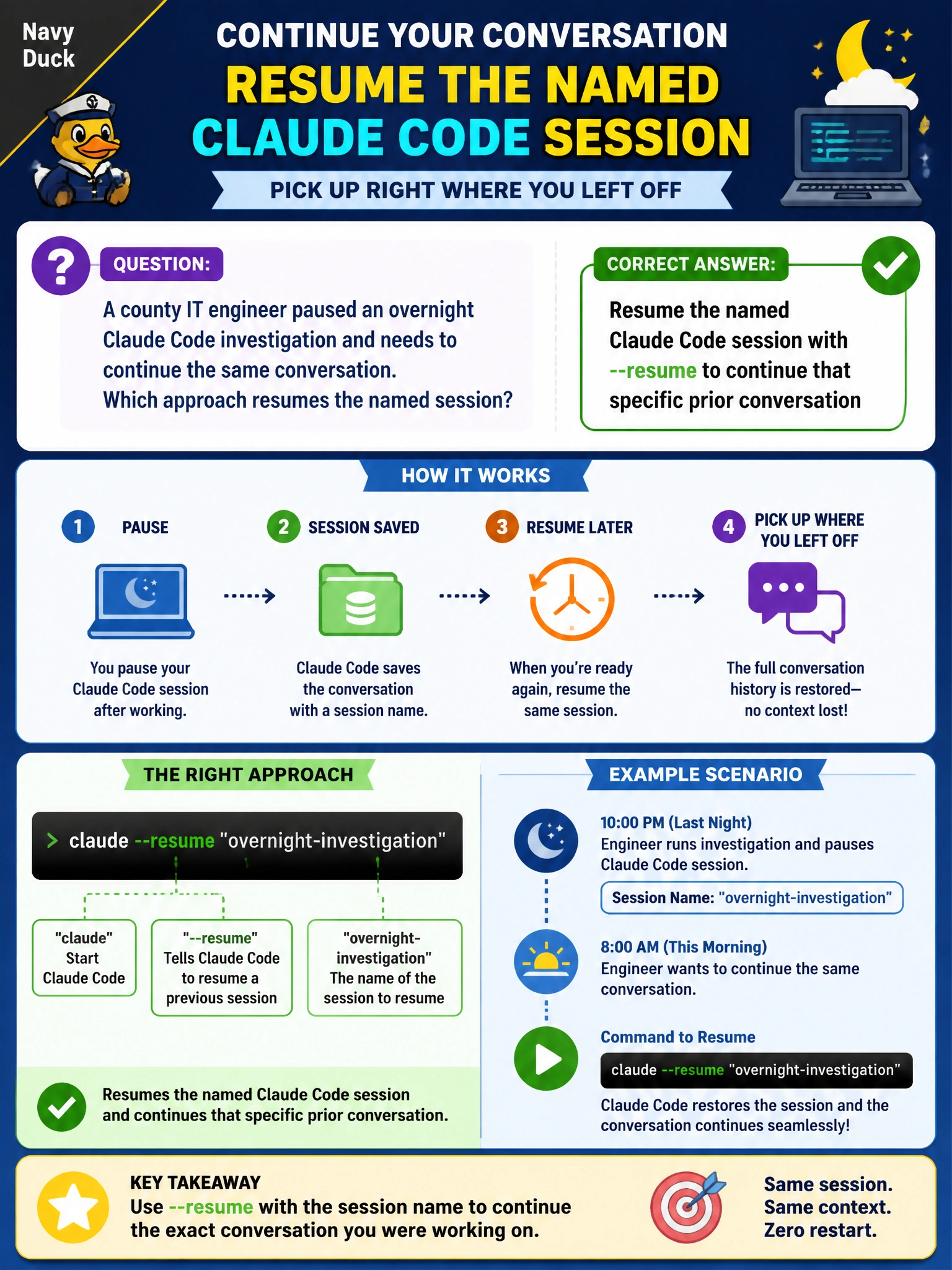
A county IT engineer paused an overnight Claude Code investigation and needs to continue the same conversation. Which approach resumes the named session?
Select an answer to reveal the explanation.
Short Explanation
Picking up overnight work is like finding a bookmark. Use --resume on the named Claude Code session so the exact conversation continues—not a blank new chat that forgot the plot.
Full Explanation
To continue the same overnight investigation, the county IT engineer should resume the named Claude Code session with --resume so that specific prior conversation continues with its accumulated context, tool history, and task state. Session continuity is an operational primitive for multi-hour municipal engineering work where starting over would waste investigation already paid for in time and tokens.
Starting an unrelated new session and hoping the model recalls the overnight thread fails because a new session does not inherit that conversation’s memory, decisions, or partial tool results. Deleting the session name so history cannot be restored fails conceptually when the goal is continuation—it destroys the recovery handle on purpose and forces a cold start. Forking immediately without resuming fails when the goal is simply to continue the same thread; fork is for divergent exploration from a baseline, not for picking up the identical paused conversation.
Exam caveat: --resume restores session state, not necessarily the latest filesystem reality—engineers may still need to announce external overnight changes after resume. Operational check: name long-running investigations explicitly, document the resume command in the runbook, verify after --resume that the agent restates the last objective before new tool use, and confirm the working directory matches the overnight worktree.