
A GIS ETL remediation has stable, known steps that rarely change. When do fixed sequential pipelines beat adaptive decomposition?
Select an answer to reveal the explanation.
Short Explanation
When the GIS ETL dance steps never change, play the fixed choreography. Adaptive replanning shines for mysteries; stable known steps love a boring sequential pipeline.
Full Explanation
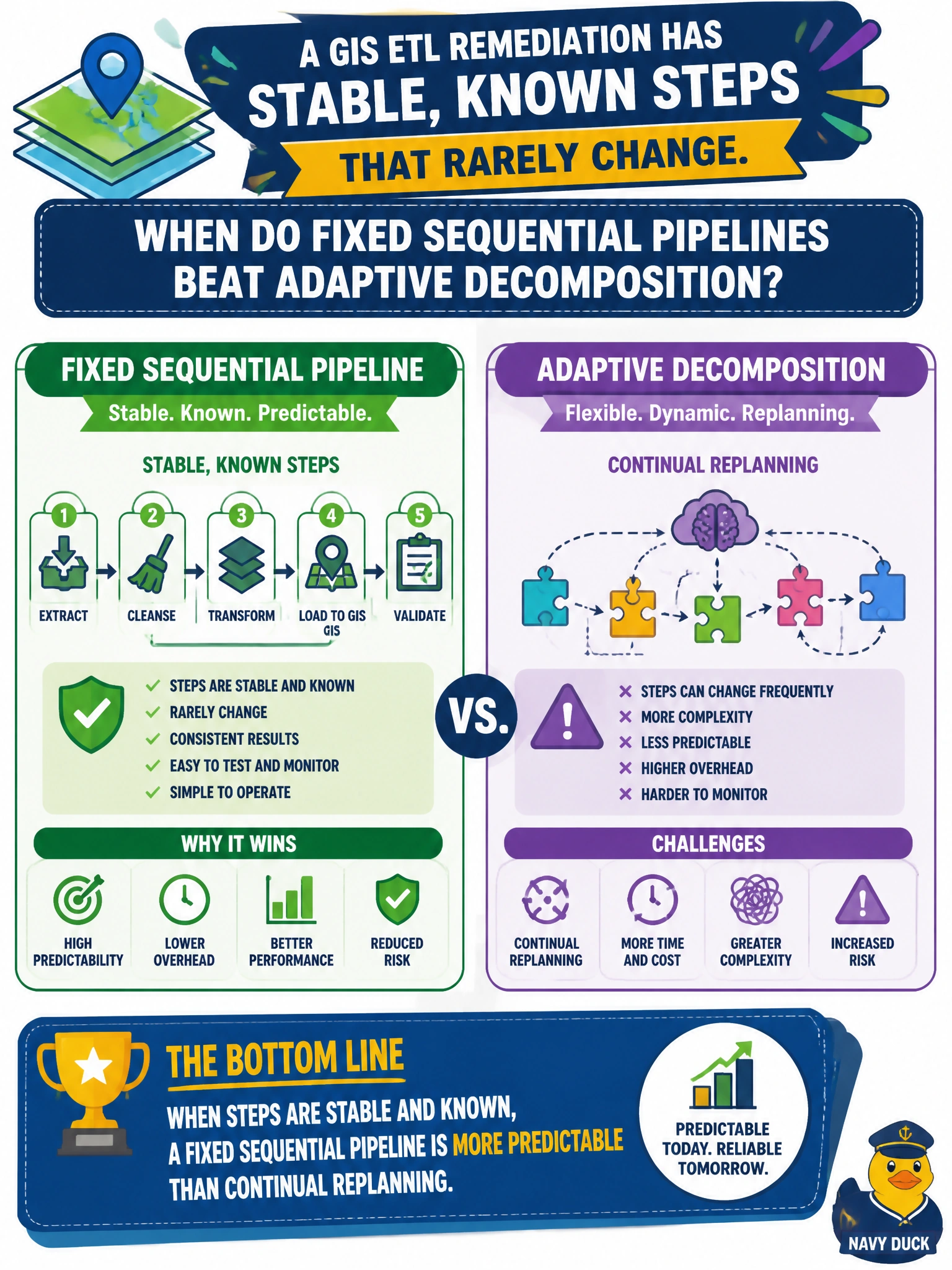
Fixed sequential pipelines beat adaptive decomposition for GIS ETL remediation when steps are stable and known, because a predictable choreography outperforms continual replanning on work that does not benefit from discovery. Municipal ETL that always extract→validate→transform→load the same layers should be boring and repeatable.
Saying fixed pipelines win only when every step is unknown inverts the criterion—unknown-heavy work is where adaptive planning shines. Claiming adaptive decomposition is always superior for ETL fails conceptually; adaptability has overhead and can destabilize proven sequences. Waiting until the pipeline has already failed repeatedly in production before allowing a fixed design fails because stable known steps justify a fixed pipeline before outages teach the lesson the hard way.
Exam caveat: “stable and known” can rot—schema drift or new source systems can invalidate a once-fixed pipeline; monitor for change signals that should reopen adaptive redesign. Operational check: document the fixed step list with owners and SLAs, add regression checks after each stage, and define a trigger (schema mismatch rate, new source onboarding) that forces replanning rather than silent patching.