
A water SCADA companion must review multiple services without diluting model attention. What should the architecture avoid?
Select an answer to reveal the explanation.
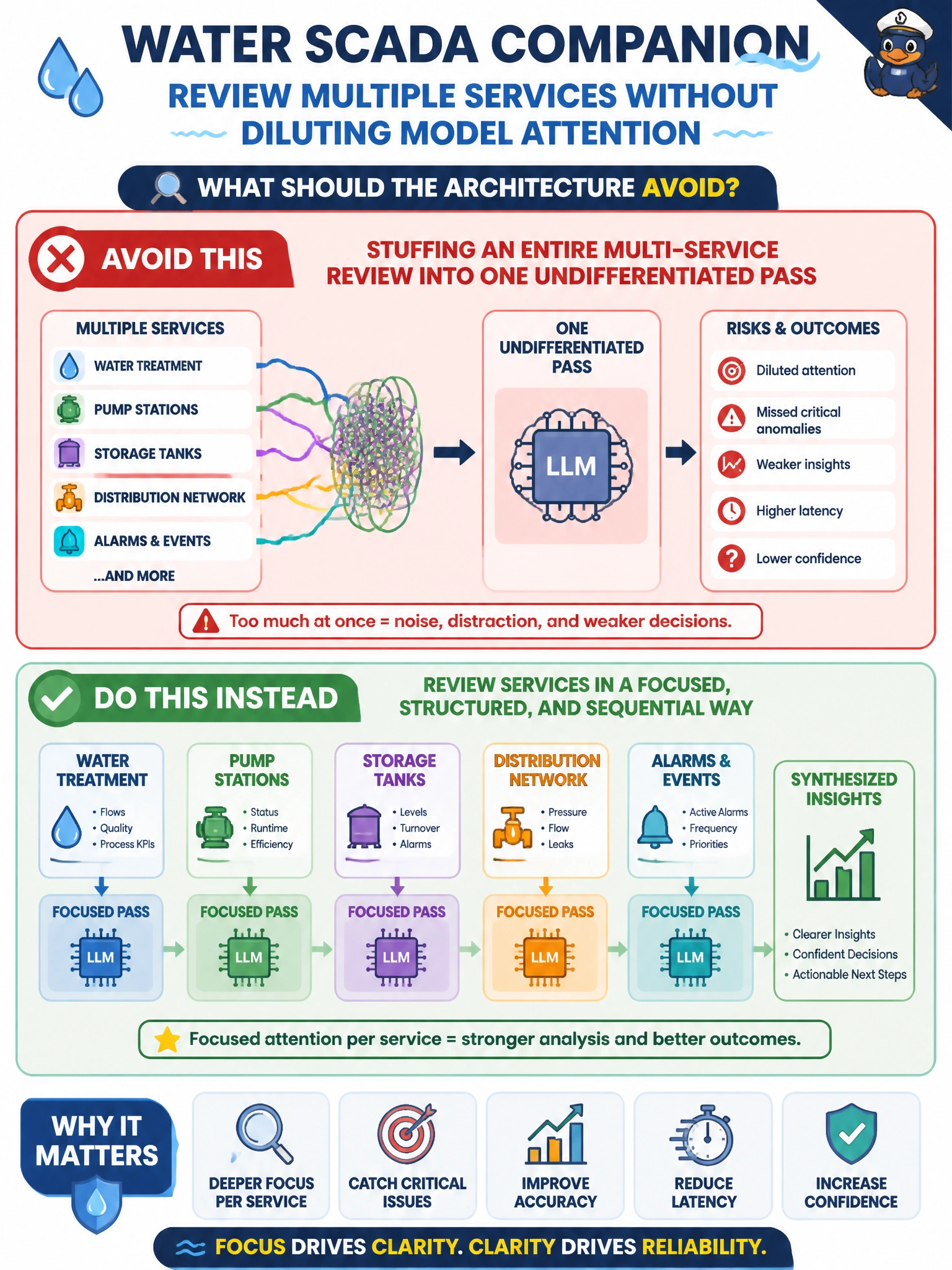
Short Explanation
Shoving every SCADA service into one mega-review is like proofreading a phone book in one glance. Split the work so attention stays sharp on each slice.
Full Explanation
A water SCADA companion reviewing multiple services should avoid stuffing an entire multi-service review into one undifferentiated pass. SCADA and related civic OT/IT services exceed comfortable attention width; undifferentiated mega-reviews dilute focus and miss service-specific hazards.
Splitting large reviews into focused passes that preserve attention on each service is sound practice, not something to avoid—the distractors naming split/sequence/scope describe the architecture you want. Sequencing service reviews when blast radius is too wide for one context window is likewise appropriate control of scope. Scoping each pass to a coherent subset of SCADA concerns is the discipline that keeps findings sharp. The failure mode under test is the all-at-once undifferentiated pass that pretends attention is unlimited.
Exam caveat: splitting still requires a final integration view for cross-service dependencies (shared historians, alarm routes, network segments); pure siloed passes can miss systemic issues. Operational check: partition the review into service-scoped passes with explicit concern lists, store per-service findings, then run a bounded cross-service integration pass before closing the review.