
A school-district test-coverage agent faces an open-ended codebase improvement task. How should it decompose the work?
Select an answer to reveal the explanation.
Short Explanation
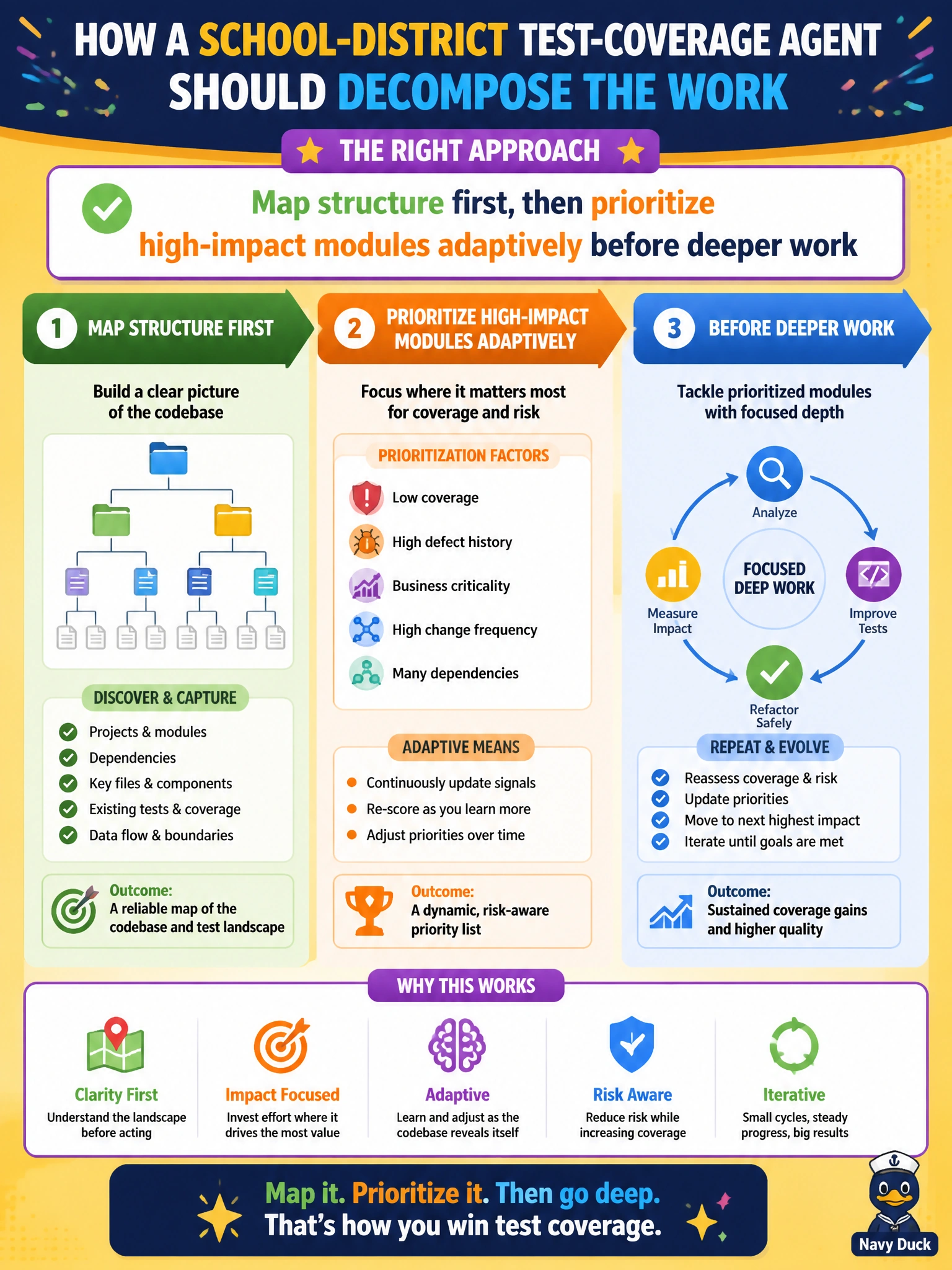
Do not boil the ocean alphabetically. Sketch the map of the district codebase first, then dive into the high-impact modules where better tests actually move the needle.
Full Explanation
A school-district test-coverage agent facing open-ended codebase improvement should map structure first, then prioritize high-impact modules adaptively before deeper work. Coverage effort is finite; architecture awareness plus impact ranking yields tests where failures hurt students, staff, or district operations most, rather than spreading thin noise across the entire tree.
Writing tests for every file in alphabetical order with no impact ranking fails because alphabetical order is unrelated to risk, usage frequency, or blast radius in student-information and operations systems. Generating a full coverage suite in one shot without mapping the codebase fails conceptually—unscoped one-shot generation ignores structure, shared libraries, and critical paths that actually matter. Ignoring structure and only patching whichever file was opened last fails because recency bias is not prioritization and leaves core modules chronically untested.
Exam caveat: “high-impact” must be defined explicitly (critical student-data paths, payment, gradebook, attendance) or adaptive prioritization becomes taste-driven and hard to defend in audit. Operational check: produce a module map with dependency and criticality scores, select the top tier for first coverage, measure delta coverage and defect catch on that tier, then expand adaptively with a written stop criterion.