
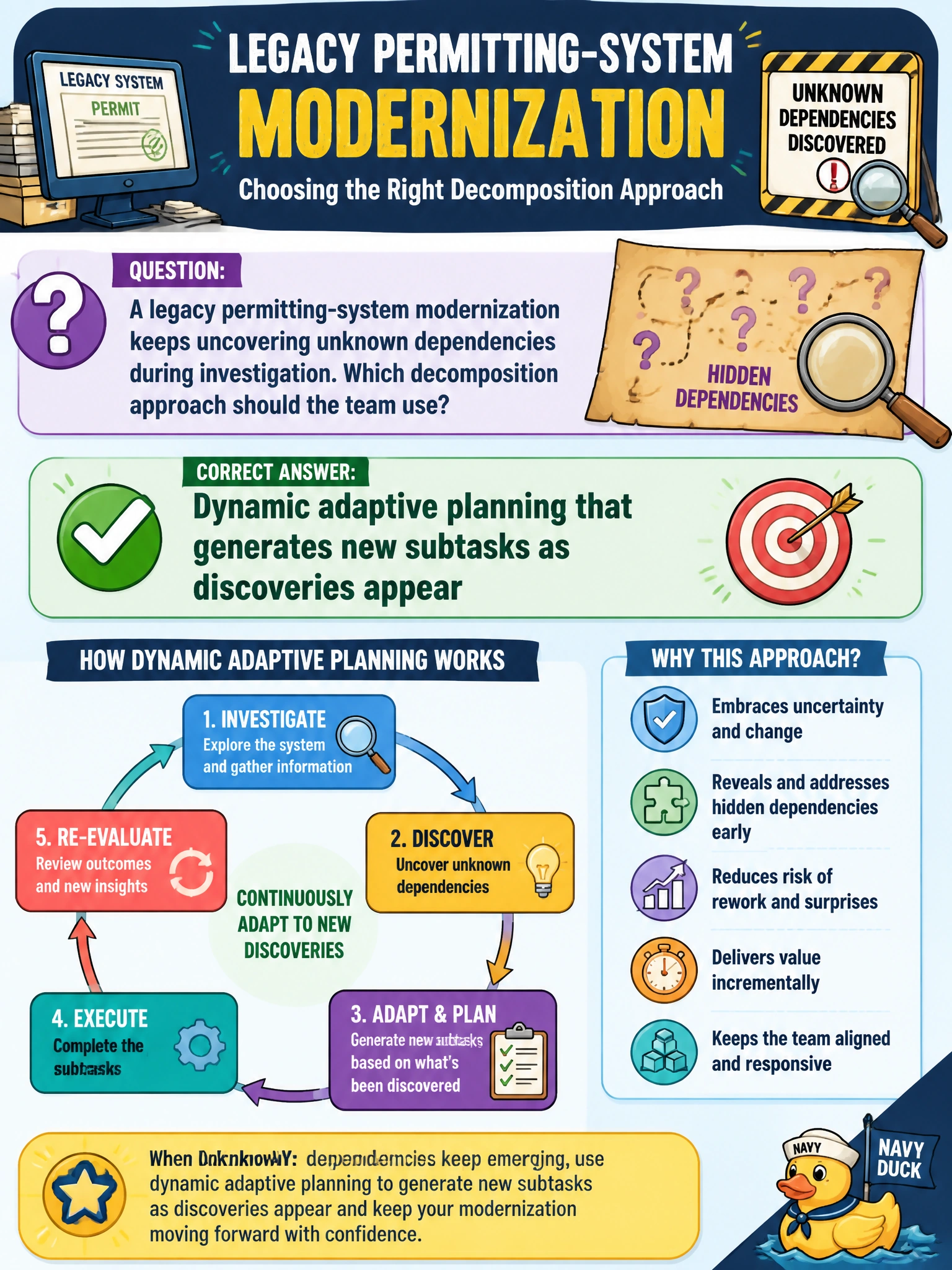
A legacy permitting-system modernization keeps uncovering unknown dependencies during investigation. Which decomposition approach should the team use?
Select an answer to reveal the explanation.
Short Explanation
Legacy permitting is a house with surprise wiring. Use an adaptive plan that grows new subtasks as discoveries appear—frozen checklists miss the hidden junctions.
Full Explanation
Dynamic adaptive planning that generates new subtasks as discoveries appear is the right decomposition for legacy permitting-system modernization when investigation keeps uncovering unknown dependencies. Exploration work in municipal legacy estates is inherently incomplete at kickoff; the plan must grow with evidence rather than pretend the dependency graph was known on day one.
A frozen checklist that never changes after the first hour fails because early inventories systematically miss hidden coupling in permitting, payments, document management, and GIS adjuncts. A single prompt demanding a complete modernization design with no intermediate exploration fails conceptually by skipping the investigation that makes design credible. Disabling investigation tools and modernizing modules in random order fails because unexamined dependencies turn random rewrites into outage generators for applicants and staff.
Exam caveat: adaptive planning still needs guardrails—unbounded discovery without decision points can become perpetual analysis. Operational check: after each investigation burst, require an updated dependency map, a prioritized subtask list with owners, and an explicit stop/go criterion before another discovery cycle starts.