
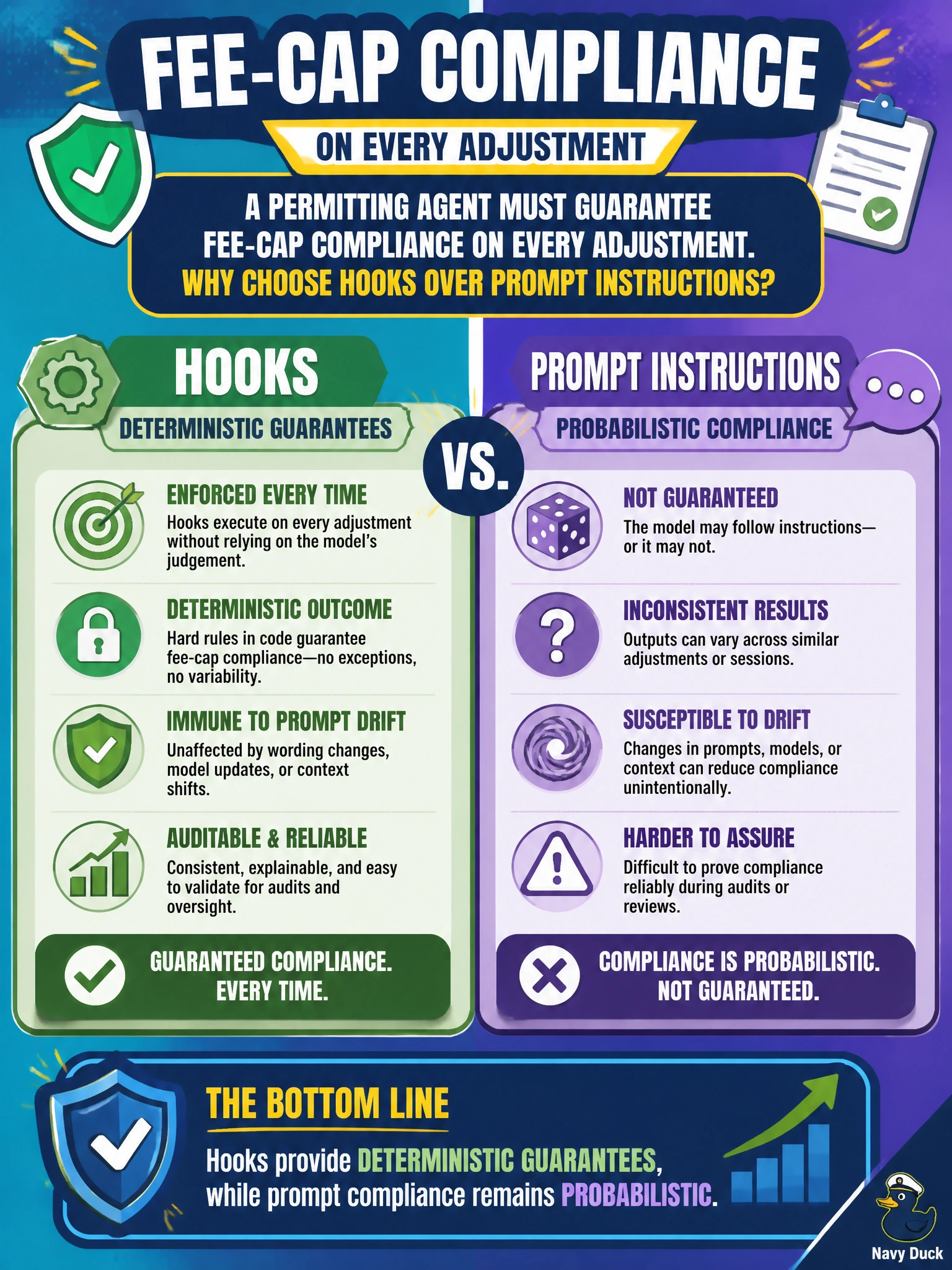
A permitting agent must guarantee fee-cap compliance on every adjustment. Why choose hooks over prompt instructions?
Select an answer to reveal the explanation.
Short Explanation
Fee caps are hard city policy, not vibes. Hooks make the rule stick every time; prompts are a coin flip when money and permits are on the line.
Full Explanation
Hooks are preferred over prompt instructions when a permitting agent must guarantee fee-cap compliance on every adjustment because hooks provide deterministic guarantees while prompt compliance remains probabilistic. Fee caps are binding municipal policy; architects choose mechanisms that make violating tool calls fail closed rather than hoping the model remembers the cap.
Asserting prompts always execute fee caps with zero failure risk fails because production agents face long contexts, tool schemas, and competing instructions that produce non-zero skip rates. Claiming hooks are only cosmetic logs and cannot block tool calls fails conceptually—interception hooks exist specifically to deny or redirect disallowed actions. Treating fee caps as optional guidelines that never need deterministic enforcement fails because caps exist to prevent unauthorized revenue leakage and inequitable fee treatment.
Exam caveat: deterministic hooks enforce the encoded cap; if the cap table is stale relative to ordinance, enforcement will be consistently wrong until policy data is updated. Operational check: configure a PreToolUse/outgoing hook on fee-adjust tools that compares the proposed amount to the active cap table and blocks with an escalation path when the proposal would exceed policy.