
A transit fare-adjustment agent must prevent policy-violating tool calls at runtime. What should interception hooks do?
Select an answer to reveal the explanation.
Short Explanation
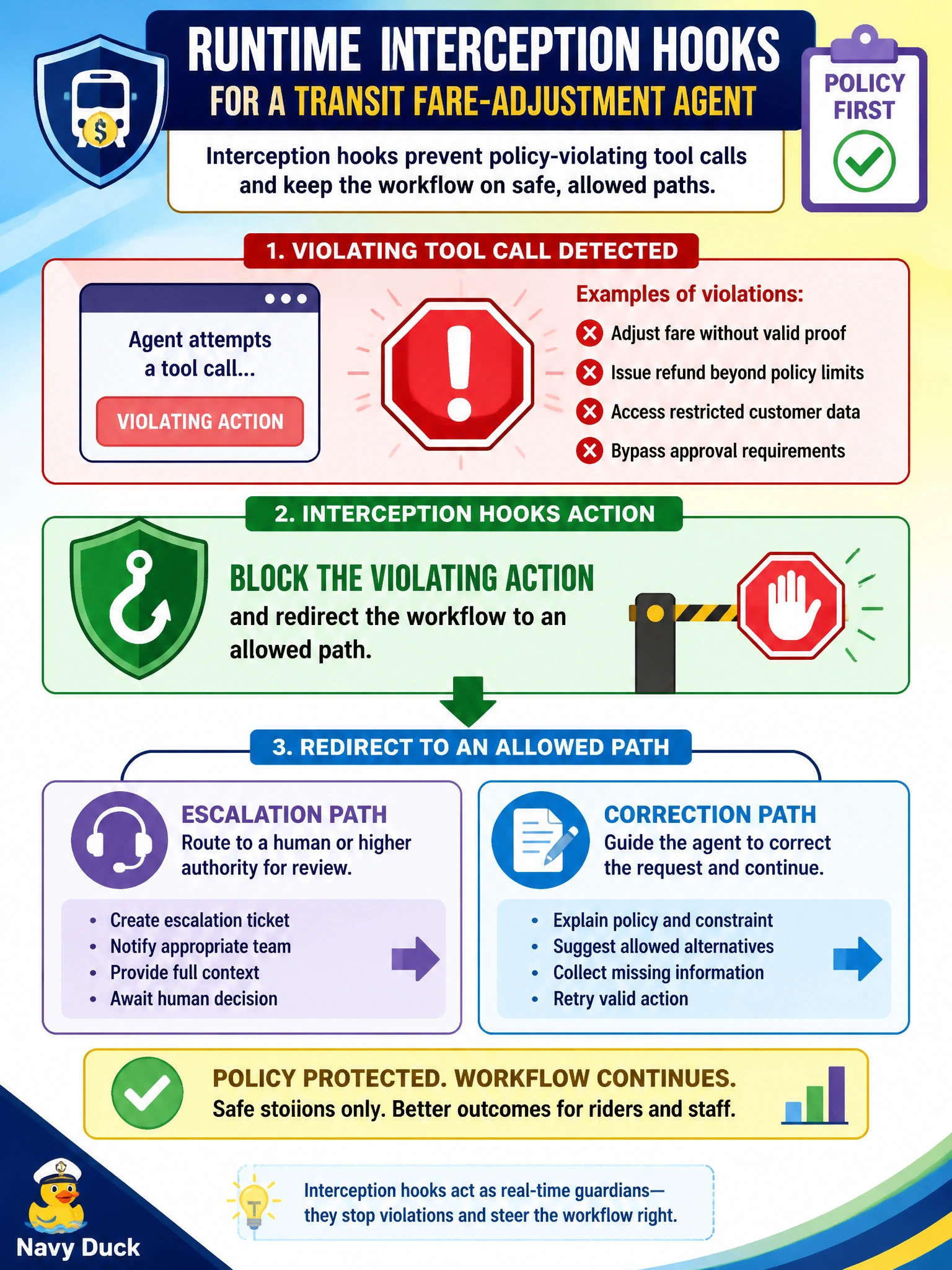
Think of interception like a turnstile that will not spin the wrong way. Block the bad fare tool call and shove the flow onto an allowed path—warnings after the fact do not un-charge a rider.
Full Explanation
For a transit fare-adjustment agent, interception hooks should block the violating action and redirect the workflow to an allowed path such as escalation or correction. Runtime prevention means the disallowed fare tool call never executes; redirection preserves a lawful next step for the rider and the agency instead of dead-ending the session or leaving an illegal change in place.
Allowing the violating fare change and attaching a warning afterward fails because the policy breach already posted to the fare system and a comment cannot un-charge or un-credit a rider. Ignoring policy checks when ridership volume is high fails conceptually—load is not a waiver of fare-policy controls and creates uneven enforcement that favors busy periods over compliance. Replacing interception with a weekly email of violations fails because summaries are retrospective reporting, not a mechanism that stops disallowed tool calls at the moment of invocation.
Exam caveat: redirect paths must be specific (correct amount, supervisor approval, or manual desk) or blocked callers will loop or invent unsafe alternatives under rider pressure. Operational check: on policy violation, deny the tool result to the model, inject a structured redirect instruction (escalate / correct / explain), metric-alert on interception rate by fare product, and sample redirected cases weekly for false positives.