
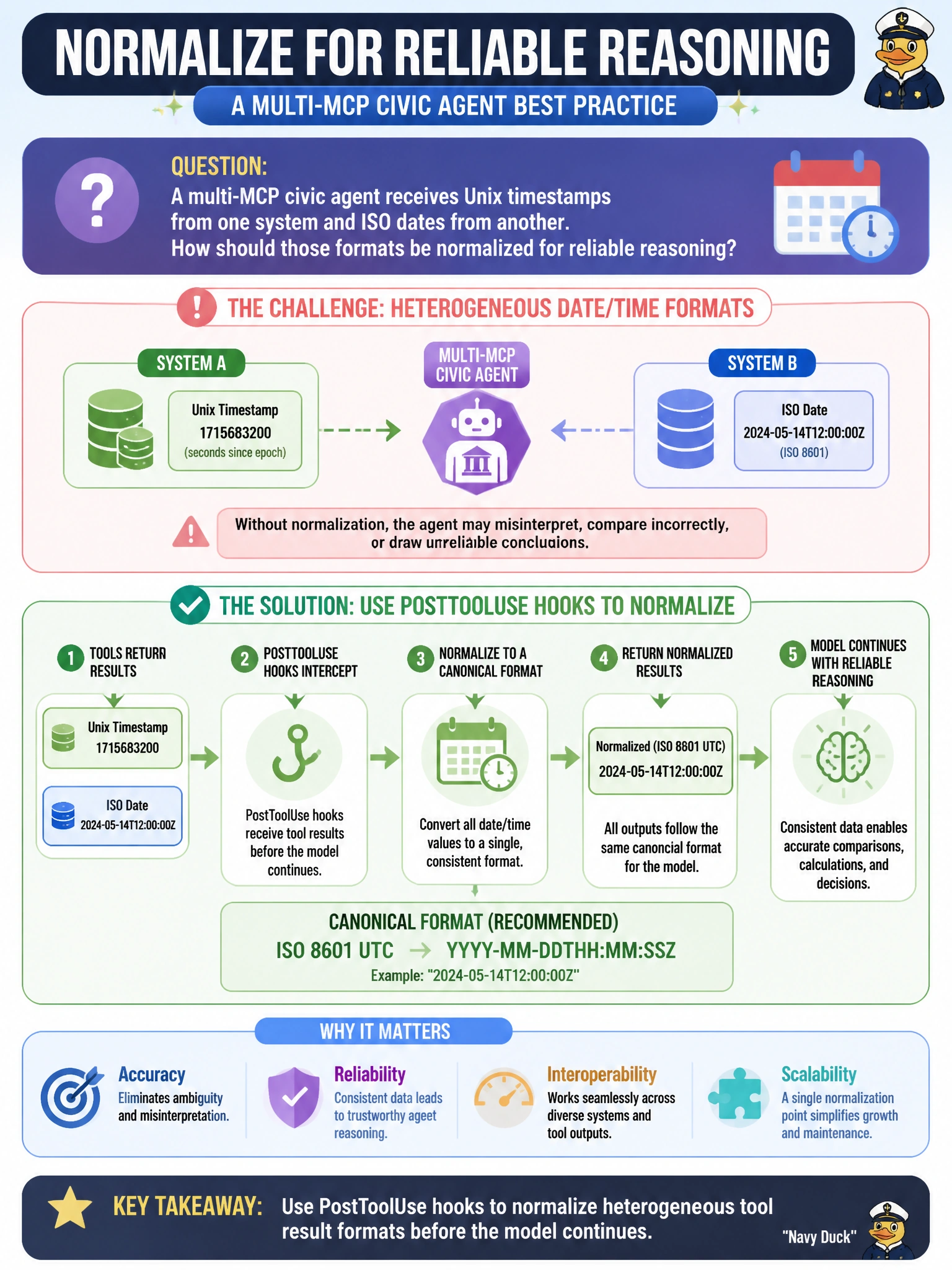
A multi-MCP civic agent receives Unix timestamps from one system and ISO dates from another. How should those formats be normalized for reliable reasoning?
Select an answer to reveal the explanation.
Short Explanation
Different city systems speak different date dialects. Catch tool results in a PostToolUse hook and translate Unix vs ISO into one clean format before Claude keeps reasoning.
Full Explanation
When a multi-MCP civic agent receives Unix timestamps from one system and ISO dates from another, PostToolUse hooks should normalize heterogeneous tool results before the model continues. Reliable reasoning needs one coherent temporal representation; leaving format dialects for the model to reconcile each turn invites comparison errors across municipal systems.
Asking the model in prose to remember both formats and never transform payloads fails because memory-of-convention is not a transformation pipeline and drifts across long conversations. Deleting timestamps so format conflicts disappear fails conceptually—it removes the evidence needed for SLA calculations, due dates, and audit timelines. Requiring every municipal MCP to crash when formats differ fails because brittle refusal is not interoperability; civic platforms must normalize at the agent boundary when upstream systems cannot be homogenized overnight.
Exam caveat: normalization must preserve timezone and precision semantics—silent UTC/local shifts can move court or billing deadlines by a day. Operational check: implement a PostToolUse normalizer that converts known date fields to a single canonical form (with timezone), attaches provenance of the source format, and rejects unrecognized date shapes instead of guessing.