
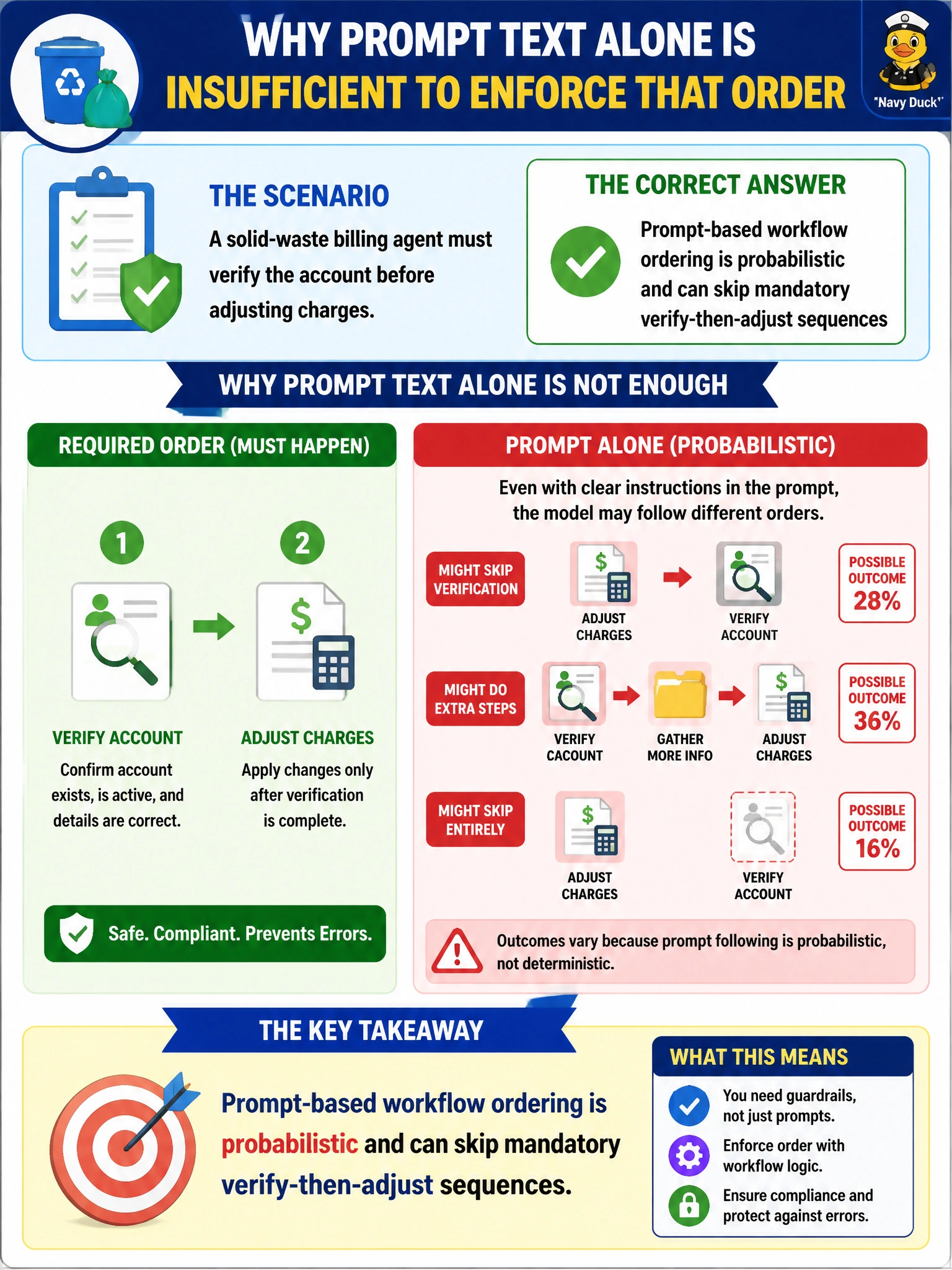
A solid-waste billing agent must verify the account before adjusting charges. Why is prompt text alone insufficient to enforce that order?
Select an answer to reveal the explanation.
Short Explanation
Telling the model "verify first" is like a paper sign on a vault. For solid-waste billing, assume prompts can be skipped—use real gates so adjust cannot run before verify.
Full Explanation
Prompt text alone is insufficient to enforce verify-then-adjust ordering for solid-waste billing because prompt-based workflow sequencing is probabilistic and can skip mandatory verification under tool pressure, long histories, or conflicting goals. Municipal waste charge adjustments alter accounts receivable; the verify-before-adjust sequence must be a runtime constraint, not a reminder.
Claiming system prompts deterministically block every disallowed tool call without hooks fails because natural-language instructions are not a compiler for hard authorization. Asserting billing adjustments never need verification in municipal waste systems fails conceptually—wrong-account credits and debits are classic civic billing failures. Believing natural-language reminders automatically compile into hard runtime gates fails because there is no such compilation path; gates must be implemented in hooks or equivalent control code.
Exam caveat: even with hooks, verification quality matters—checking the wrong account ID still produces a correctly ordered wrong adjustment. Operational check: bind the adjust-charge tool behind a gate that requires a successful verify-account result in the same session, and record block events when adjust is attempted without verification.