
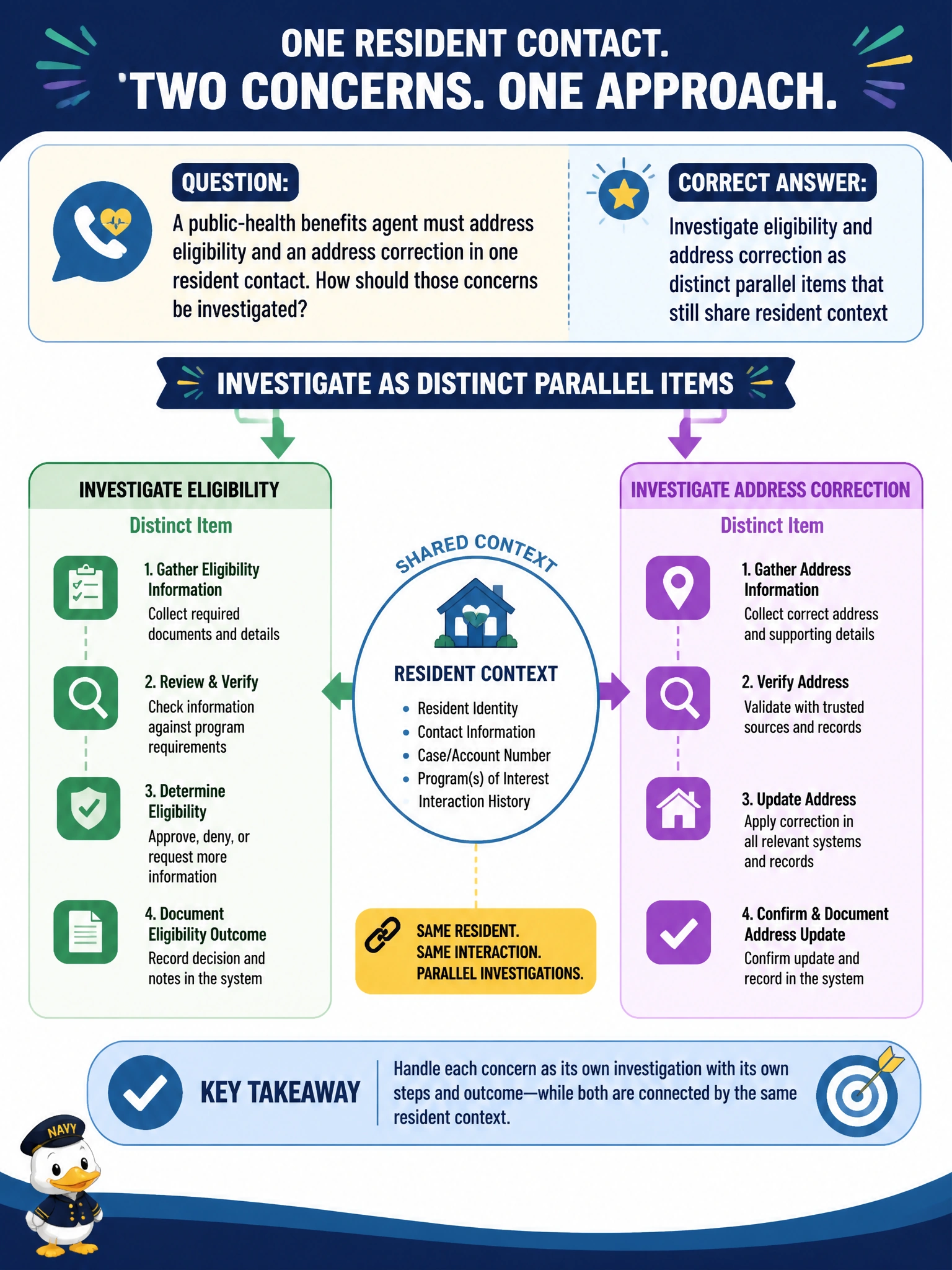
A public-health benefits agent must address eligibility and an address correction in one resident contact. How should those concerns be investigated?
Select an answer to reveal the explanation.
Short Explanation
Two problems, one resident—run eligibility and address fix side by side, but keep the shared case facts so both tracks stay on the same person.
Full Explanation
Eligibility review and address correction in one public-health benefits contact should be investigated as distinct parallel items that still share resident context. Separating the concerns prevents outcome conflation while shared identity, program, and contact facts keep both tracks on the same person and household.
Merging both into one undifferentiated tool call fails because the model cannot cleanly attribute success or failure to eligibility versus address update, complicating retries and audit. Finishing eligibility only and deferring address correction indefinitely fails conceptually because an outdated address can invalidate notices, shipment of benefits materials, and ongoing case mail—deferral is not resolution. Dropping shared resident context to maximize isolation fails because over-isolation creates duplicate identities, mismatched program records, and contradictory updates across the two investigations.
Exam caveat: parallel tracks still need a merge step that detects conflicts (for example, eligibility tied to an address that the other track just changed). Operational check: spawn two sub-investigations with a shared resident key, require each to return a typed result object, then synthesize one resident reply only after both dispositions are present.