
A court-fee waiver agent must enforce prerequisite gates before filing adjustments. Which approach provides reliable enforcement when prompt guidance has non-zero failure risk?
Select an answer to reveal the explanation.
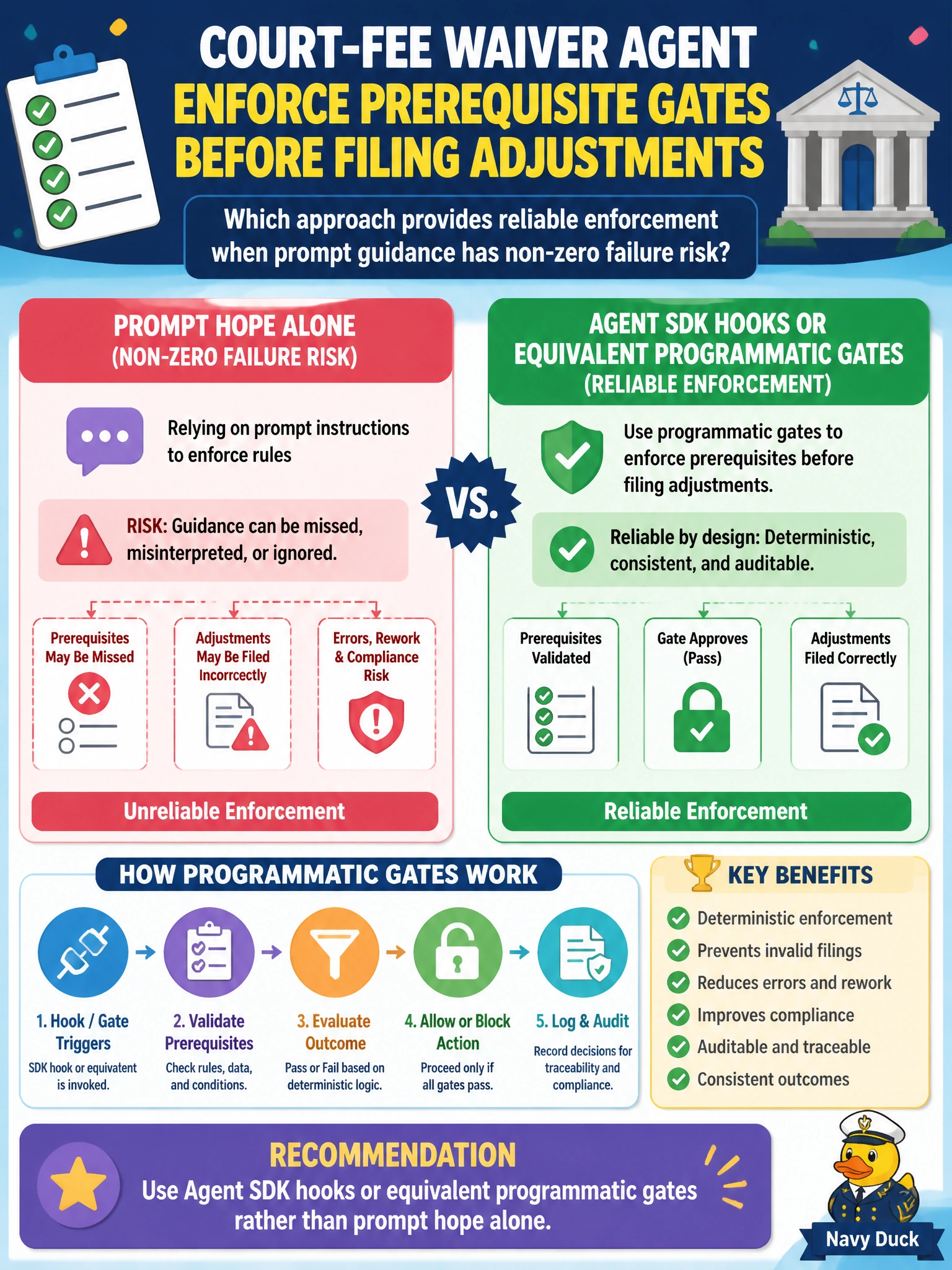
Short Explanation
When a wrong click costs a court fee, sticky-note prompts are not enough. Wire hooks or hard gates so the waiver tools literally cannot fire until prerequisites pass.
Full Explanation
When a court-fee waiver agent must enforce prerequisites before filing adjustments, Agent SDK hooks or equivalent programmatic gates provide reliable enforcement because they make disallowed tool calls impossible rather than merely discouraged. Prompt guidance has non-zero failure risk; for court money paths that risk is unacceptable because a skipped prerequisite can file an unauthorized adjustment.
Repeating the prerequisite louder in the system prompt fails because volume does not convert probabilistic instruction-following into a hard gate. Disabling all tools and forcing paper-only waivers fails conceptually because it abandons legitimate assisted digital workflows instead of fixing the control plane. Letting the model invent prerequisites per conversation fails because eligibility gates must be policy-stable and auditable, not improvised for flexibility.
Exam caveat: hooks enforce what you encode—if prerequisite logic is wrong or outdated, deterministic enforcement will reliably apply the wrong rule. Operational check: place a PreToolUse (or equivalent) gate on waiver/adjust tools that checks required evidence fields, returns a structured block reason on failure, and routes to human review rather than allowing the model to proceed.