
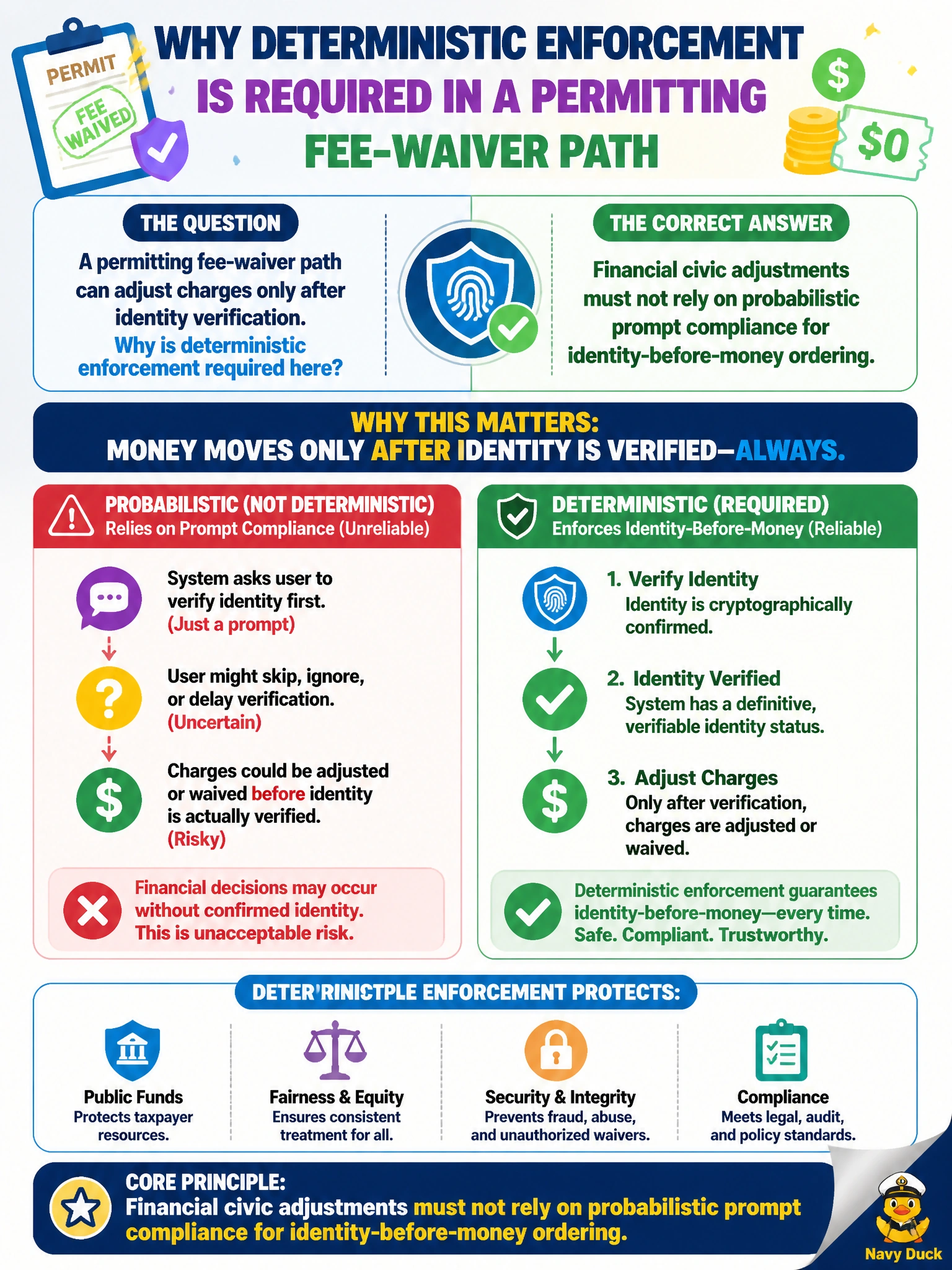
A permitting fee-waiver path can adjust charges only after identity verification. Why is deterministic enforcement required here?
Select an answer to reveal the explanation.
Short Explanation
Fee waivers move real money on the city's books. Treat verify-then-adjust like a locked gate, not a sticky note on the prompt—hope is not a control for financial civic ops.
Full Explanation
Deterministic enforcement is required on a permitting fee-waiver path because identity-before-money ordering is a hard municipal control, not a stylistic preference. Financial civic adjustments change receivables and can create wrongful waivers; those steps must not depend on the model happening to obey a prompt when identity verification is incomplete.
Claiming prompts alone always guarantee identity checks before every fee change fails because prompt compliance is probabilistic under tool pressure, long contexts, and conflicting instructions. Treating fee waivers as low-risk cosmetic edits fails conceptually because charge adjustments are financial events on the city's books and need the same gating discipline as other money movement. Allowing verification after the waiver posts if the resident sounds truthful fails because subjective credibility is not an identity control and cannot reverse an already-posted adjustment cleanly.
Exam caveat: deterministic gates still need correct policy configuration—blocking the wrong tool or skipping legitimate verified waivers is also an operational failure. Operational check: instrument the fee-adjust tool so it is unreachable unless an identity-verified flag is present in session state, and log blocked attempts for compliance review.