
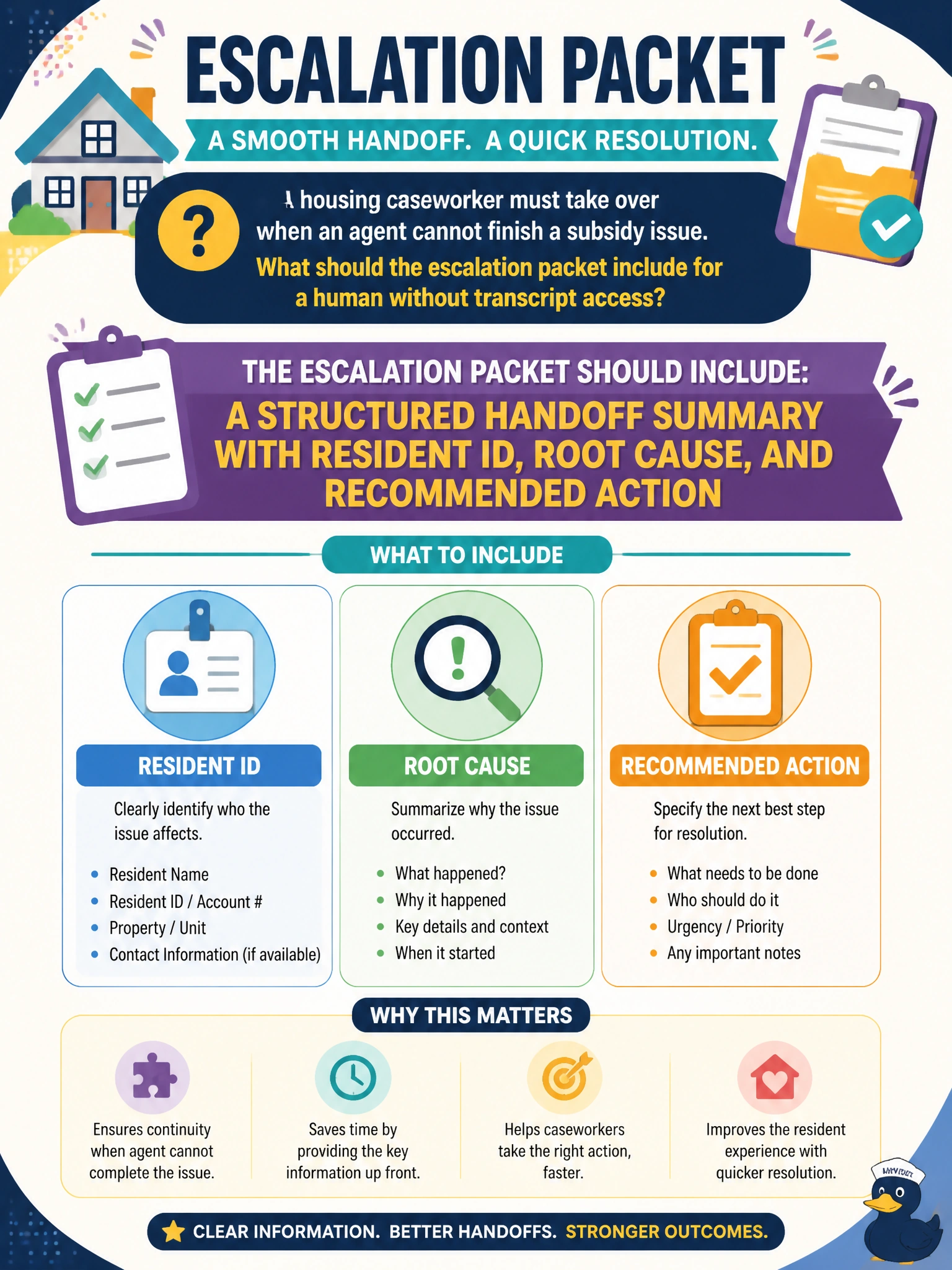
A housing caseworker must take over when an agent cannot finish a subsidy issue. What should the escalation packet include for a human without transcript access?
Select an answer to reveal the explanation.
Short Explanation
Hand the caseworker a briefing packet, not a scavenger hunt. Put resident ID, what went wrong, and what to do next in one structured summary so they can act without reading the whole chat.
Full Explanation
A structured escalation packet with resident ID, diagnosed root cause, and recommended next action lets a housing caseworker continue a subsidy issue without transcript access because it transfers decision-ready state rather than raw conversation archaeology. Mid-process handoffs in civic casework succeed when the human can identify the household, understand what already failed, and act without replaying the entire agent path.
Sending only the last assistant sentence plus a chat screenshot fails because screenshots omit durable identifiers, eligibility fields, and an explicit next step, forcing scavenger-hunt casework. Dumping the full raw tool trace without a summary fails conceptually because volume is not clarity—caseworkers need curated facts, not every intermediate token. A vague note that the resident seems upset fails because affect without ID, root cause, and recommended action cannot authorize subsidy decisions or preserve auditability.
Exam caveat: structured handoffs must still respect privacy minimization—include fields needed to continue, not every raw PII field the agent ever saw. Operational check: define a mandatory handoff schema (resident ID, program, root cause, evidence pointers, recommended action, urgency) and reject escalations that omit any required field before the human queue accepts the case.