
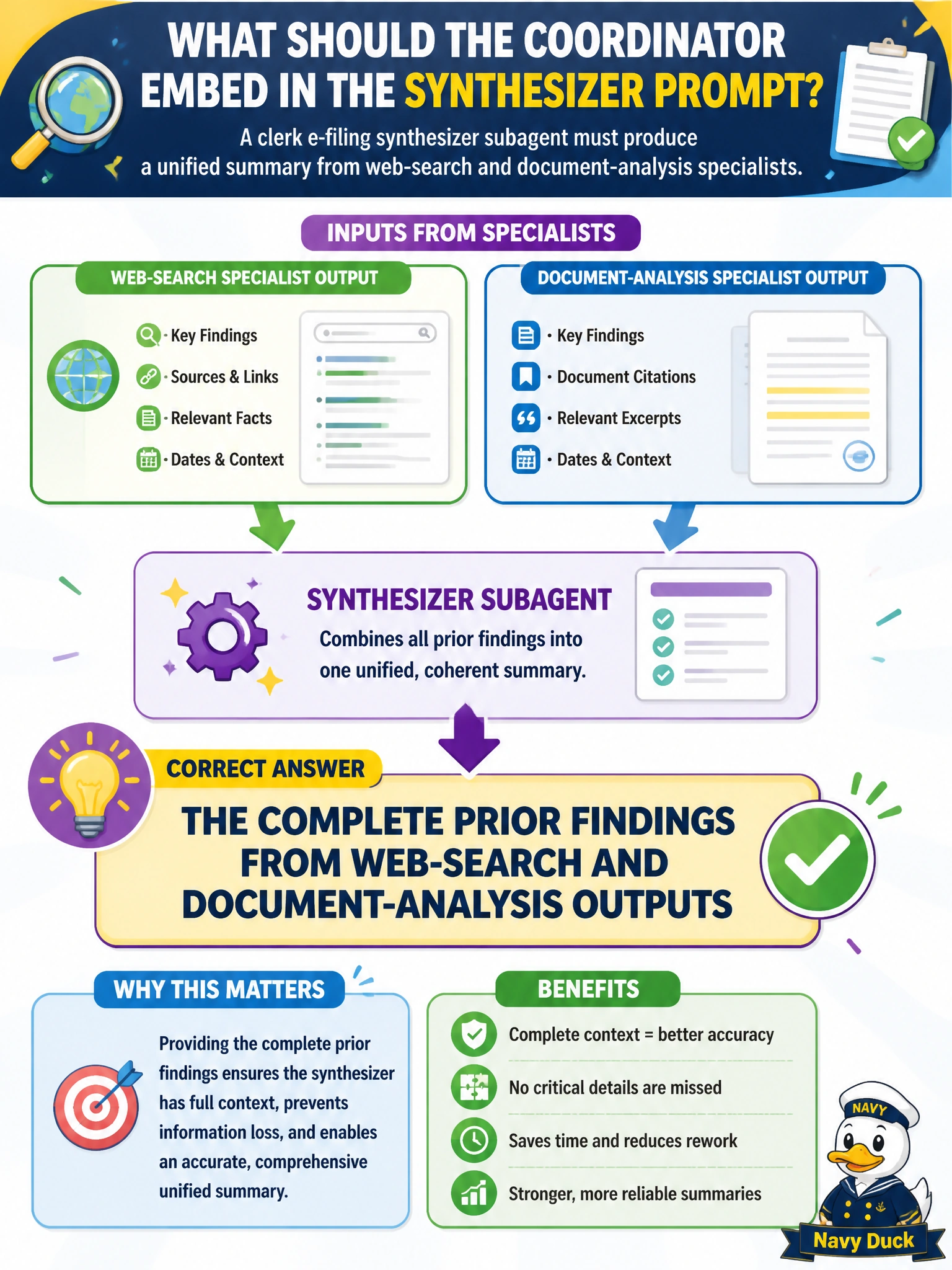
A clerk e-filing synthesizer subagent must produce a unified summary from web-search and document-analysis specialists. What should the coordinator embed in the synthesizer prompt?
Select an answer to reveal the explanation.
Short Explanation
The synthesizer cannot summarize what it never saw. Hand it the full specialist write-ups—search hits and document notes—right in the prompt, not a scavenger hunt back to the parent chat.
Full Explanation
A clerk e-filing synthesizer subagent must produce a unified summary from web-search and document-analysis specialists; the coordinator should embed the complete prior findings from those specialists in the synthesizer's prompt. Synthesis is a function of inputs: without the actual search hits and document notes, the synthesizer cannot reconcile citations, dates, or filing requirements and will invent or omit material facts affecting the clerk's packet.
Embedding complete findings works because subagents do not inherit parent transcripts automatically. The coordinator's job after specialists return is to package their outputs as explicit context for the writer or synthesizer role so e-filing guidance stays evidence-based.
Passing only specialist names without findings provides no content to summarize. Reminding the synthesizer that findings exist somewhere in the parent transcript relies on nonexistent inheritance. Blank placeholders that invite invented bridging content produce unreliable e-filing summaries and create audit risk for the clerk's office.
Exam caveat: complete means complete enough for the summary's claims—attach sources and excerpts, not necessarily every raw HTML blob if a structured digest was already produced. Operational check: compare synthesizer outputs with versus without embedded specialist findings; only the embedded case should cite concrete search and document evidence.