
A water-quality research pipeline must keep source URLs attributable while feeding excerpt text to a synthesis subagent. How should that information be passed?
Select an answer to reveal the explanation.
Short Explanation
Keep the quote in one pocket and the source sticker in another. Structured metadata for URLs beats smushing links into the middle of water-quality excerpts.
Full Explanation
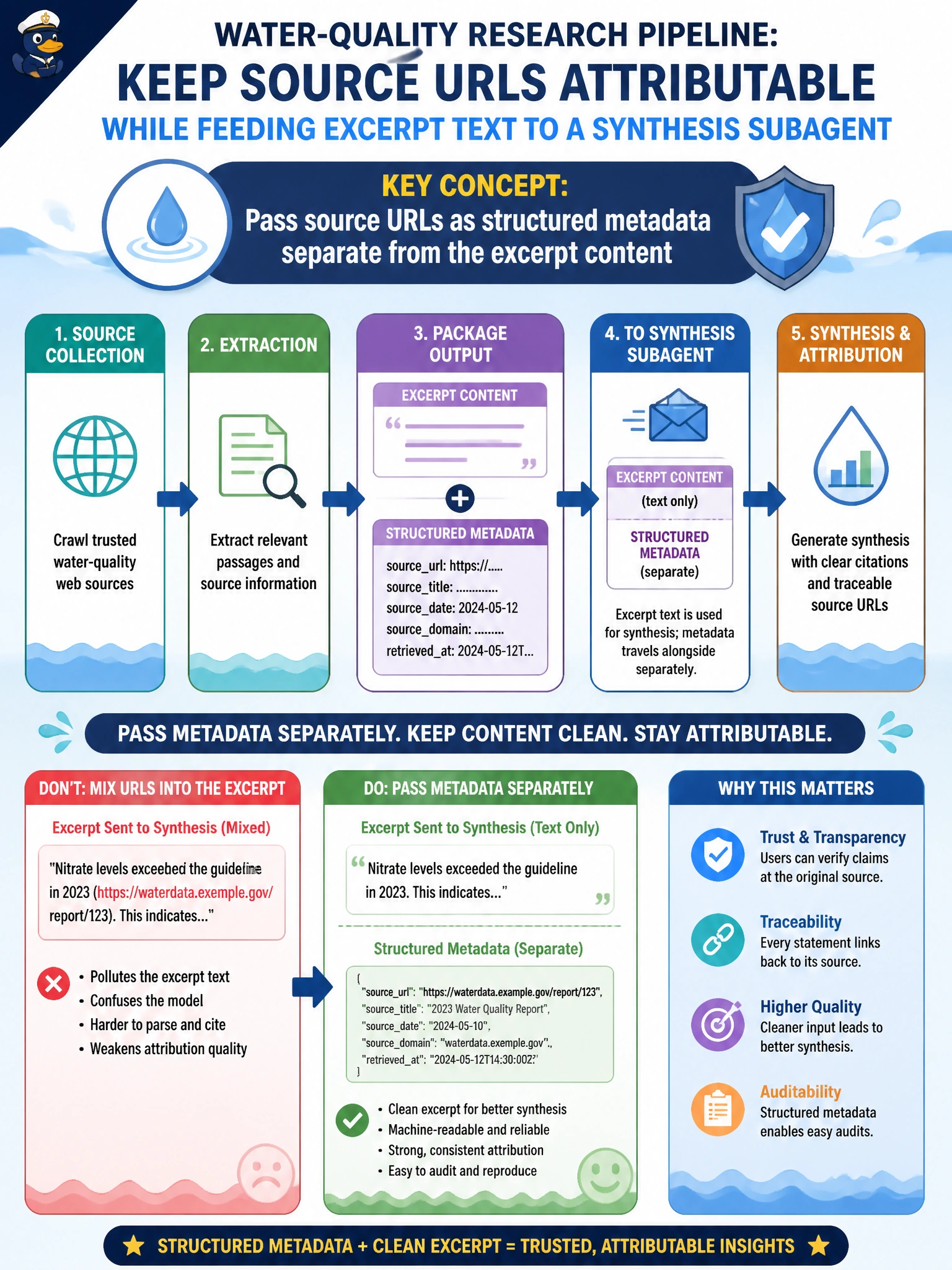
A water-quality research pipeline that must keep source URLs attributable while feeding excerpt text to a synthesis subagent should pass source URLs as structured metadata separate from the excerpt content. Separation preserves clean quotation text for reasoning while retaining machine-readable provenance for citations, audits, and link checking in public-trust environmental reporting.
Structured metadata works because synthesizers and downstream civic reports need both faithful excerpts and stable attribution. URLs as fields, or parallel arrays keyed to excerpt ids, avoid corrupting analysis on the excerpt and support deterministic bibliography generation for boards or regulators.
Concatenating URLs into the middle of excerpt sentences damages readability and can confuse models about what was actually quoted from the lab or agency source. Dropping URLs to shorten prompts destroys attributability required for water-quality claims. Hiding URLs in Base64 inside excerpts is obfuscation that invites ignore or mis-parse behavior and fails transparent governance.
Exam caveat: metadata must travel with the excerpts through every hop to synthesis—do not strip URLs in an intermediate cleaner. Operational check: after synthesis, regenerate citations from metadata alone and verify each excerpt claim maps to a live source URL.