
A public-health literature coordinator collects findings from multiple research subagents before writing for the board. What is the coordinator's primary role at that stage?
Select an answer to reveal the explanation.
Short Explanation
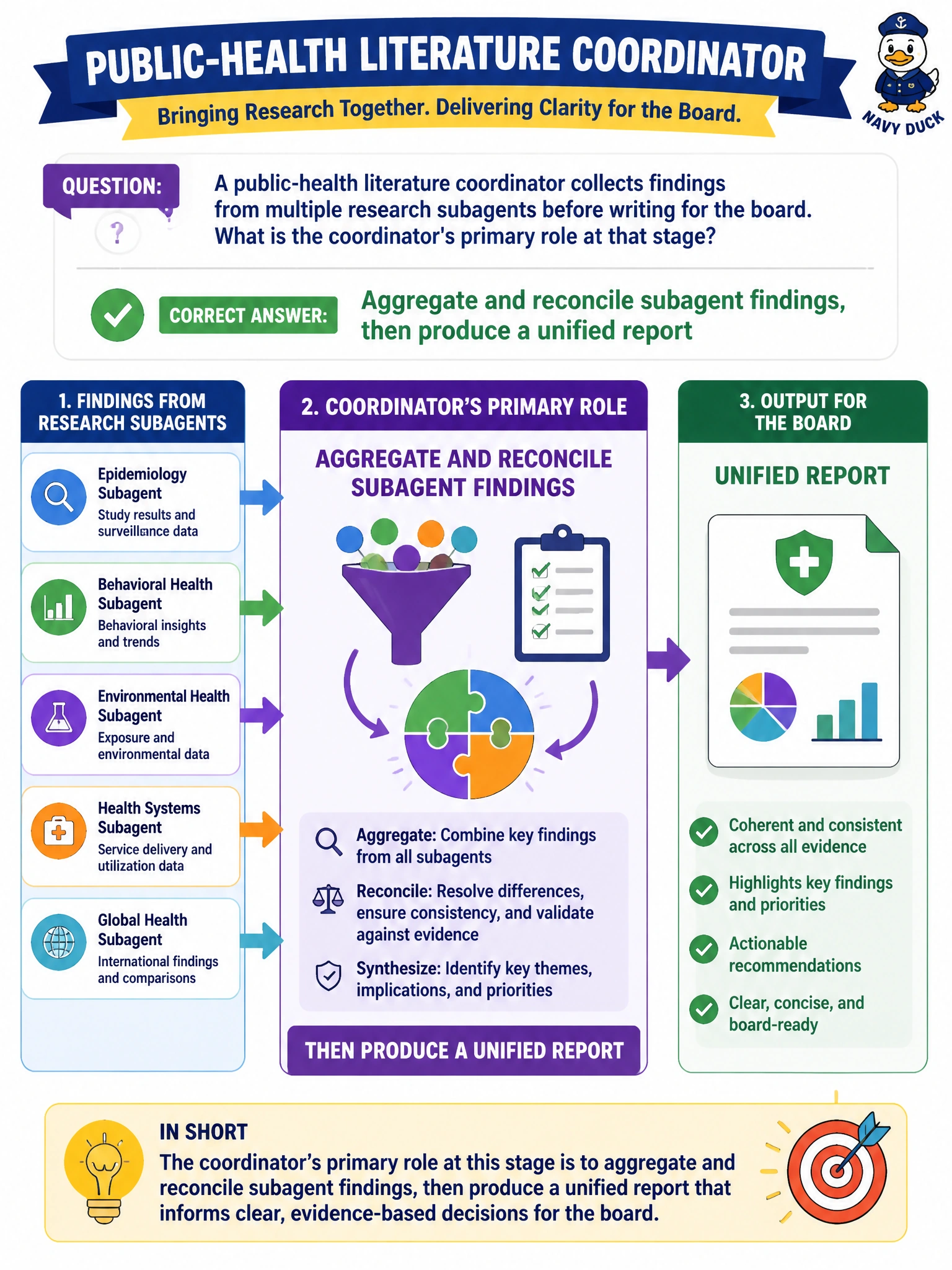
The coordinator is the editor-in-chief: gather every reporter's notes, sort the conflicts, and write one board-ready story. Do not dump a pile of raw transcripts on the trustees.
Full Explanation
After a public-health literature coordinator collects findings from multiple research subagents, its primary role is to aggregate and reconcile those findings, then produce a unified board report. In hub-and-spoke research, specialists gather; the coordinator synthesizes. Reconciliation includes resolving conflicts, weighting source quality, and presenting one coherent narrative trustees can act on for community health decisions.
Aggregation as the primary role works because boards cannot be expected to merge raw specialist transcripts under meeting time pressure. The coordinator is the quality and accountability layer for the civic brief and owns the final narrative presented to leadership.
Forwarding each raw transcript without synthesis shifts burden onto the board and invites inconsistent conclusions across trustees. Discarding conflicting findings so only one source remains hides uncertainty that public-health decisions often need to surface explicitly. Letting each subagent draft the board memo independently yields multiple competing memos instead of one governed product.
Exam caveat: reconciliation is not the same as silently deleting dissent—document material conflicts when they affect recommendations. Operational check: feed two conflicting prevalence estimates from subagents and verify the coordinator's report either reconciles them with rationale or explicitly flags the conflict before board delivery.