
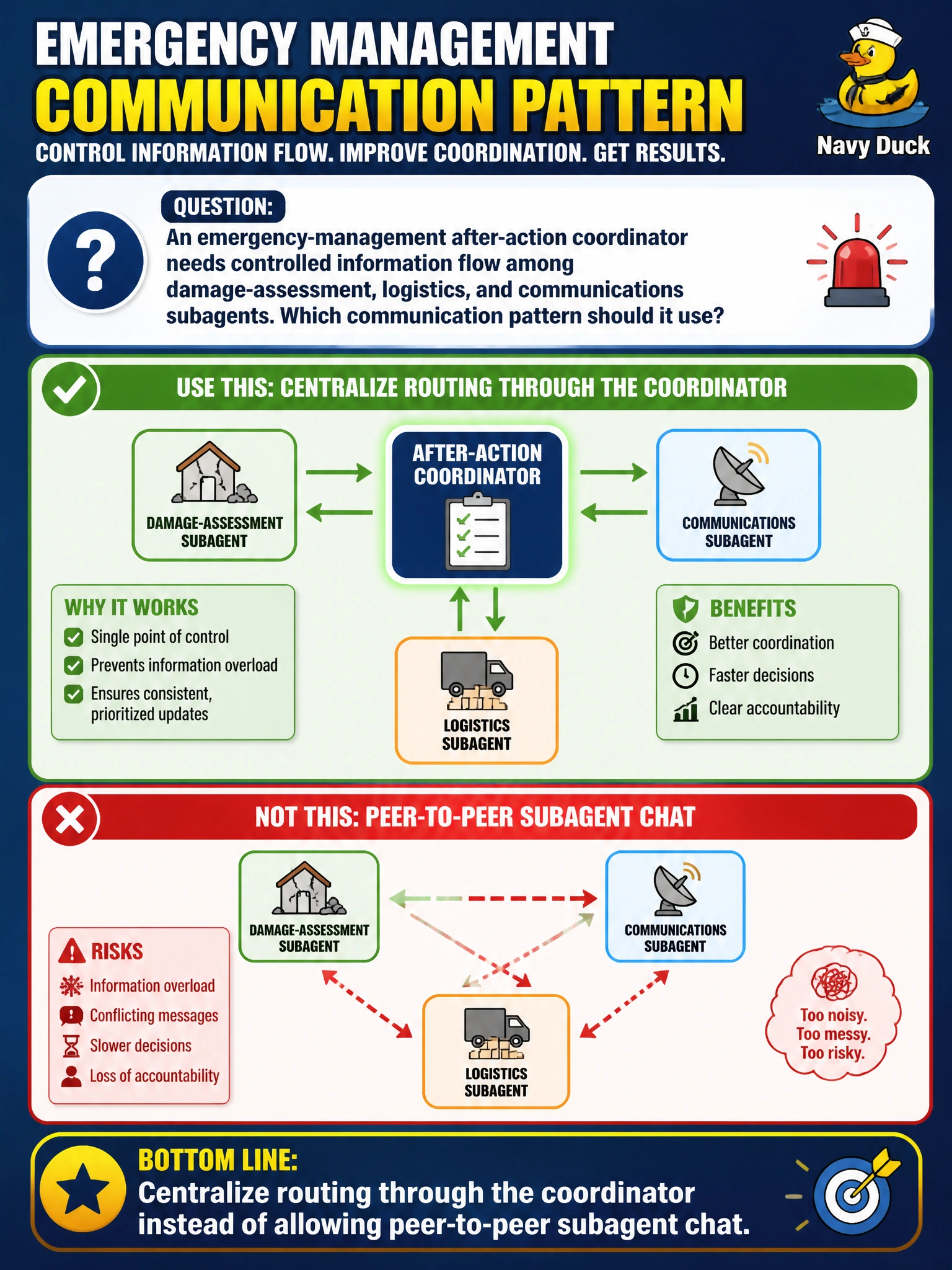
An emergency-management after-action coordinator needs controlled information flow among damage-assessment, logistics, and communications subagents. Which communication pattern should it use?
Select an answer to reveal the explanation.
Short Explanation
In an after-action war room, messages go through the incident desk—not side chats that nobody logs. Keep the coordinator in the middle so nothing critical slips into the ether.
Full Explanation
An emergency-management after-action coordinator that must control information flow among damage-assessment, logistics, and communications subagents should centralize routing through the coordinator rather than allowing peer-to-peer subagent chat. Centralization preserves ordering, observability, and error handling when after-action accuracy and chain-of-custody for findings matter to the incident review.
Coordinator-centered routing works in incident review because conflicting field reports must be mediated: logistics should not silently overwrite damage numbers via a side channel the incident desk never logged. The hub can enforce need-to-know and produce a single authoritative timeline for after-action documentation.
Unrestricted peer-to-peer messaging hides failures and creates unreviewed consensus among specialists. Publishing only to a public social channel abandons controlled civic information flow and confidentiality expectations. Silencing the coordinator after spawn so subagents self-organize removes the oversight emergency governance requires.
Exam caveat: high-tempo operations still need the hub; faster peer chat is not an excuse to drop auditability. Operational check: inject a logistics correction and confirm it reaches communications only via coordinator routing with an audit log entry—not via a direct peer message.