
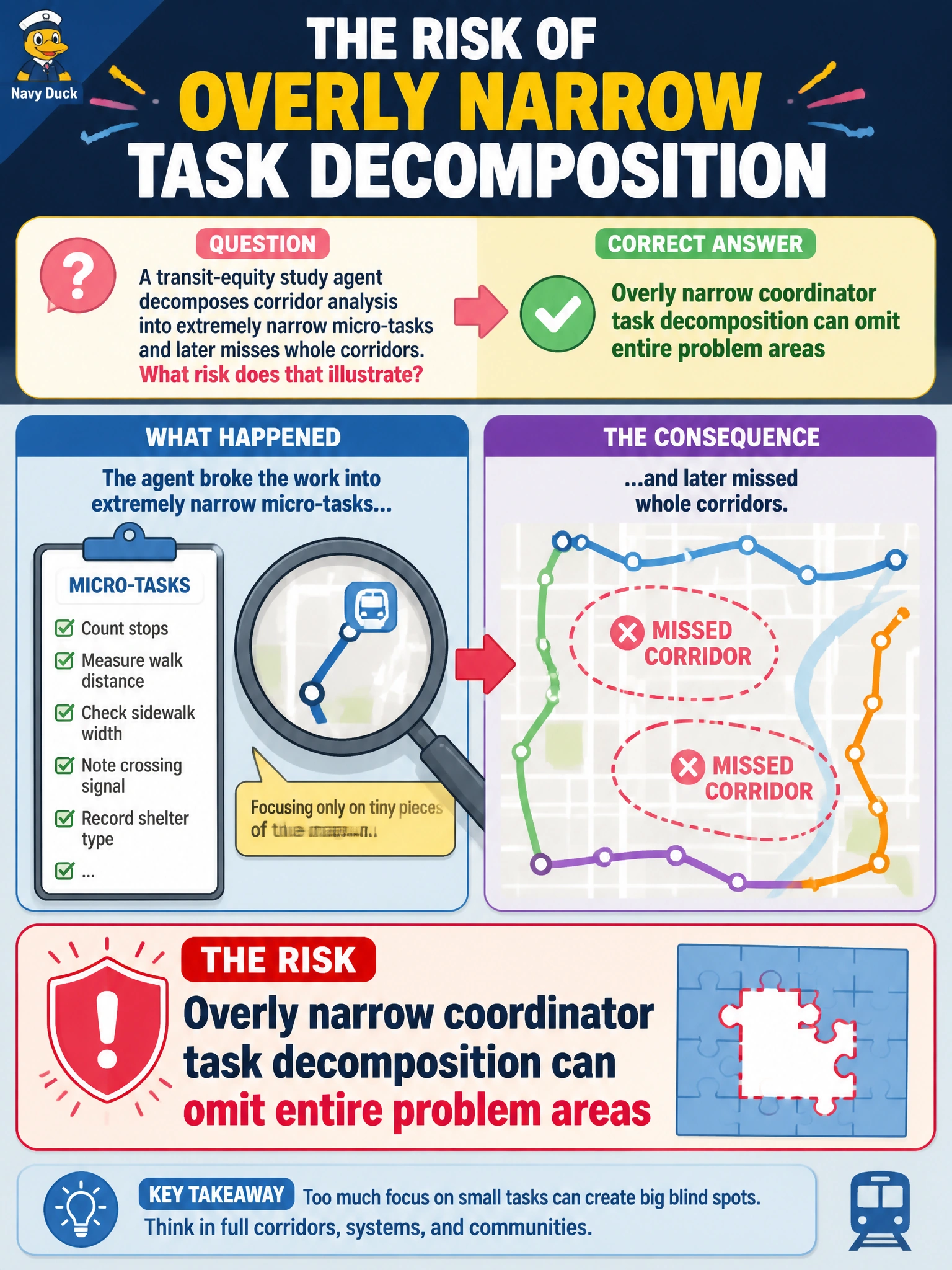
A transit-equity study agent decomposes corridor analysis into extremely narrow micro-tasks and later misses whole corridors. What risk does that illustrate?
Select an answer to reveal the explanation.
Short Explanation
Slice the pizza too thin and somebody forgets a whole slice exists. Over-narrow tasks sound precise, but they can leave entire transit corridors off the map.
Full Explanation
A transit-equity study agent that decomposes corridor analysis into extremely narrow micro-tasks and later misses whole corridors illustrates the risk that overly narrow coordinator task decomposition can omit entire problem areas. When no subagent's scope covers Corridor C as a coherent unit, findings never appear in aggregation—even if each micro-task reports success.
This risk is about grain size. Decomposition should preserve problem integrity: tasks small enough for focus, large enough that geographic or demographic slices remain owned. Excess fragmentation also breaks cross-metric reasoning about access, ridership, and transfer poverty that only makes sense at corridor scale for equity analysis.
Claiming overly broad tasks always outperform narrow ones is false; extremes fail both ways. Claiming subagents cannot process geographic data under any decomposition misstates capability. Treating corridor misses as proof that hub-and-spoke cannot be used for equity work confuses orchestration topology with bad task design—hub-and-spoke remains valid when scopes keep problem areas intact.
Exam caveat: watch for completeness-versus-parallelism tradeoffs; more Tasks is not always better coverage. Operational check: map every corridor identifier to at least one Task ownership record before spawn, and fail the plan if any corridor lacks an owner.