
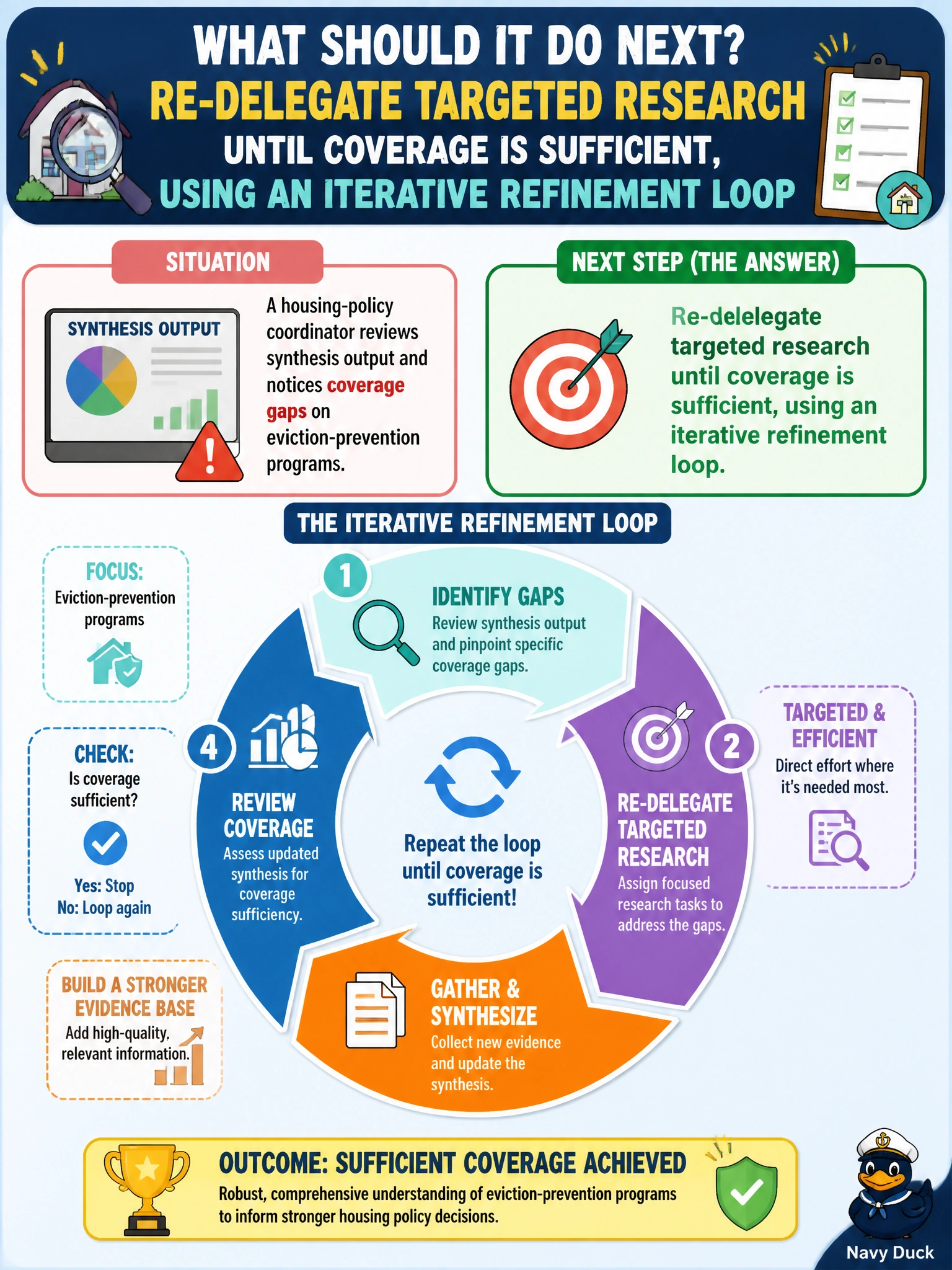
A housing-policy coordinator reviews synthesis output and notices coverage gaps on eviction-prevention programs. What should it do next?
Select an answer to reveal the explanation.
Short Explanation
If the draft looks like a jigsaw with missing pieces, send the scouts back out for those pieces. Keep refining until the coverage checklist is actually checked—not until someone gets impatient.
Full Explanation
When a housing-policy coordinator reviews synthesis and finds coverage gaps on eviction-prevention programs, it should re-delegate targeted research and continue an iterative refinement loop until coverage criteria are met. Coordinators exist not only to spawn once but to quality-gate outputs: gap detection should trigger focused Task calls, not premature publication to housing boards or councils.
Iterative refinement works because multi-agent research rarely lands complete on the first pass. Municipal housing briefs need explicit coverage checklists; missing eviction-prevention content is a signal to send specialists back with a narrowed prompt, then re-synthesize into a board-ready product.
Publishing the draft immediately so gaps become public comments externalizes quality control and risks misleading policymakers. Deleting synthesis and banning further subagent calls freezes an incomplete brief. Replacing the coordinator with a single subagent that never reports gaps removes the oversight layer that caught the omission in the first place.
Exam caveat: iteration needs a stopping rule tied to coverage metrics or end_turn on the refinement tasks—not infinite re-delegation. Operational check: define required housing topics, fail a synthetic synthesis missing one topic, and verify the coordinator issues a targeted research Task before any board export.