
A library research coordinator assigns several subagents to gather sources for a civic literacy report. What practice best minimizes duplicated source pulls?
Select an answer to reveal the explanation.
Short Explanation
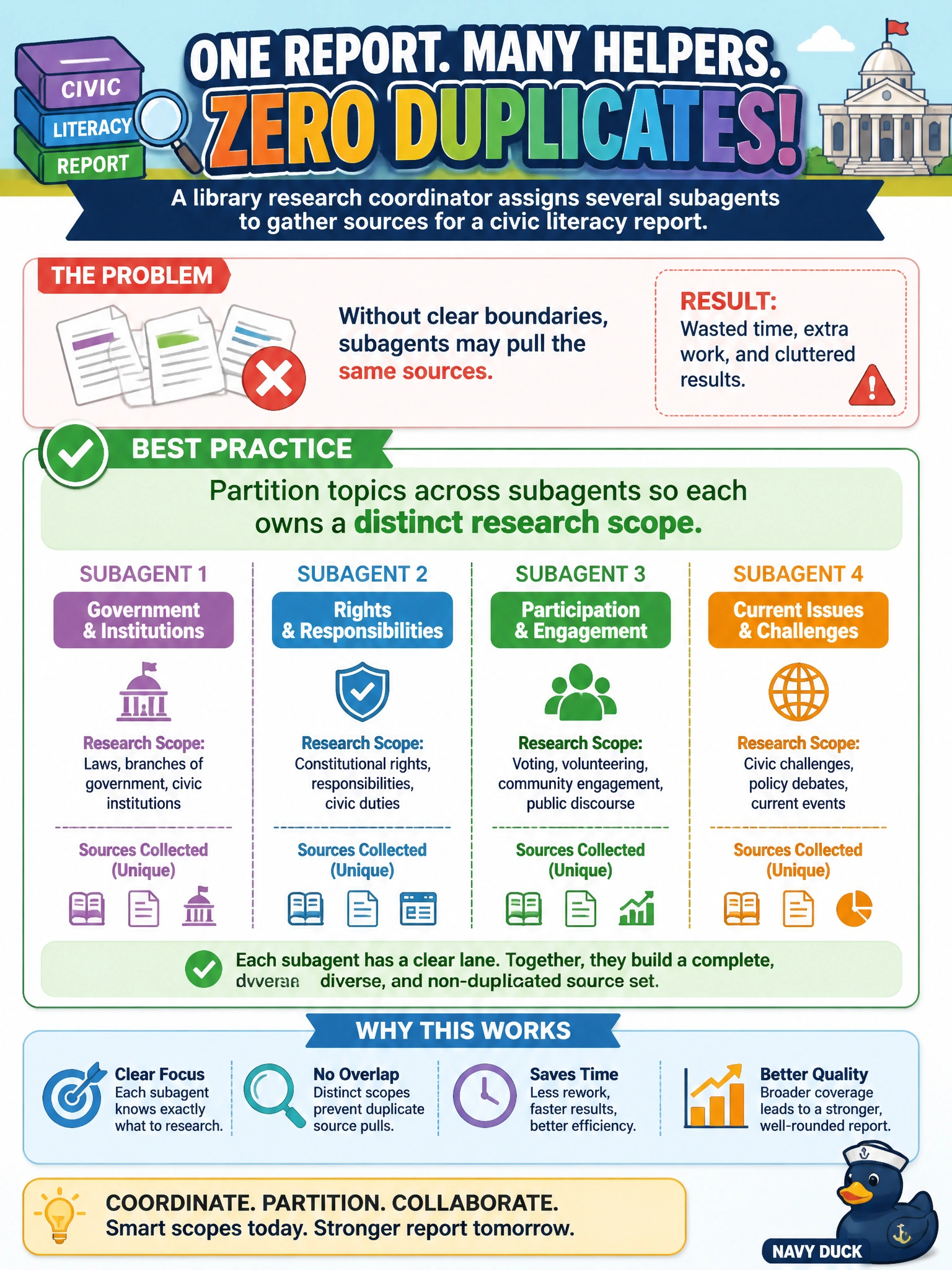
Split the card catalog: one subagent owns history, another owns current programs, and so on. Clear partitions beat three agents grabbing the same article three times.
Full Explanation
When a library research coordinator assigns several subagents to gather sources for a civic literacy report, the best practice to minimize duplicated source pulls is to partition topics so each subagent owns a distinct research scope. Clear ownership—historical programs versus current workshops versus demographic outcomes—reduces overlapping retrieval, duplicate tokens, and contradictory citations of the same article.
Partitioning works because duplication is usually a scoping failure, not a missing merge step. Distinct scopes also make gaps visible: if youth-literacy coverage is empty, the coordinator knows which subagent to re-task for the civic literacy brief.
Giving every subagent the identical broad query maximizes overlap and burns budget without improving coverage quality. Forbidding source URLs so duplication cannot be detected hides the problem instead of preventing it and weakens attribution. Merging all subagents into one mid-run whenever overlap appears is reactive chaos and loses parallel speed without a principled partition strategy.
Exam caveat: light intentional overlap on boundary topics can be acceptable if the coordinator reconciles; wholesale identical queries are not. Operational check: compare URL sets across subagent outputs after a partitioned run and confirm overlap stays within an agreed threshold for the library research pack.