
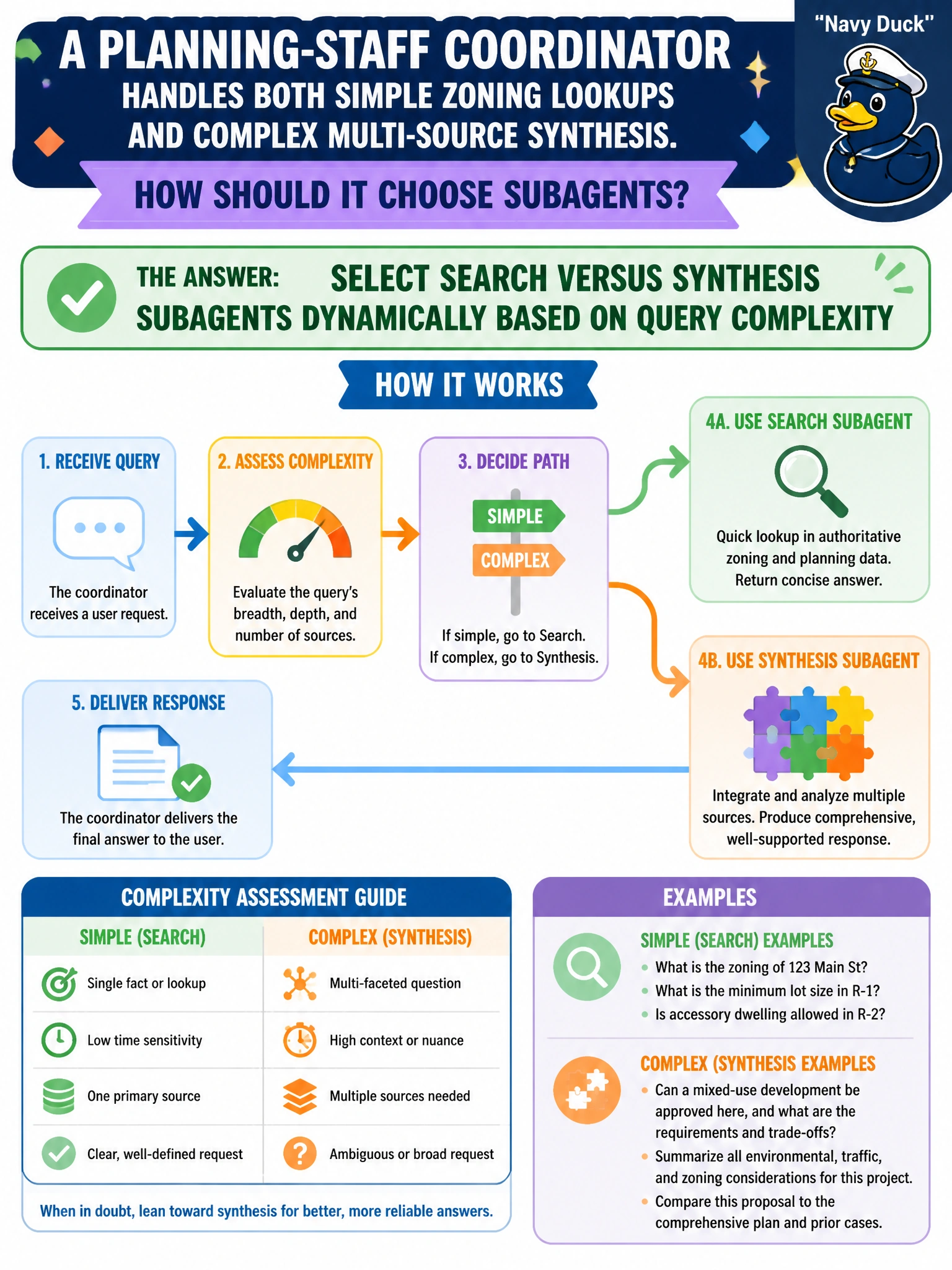
A planning-staff coordinator handles both simple zoning lookups and complex multi-source synthesis. How should it choose subagents?
Select an answer to reveal the explanation.
Short Explanation
Do not send the whole response team for a simple zoning question. Match the subagent mix to how hard the ask is—search for light lifts, synthesis when the puzzle gets thick.
Full Explanation
A planning-staff coordinator that handles both simple zoning lookups and complex multi-source synthesis should select search versus synthesis subagents dynamically based on query complexity. Simple parcel or code lookups may need a single search specialist; cross-ordinance synthesis may need search plus a synthesis writer. Dynamic selection conserves cost and latency while matching specialist capability to the planning staff ask.
Dynamic choice works because planning workloads are highly skewed: many tickets are narrow facts, fewer need board-ready multi-document reasoning. Routing by complexity keeps the simple path fast without under-powering hard cases that touch multiple codes and GIS layers.
Always running the full search-plus-synthesis pipeline wastes capacity and delay on trivial zoning questions. Never using synthesis subagents for planning workloads leaves complex packs under-analyzed. Picking a single hardcoded subagent type at deploy time underfits the diversity of live staff queries across the planning counter.
Exam caveat: dynamic still requires clear complexity criteria or model judgment with guardrails—not a random specialist lottery. Operational check: classify a batch of historical planning tickets into simple versus complex and verify the coordinator's routing distribution matches, with measurable latency and cost savings on the simple tier.