
A county open-data research system spawns subagents for separate datasets. What should architects assume about each subagent's conversation context?
Select an answer to reveal the explanation.
Short Explanation
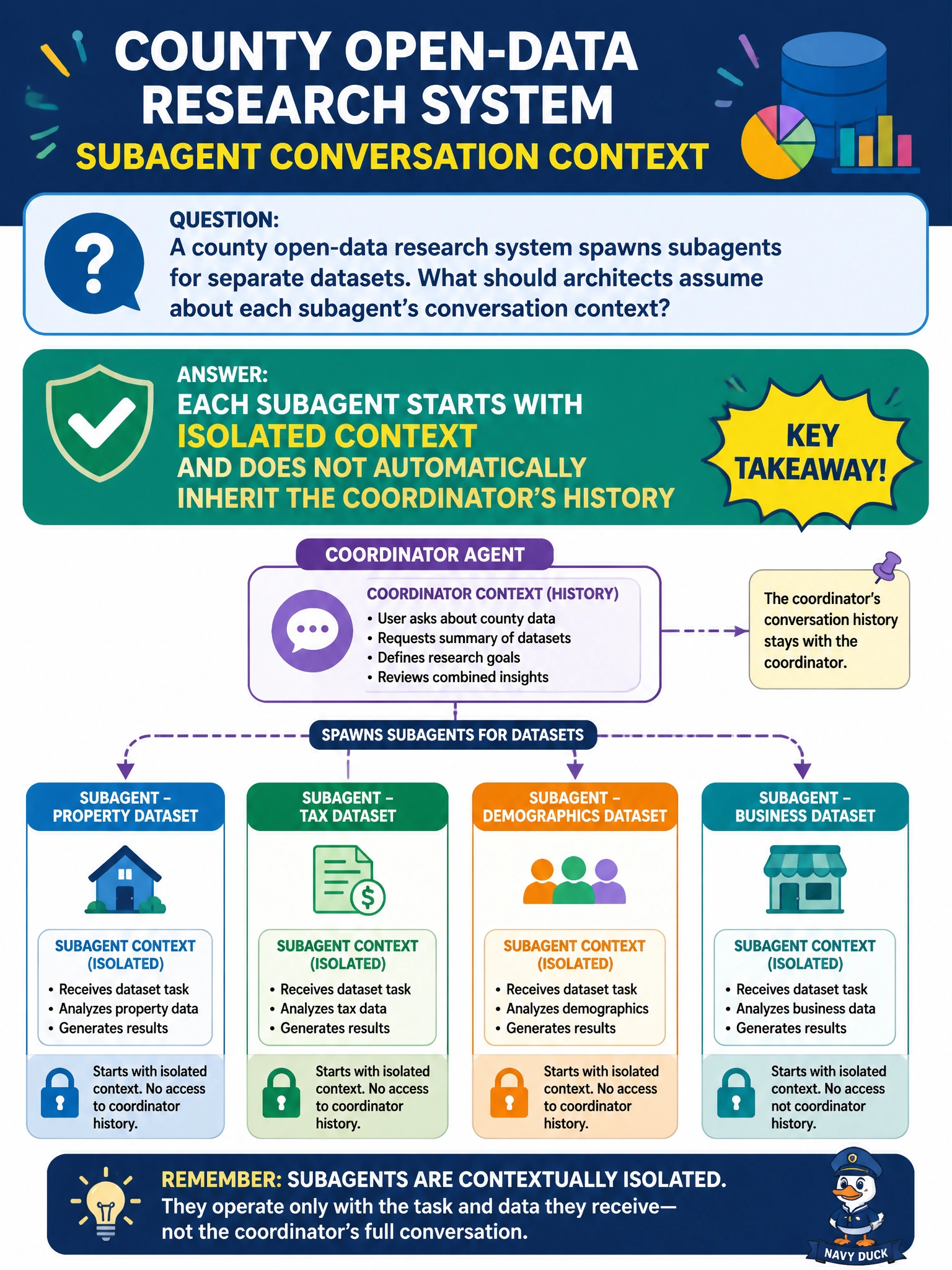
New subagents are like interns who did not sit through the morning briefing—they do not magically know what the coordinator already said. You have to hand them the context explicitly.
Full Explanation
Architects of a county open-data research system should assume each spawned subagent starts with isolated conversation context and does not automatically inherit the coordinator's full history. Isolation is the default mental model for Task and subagent designs: a new specialist begins clean unless the coordinator explicitly supplies prior findings, dataset handles, or constraints in the subagent prompt or structured input.
That assumption drives correct prompt engineering for open-data work. Dataset-specific subagents need the schema, query goals, and any prior caveats pasted in; otherwise they research blind relative to the parent's earlier turns and miss county-specific filters already established.
Assuming automatic inheritance of full coordinator history fails and leads to incomplete open-data work when teams forget to pass critical filters. Assuming a shared mutable memory buffer with the parent by default similarly over-promises platform behavior most orchestrations do not provide. Copying parent history only to the first subagent and streaming to the rest creates inconsistent specialists and race-prone context across datasets.
Exam caveat: some products may offer optional memory features—never rely on them unless configured and tested; exam answers typically expect explicit handoff. Operational check: spawn two dataset subagents after a coordinator briefing and confirm neither sees the briefing unless it was included in their Task prompts.