
A city policy-research system uses one coordinator and several research subagents. How should inter-subagent communication be routed for observability and error handling?
Select an answer to reveal the explanation.
Short Explanation
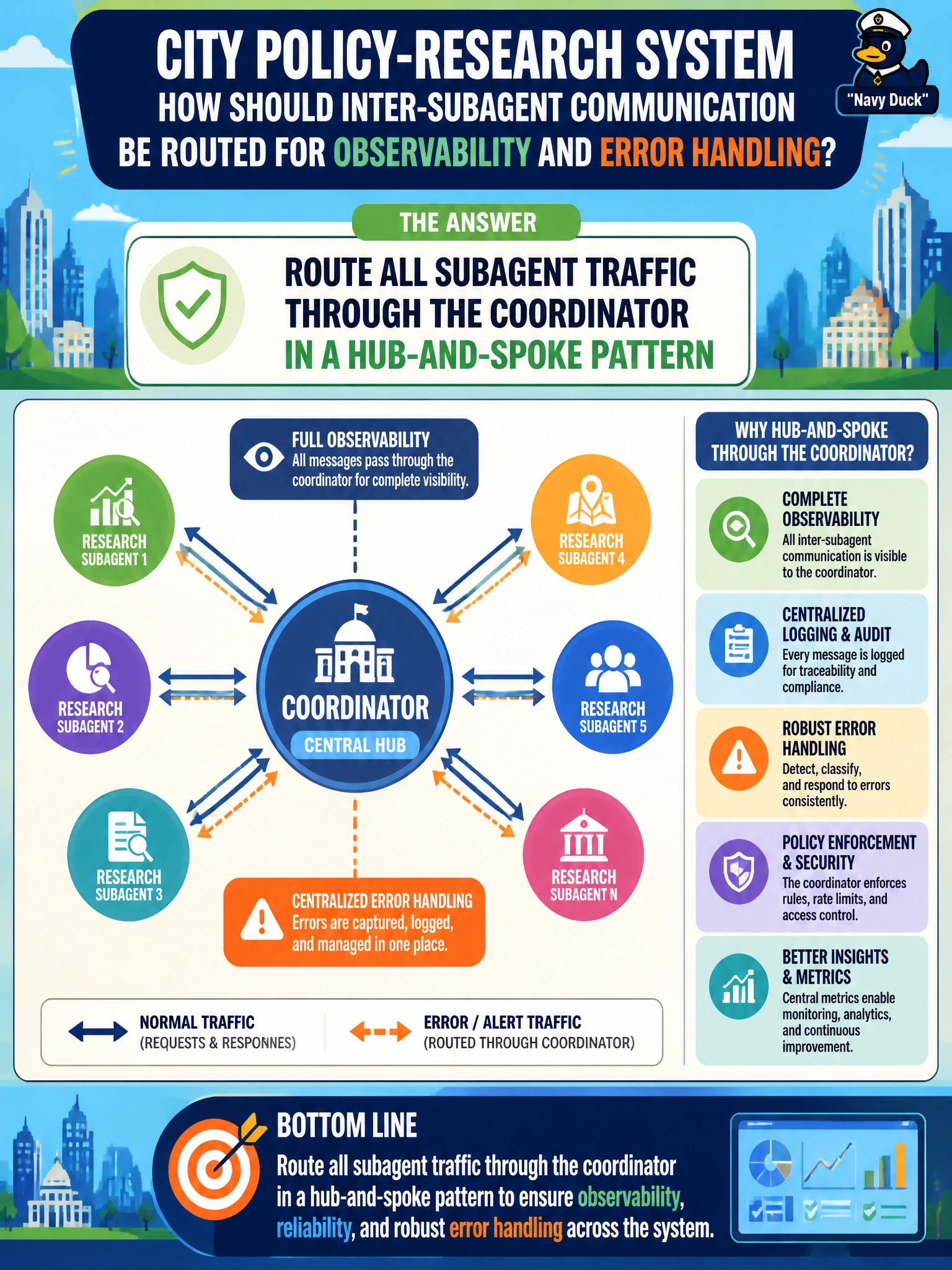
Picture the coordinator as the city's dispatch radio hub: every subagent checks in there, not sideways to each other. That hub-and-spoke layout keeps errors and progress where you can actually see them.
Full Explanation
In a city policy-research system with one coordinator and several research subagents, inter-subagent communication should be routed through the coordinator in a hub-and-spoke pattern. The coordinator owns task assignment, aggregation, retries, and error handling. Side channels between specialists reduce observability: when a housing-statute subagent fails or returns partial findings, the coordinator and operators may never see the failure if peers chat privately.
Hub-and-spoke works for municipal research because policy briefs need a single reconciliation point before publication. The coordinator can deduplicate sources, resolve conflicts, and re-delegate gaps while maintaining an audit trail of who contributed what to the civic brief.
Allowing peer-to-peer messaging so the coordinator stays idle fails observability and makes error handling inconsistent across specialists. Broadcasting every finding to all peers without filtering creates noise, token waste, and uncontrolled cross-contamination of research scopes. Disabling coordinator logging so subagents can exchange secrets privately is incompatible with public-sector accountability and incident review.
Exam caveat: through the coordinator does not forbid structured shared artifacts the coordinator writes; it forbids unsupervised peer control planes. Operational check: simulate a mid-research subagent failure and verify the coordinator logs the error, halts dependent aggregation, and can re-dispatch without relying on peer notifications that never reached the hub.