
A team wants to systematically improve their Claude-powered application over time. What evaluation practice should they establish?
Select an answer to reveal the explanation.
Short Explanation and Infographic
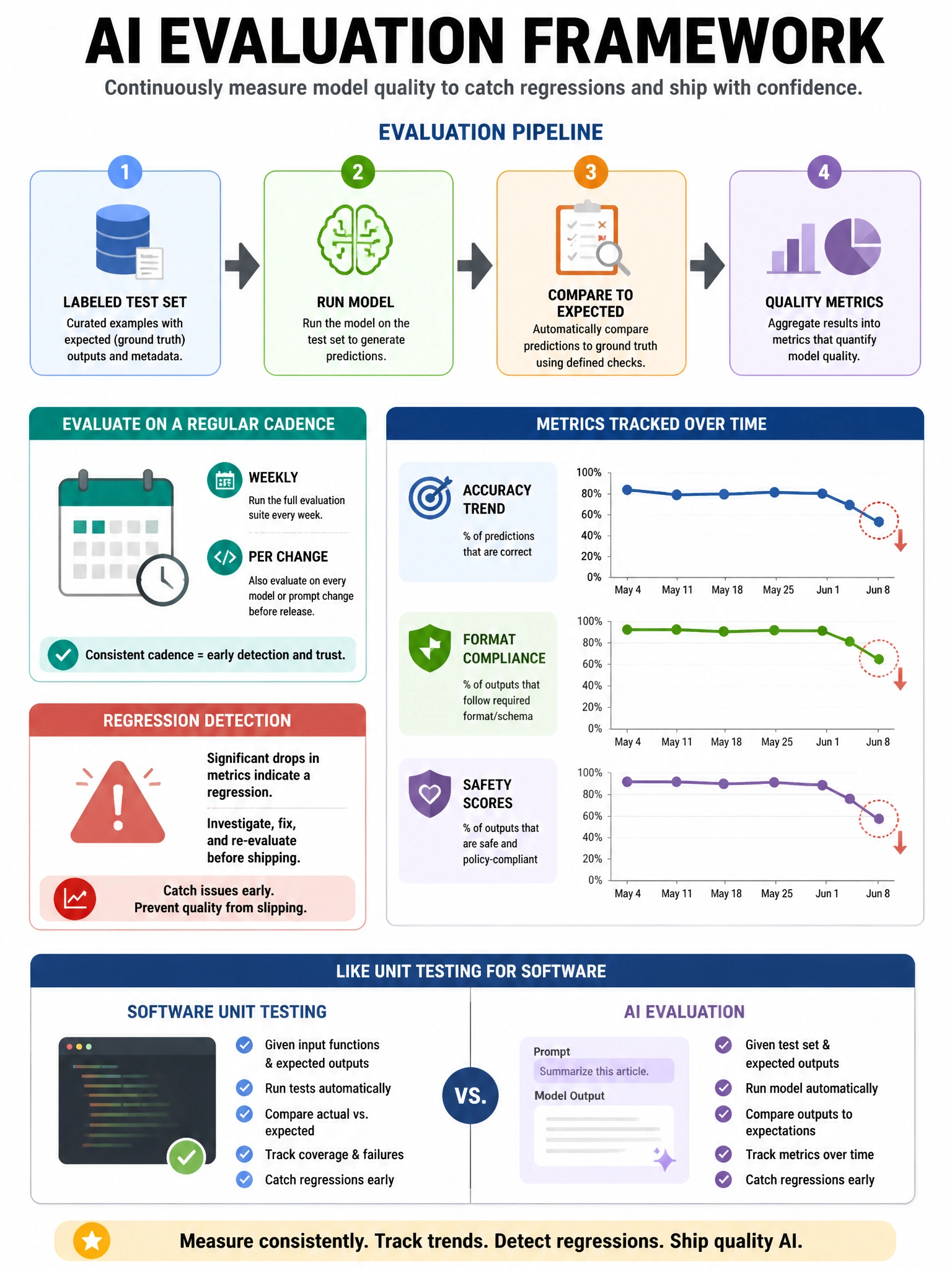
Build a proper eval suite — a labeled test set with expected outputs — and run it regularly. It's like unit tests for your AI system: catches regressions, measures progress, and drives improvement.
Full explanation below image
Full Explanation
Systematic evaluation (evals) is a critical practice for production AI applications: (1) build a test dataset of representative input examples with expected or labeled outputs, (2) define clear quality metrics (accuracy, format compliance, safety, relevance), (3) run evals regularly (on every prompt change, model update, or new use case), (4) track metrics over time to detect regressions, (5) use results to guide prompt optimization and model selection. This is analogous to software testing — essential for maintaining quality as prompts, models, and requirements evolve. Option A (reactive complaints) is too slow and misses silent failures. Option C (one-time eval) is insufficient — AI systems degrade with model and data changes. Option D (speed only) ignores output quality.