
In an agentic loop where Claude is orchestrating other AI models, what is Claude's role when it acts as an orchestrator?
Select an answer to reveal the explanation.
Short Explanation and Infographic
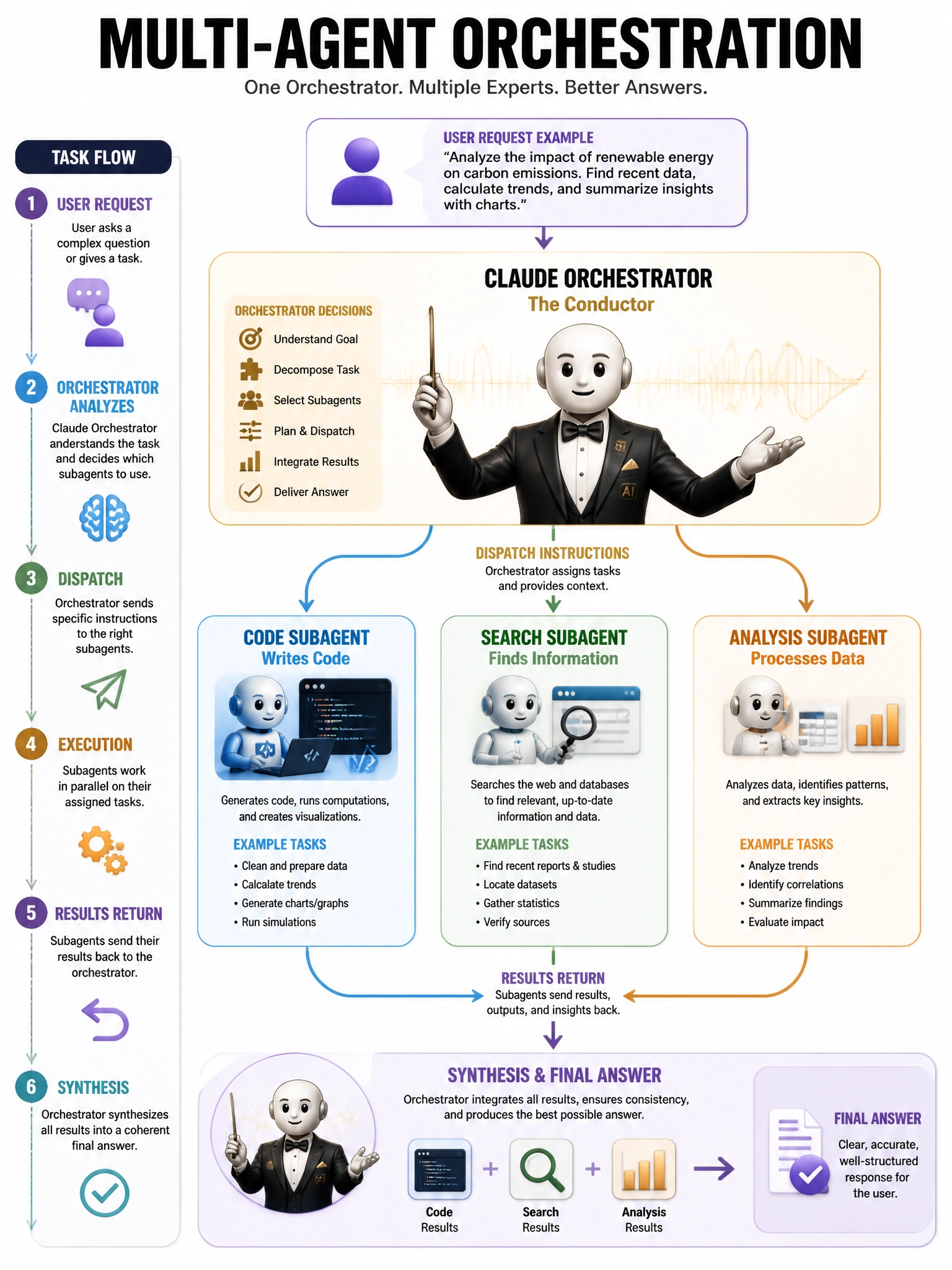
As orchestrator, Claude is the conductor — it reads the score (the task), directs which instruments (subagents) play, listens to their parts, and blends them into the final performance.
Full explanation below image
Full Explanation
In multi-agent architectures, an orchestrator Claude model: (1) receives and understands the high-level goal, (2) decomposes it into subtasks, (3) decides which specialized subagents or tools to call for each subtask, (4) passes appropriate context to each subagent, (5) collects and synthesizes results, (6) determines if the goal is met or if more steps are needed, (7) produces the final output. This requires sophisticated reasoning about task decomposition, agent selection, and result synthesis. Option A (training subagents) is wrong — no training happens at inference. Option C (database role) is wrong — storage is handled by tools/memory systems. Option D (routing without reasoning) drastically undersells the orchestrator role.