
Some developers use Claude through an OpenAI-compatible API layer. What should developers be aware of when using these compatibility layers?
Select an answer to reveal the explanation.
Short Explanation and Infographic
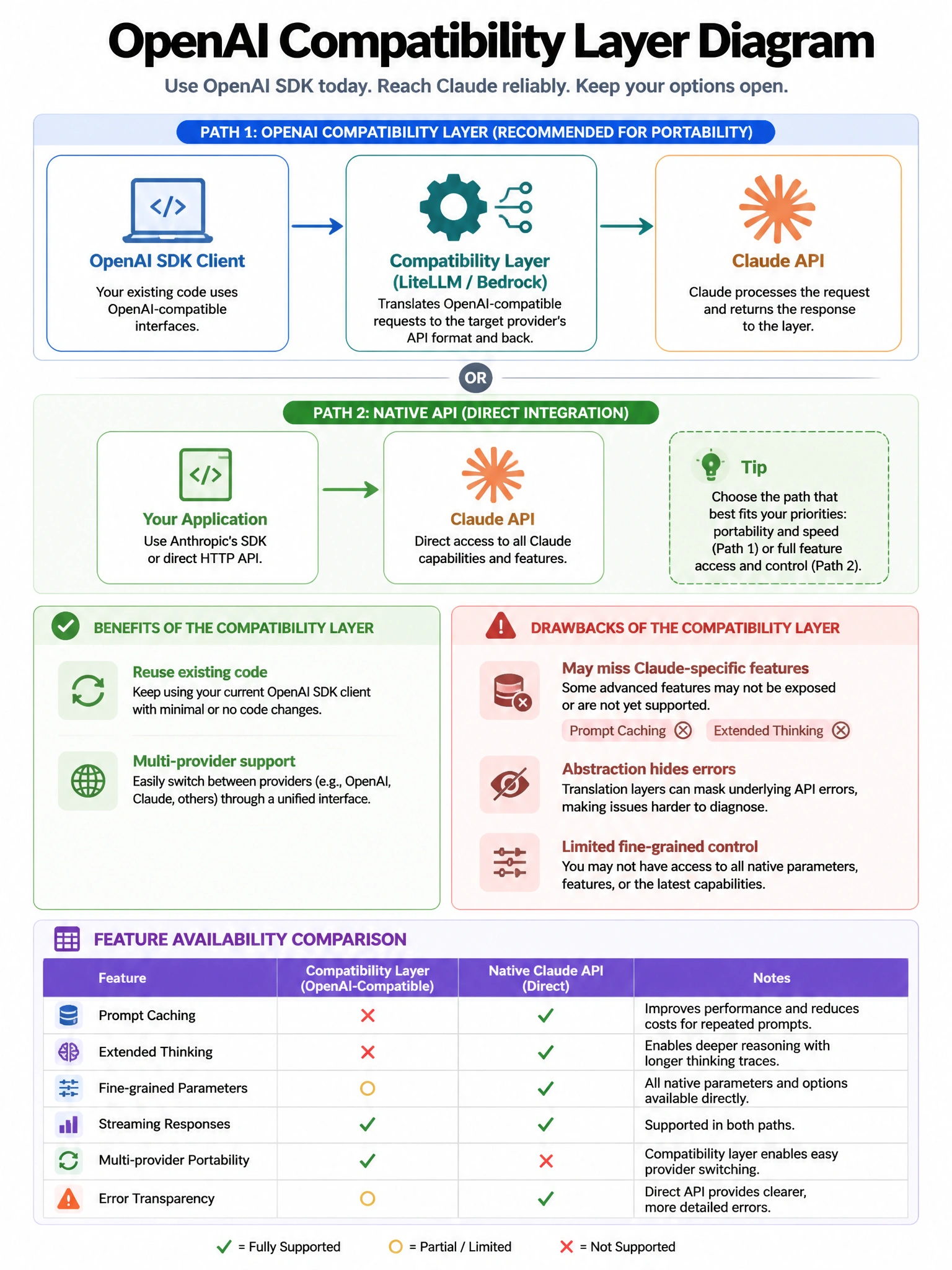
OpenAI-compatible wrappers around Claude let you reuse OpenAI client code, but you lose access to Claude-specific features and add a layer of abstraction that can hide issues.
Full explanation below image
Full Explanation
Some services (like LiteLLM, or Amazon Bedrock's Converse API) provide OpenAI-compatible endpoints that route to Claude. This lets teams reuse existing OpenAI client code without refactoring. Trade-offs: you may not have access to Claude-specific capabilities (prompt caching, extended thinking, claude-specific tool use features), error messages may be translated/obscured, and performance may differ. For full Claude feature access, the native Anthropic API is preferable. Compatibility layers are useful for multi-provider flexibility but not officially endorsed by Anthropic. Option A is wrong — Anthropic doesn't officially support compatibility layers. Option C is wrong — behavior differences remain. Option D has no basis in fact.