
An adult intensive care unit patient has a functioning, non-tunneled triple-lumen central venous catheter placed seven days ago with a clean, intact insertion site and no signs of local or systemic infection. A resident asks whether the catheter should be scheduled for routine replacement solely because of its dwell time. What should the infection preventionist recommend?
Select an answer to reveal the explanation.
Short Explanation
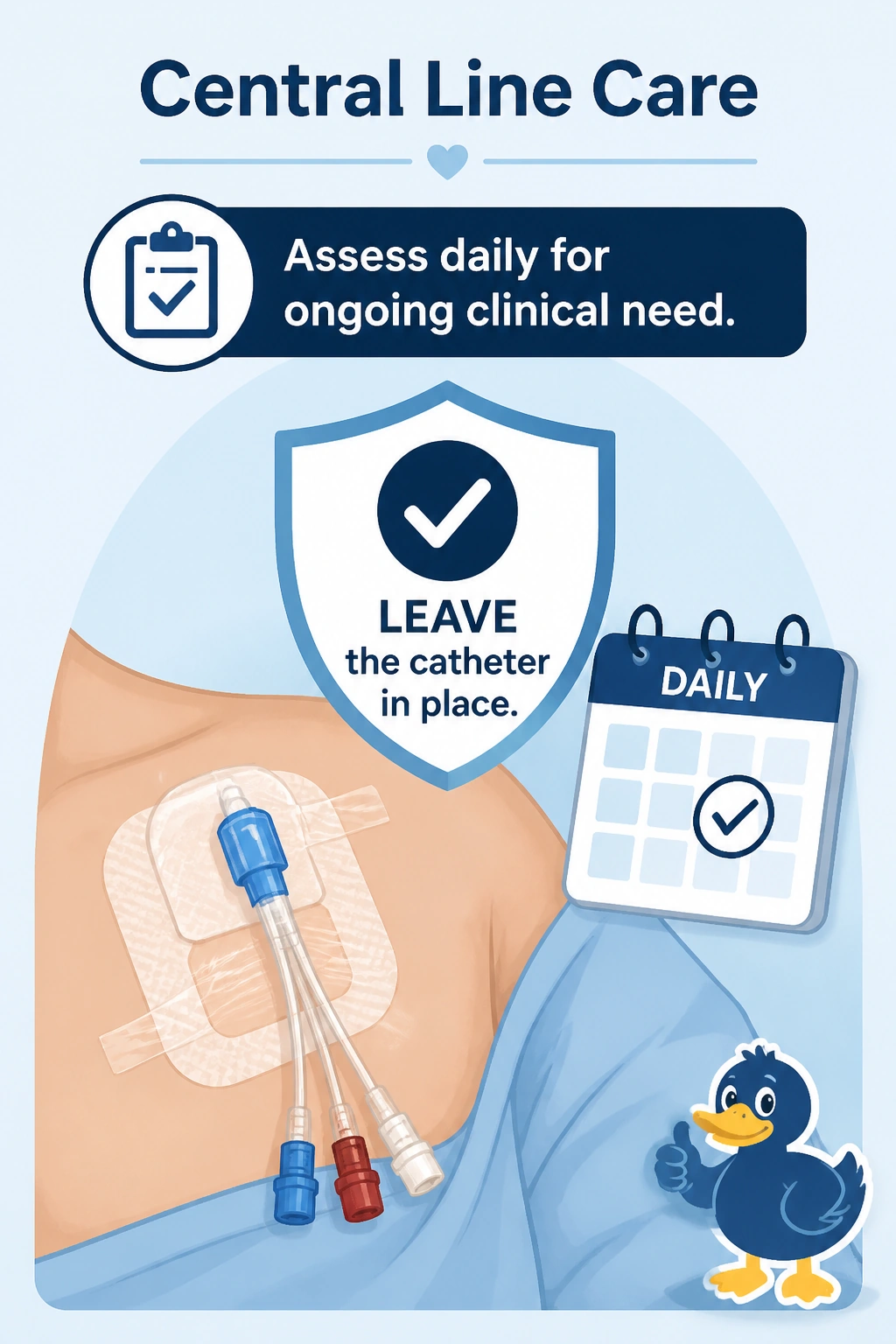
Changing a working central line just because the calendar hit day seven creates more risk than it prevents. The trap is assuming scheduled swaps automatically lower infection rates. CDC guidelines direct you to leave the catheter in place and assess daily for ongoing clinical need, removing it promptly once it is no longer required.
Full Explanation
Every central venous catheter insertion or guidewire exchange carries mechanical risks—such as pneumothorax, arterial puncture, and bleeding—alongside a fresh opportunity to introduce skin flora into the bloodstream. Under CDC Guidelines for the Prevention of Intravascular Catheter-Related Infections, clinicians should Leave the catheter in place and assess daily for ongoing clinical need rather than replacing functioning central lines on a fixed schedule. Choosing to Exchange the central venous catheter over a guidewire every seven days is explicitly discouraged for infection prevention because guidewire exchange can seed the new catheter from a colonized tract. Deciding to Remove and reinsert the catheter at a new anatomical site every seven days subjects the patient to unnecessary invasive procedures without reducing bloodstream infection rates. Waiting to Replace the catheter only after obtaining a surveillance tip culture is flawed because catheter tips cannot be cultured without first removing the line, and routine tip cultures in asymptomatic patients are not indicated. Evaluate promptly for catheter infection when purulence or sepsis occurs; obtain appropriate cultures and remove when indicated by catheter type, pathogen, severity and clinical course. Fever alone is not an automatic removal indication, and a new line is needed only if ongoing access is required. Operational check: verify during daily ICU rounds that every central line has a documented clinical indication and intact, dry dressing.
Prefer to study offline? Printable PDF study book + test engine ($7.50, unofficial). These questions stay free here.