
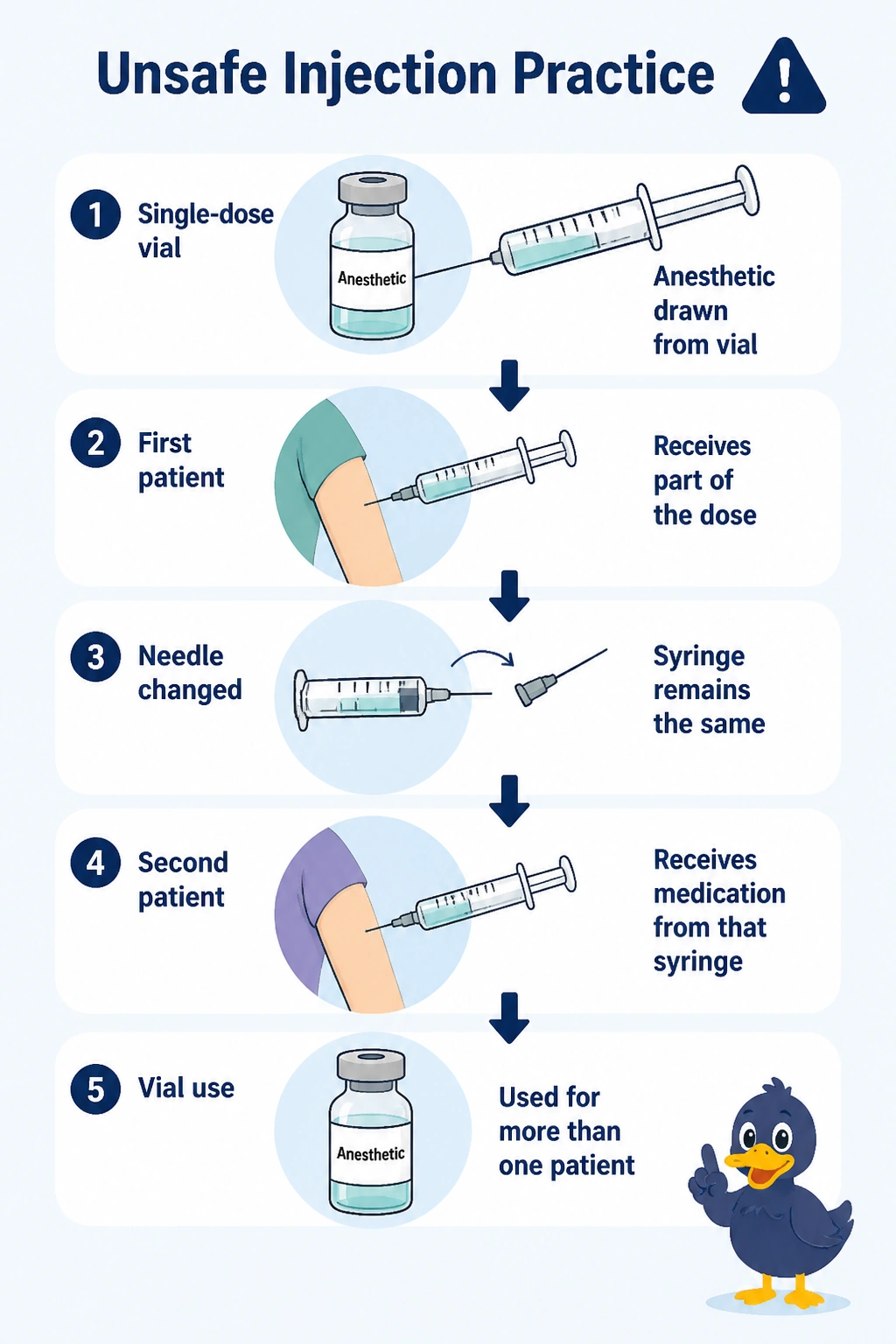
During an outpatient ambulatory surgery center audit, an infection preventionist observes a clinician drawing anesthetic from a single-dose vial, administering part of the dose to one patient, changing only the needle, and using the remaining medication in the same syringe for a second patient. Which unsafe injection practice occurred?
Select an answer to reveal the explanation.
Short Explanation
Changing only the needle on a used syringe is like putting a clean straw into a contaminated cup—backflow already tainted the barrel. The trap is thinking a fresh needle makes a syringe safe, when you must use one needle, one syringe, one time, and one single-dose vial per patient.
Full Explanation
Reusing a syringe across multiple patients and using a single-dose vial for more than one patient captures both critical CDC Standard Precautions violations observed: microscopic bloodborne pathogens can reflux into the syringe barrel during injection even when the needle is replaced, and single-dose vials generally lack antimicrobial preservatives and must be dedicated to a single patient and discarded immediately after use. Failing to disinfect the rubber septum with alcohol before the initial medication draw was not described in the scenario and misses the severe cross-patient bloodborne transmission hazard. Administering an intravenous anesthetic without wearing sterile surgical gloves during injection is incorrect. Sterile surgical gloves are not required for routine IV medication administration; select clean gloves when blood/body-fluid contact is anticipated and maintain aseptic non-touch technique. Storing an unopened single-dose vial at room temperature instead of inside a locked refrigerator misidentifies a storage rule that depends on the specific drug's label rather than the core injection safety breach observed. As a caveat, if reused syringes or shared single-dose vials ever occur, immediately halt the practice and coordinate patient notification and bloodborne pathogen testing with public health. For an operational check, observe medication preparation in procedure rooms and verify single-dose vials are stocked in smaller volumes suited to individual cases.
Prefer to study offline? Printable PDF study book + test engine ($7.50, unofficial). These questions stay free here.