
During daily NHSN central line-day denominator collection in a surgical intensive care unit, a charge nurse finds one patient who simultaneously has both a triple-lumen internal jugular catheter and a tunneled femoral dialysis catheter in place. How many central line-days should be recorded for this patient on that calendar day?
Select an answer to reveal the explanation.
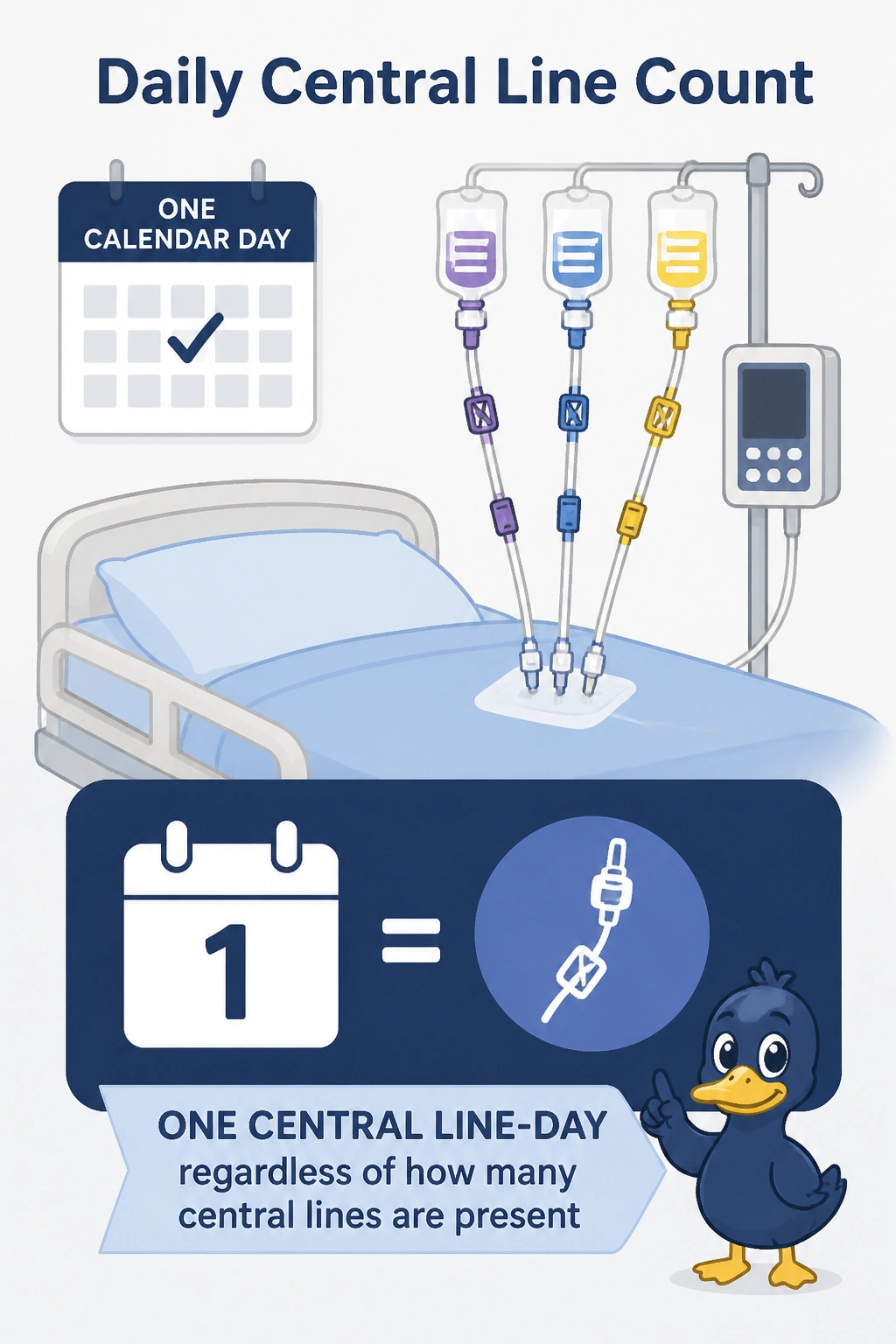
Short Explanation
NHSN counts the patient, not the hardware—whether a patient has one central line or three, your denominator tally for that day stays at one. The trap is multiplying line-days by catheter sites or lumens, which artificially inflates the denominator and hides true infection risk.
Full Explanation
Under CDC NHSN Device-Associated Module surveillance rules, central line-day denominators measure the number of patients on a unit who have at least one central line in place at the fixed daily collection time. Accordingly, the nurse records One central line-day regardless of how many central lines are present for that patient on that calendar day. Recording Two central line-days because two separate central venous sites are accessed double-counts a single patient and violates NHSN standardized denominator definitions. Recording Four central line-days to reflect each lumen across both central catheters similarly overcounts exposure and would distort the unit's Standardized Utilization Ratio and CLABSI rate. Recording Zero central line-days until one of the two central catheters is removed omits an eligible at-risk patient from the denominator. As a caveat, if a patient has both a temporary central line and a permanent tunneled catheter, CLABSI attribution still applies if a bloodstream infection meets criteria, even though only one line-day is counted. As an operational check, audit electronic health record line-day reports against manual unit counts to confirm patients with multiple lines are deduplicated to one day.
Prefer to study offline? Printable PDF study book + test engine ($7.50, unofficial). These questions stay free here.