
An infection preventionist investigates a small cluster of four postoperative infections associated with two different operating room teams and wants to test the association in a two-by-two contingency table where two expected cell counts are less than 5. Which statistical test should the infection preventionist select?
Select an answer to reveal the explanation.
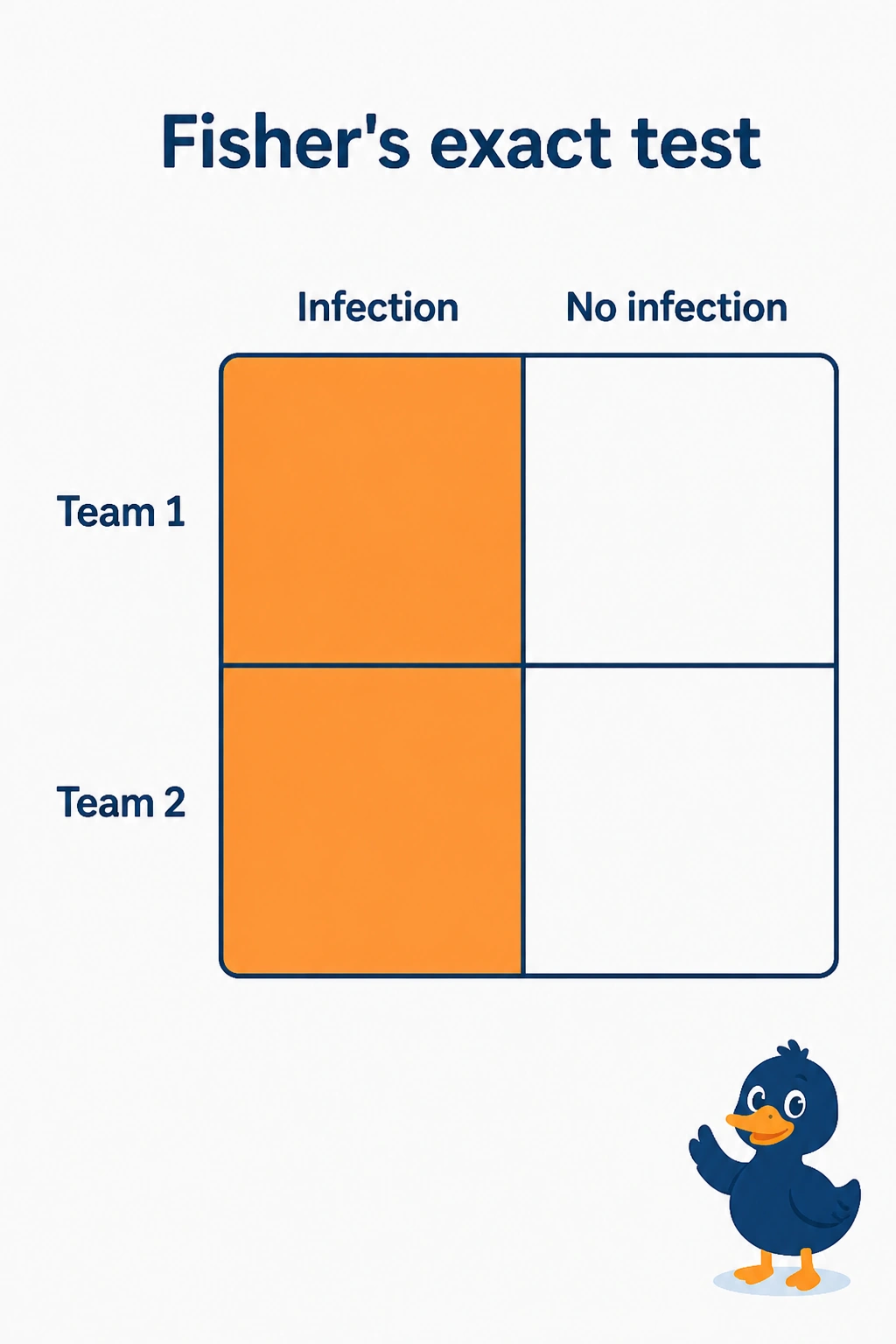
Short Explanation
When an outbreak table has tiny expected counts, standard large-sample approximations break down, so you need an exact calculation. The trap is defaulting to a routine chi-square test out of habit, which can produce misleading p-values when expected cell frequencies fall below five.
Full Explanation
Fisher's exact test is the appropriate choice because it computes the exact probability of obtaining the observed two-by-two table or a more extreme distribution given fixed marginal totals, without relying on large-sample approximations. A Pearson chi-square test assumes sufficiently large expected frequencies—typically at least 5 in most or all cells—and becomes unreliable when sparse counts violate that assumption. An Independent Student's t-test compares the means of a continuous, normally distributed variable between two groups rather than categorical infection counts. Similarly, One-way analysis of variance compares continuous means across three or more independent groups, making it unsuitable for a two-by-two contingency table of infection status versus team exposure. As an analytical caveat, Fisher's exact test can be slightly conservative because discrete marginal totals limit possible p-values, and it is intended for categorical tables rather than continuous outcomes. As an operational check, always inspect the expected cell counts—not just the observed counts—in your statistical software output before selecting between exact and asymptotic tests in small cluster investigations.
Prefer to study offline? Printable PDF study book + test engine ($7.50, unofficial). These questions stay free here.