
An infection preventionist evaluates a new rapid nasal screening assay for methicillin-resistant Staphylococcus aureus against standard broth-enriched culture. Among 100 culture-positive patients, 80 test positive on the rapid assay; among 400 culture-negative patients, 360 test negative. What is the sensitivity of the rapid assay?
Select an answer to reveal the explanation.
Short Explanation
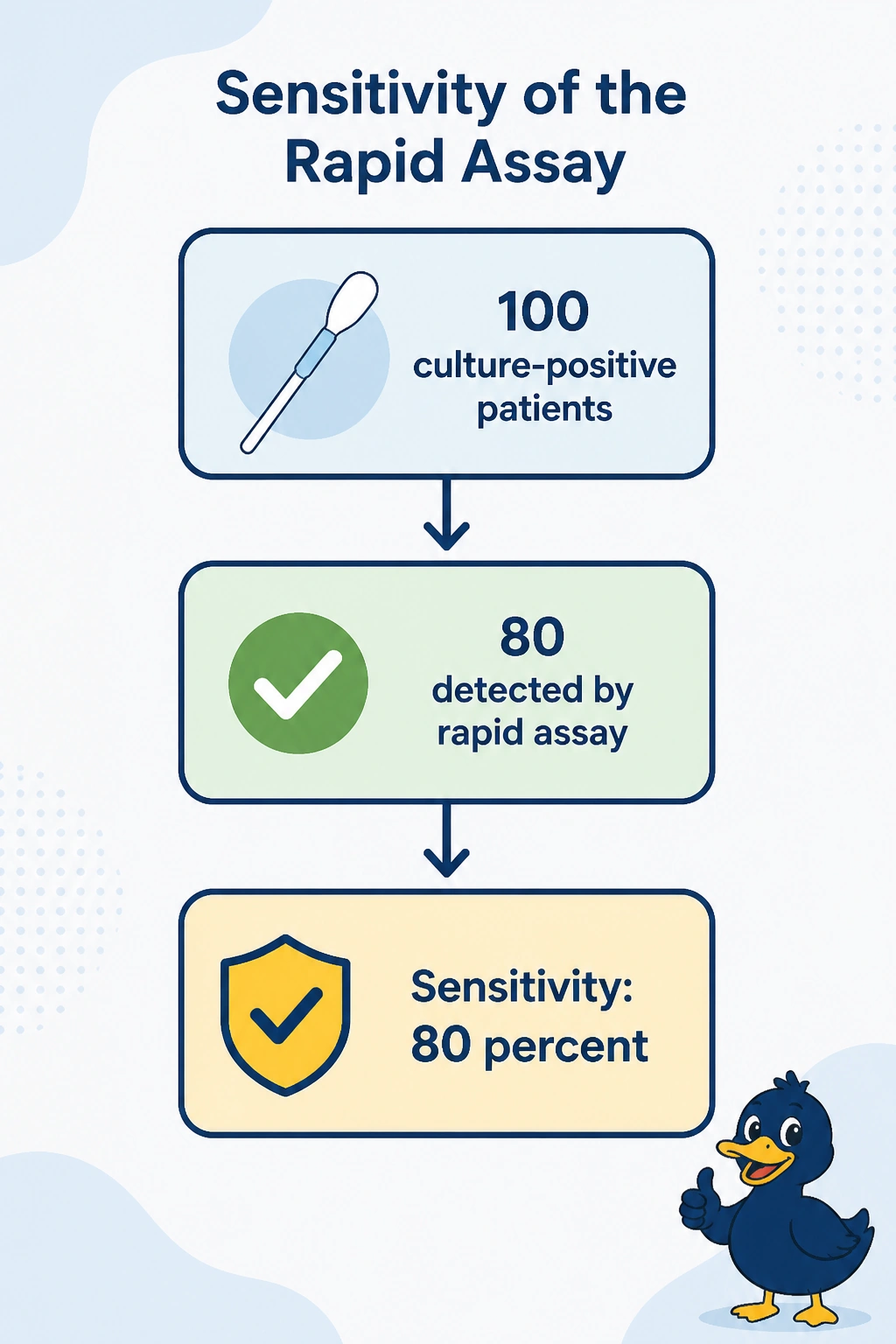
Think of sensitivity as a smoke detector's ability to sound the alarm whenever a real fire is actually burning. You divide the 80 true positives by all 100 culture-positive patients to get 80 percent, so the trap is mixing up the denominator with culture-negative patients or all positive assay results.
Full Explanation
Sensitivity measures how accurately a test identifies individuals who truly have the condition, calculated as true positives divided by the sum of true positives and false negatives, which yields 80 percent based on true-positive results among culture-positive patients (80 divided by 100). Selecting 90 percent based on true-negative results among culture-negative patients calculates specificity (360 divided by 400), which reflects the assay's ability to rule out disease in uninfected patients rather than detect true cases. Choosing 67 percent based on true-positive results among all positive assay tests calculates the positive predictive value (80 divided by 120), a metric that shifts substantially with underlying population prevalence. Picking 88 percent based on all concordant positive and negative screening results calculates overall diagnostic accuracy (440 divided by 500), which can appear reassuringly high even when a test misses many true cases in low-prevalence settings. As a caveat, sensitivity and specificity are intrinsic test properties, whereas predictive values depend heavily on how common the pathogen is in your screened population. For an operational check, always verify the 2x2 table against the reference culture before adopting a rapid screen, and confirm whether false negatives require secondary broth backup.
Prefer to study offline? Printable PDF study book + test engine ($7.50, unofficial). These questions stay free here.