
Over a five-year period, a regional health system introduces a highly effective new antiretroviral regimen that extends the life expectancy of patients living with HIV, while the annual number of new infections per 1,000 at-risk residents remains unchanged. Assume stable population size, migration and case ascertainment. How will this treatment advance affect HIV epidemiologic measures in the community?
Select an answer to reveal the explanation.
Short Explanation
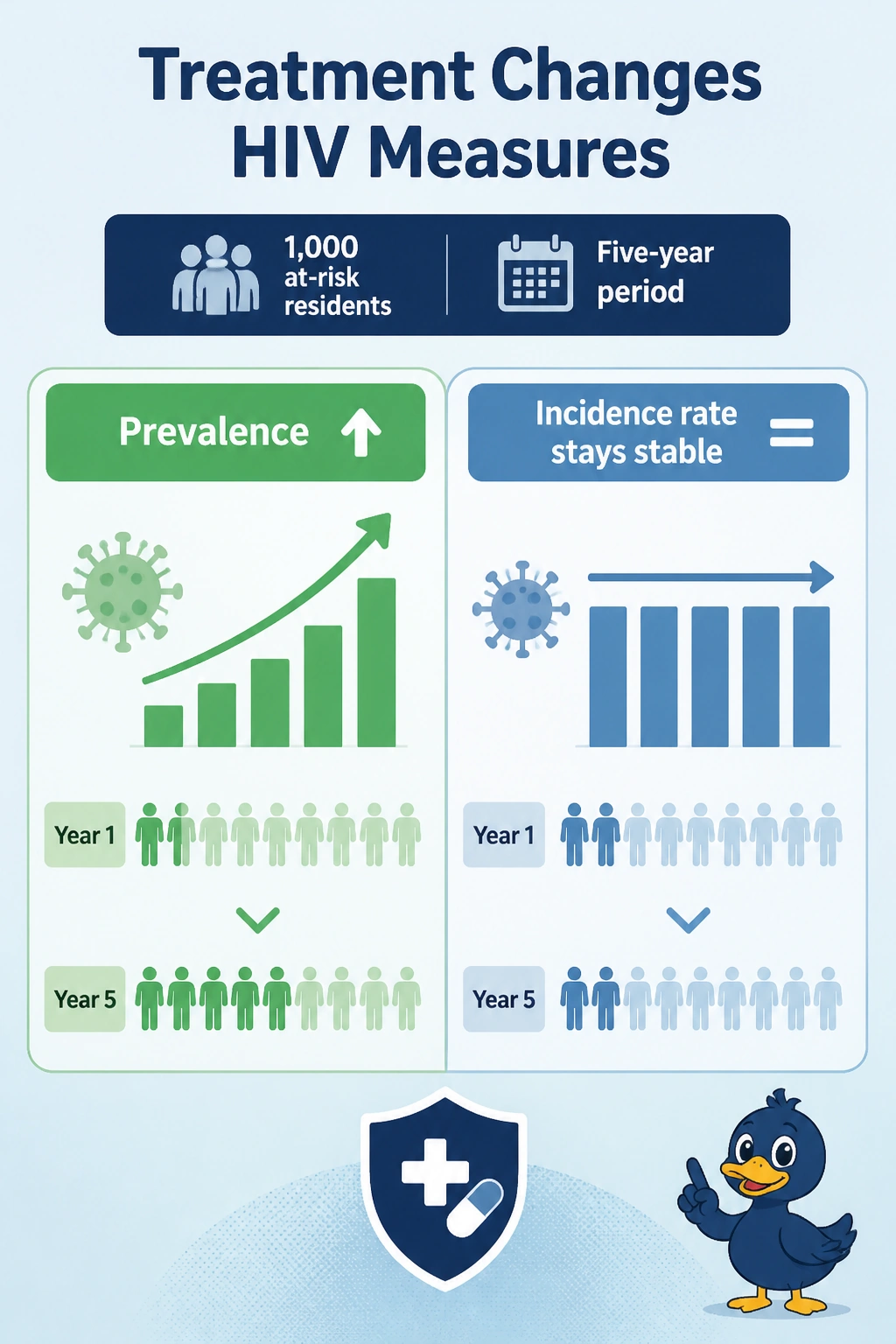
Imagine a bathtub where the faucet flows at a steady drip, but you slow down the drain—the water level in the tub rises even though the faucet didn't change. Better survival keeps existing cases in the population longer, so you see prevalence climb while incidence stays flat, and the trap is thinking better treatment lowers prevalence.
Full Explanation
Prevalence will increase while incidence rate stays stable because prevalence reflects existing cases at a given time and is roughly incidence multiplied by average disease duration. When effective therapy prolongs survival without curing HIV, patients remain in the prevalent pool longer while new infections enter at the same rate, so under stable population size, migration and case ascertainment the total living cases rise. New diagnoses are not necessarily infections acquired during that year; under the stated assumptions longer disease duration increases prevalence. Concluding that incidence rate and prevalence will both decrease is incorrect because the stem specifies annual new infections per 1,000 at-risk residents remain unchanged, and longer survival expands rather than shrinks living cases. Claiming that incidence rate will increase while prevalence drops reverses both behaviors, since longevity neither creates new infections nor removes existing cases. Stating that prevalence will stay stable as survival time lengthens overlooks the duration-prevalence relationship in chronic disease. As a caveat, if therapy suppresses viral load enough to curb transmission, incidence could eventually decline, so separate new-infection trends from total active-case counts in surveillance reports.
Prefer to study offline? Printable PDF study book + test engine ($7.50, unofficial). These questions stay free here.